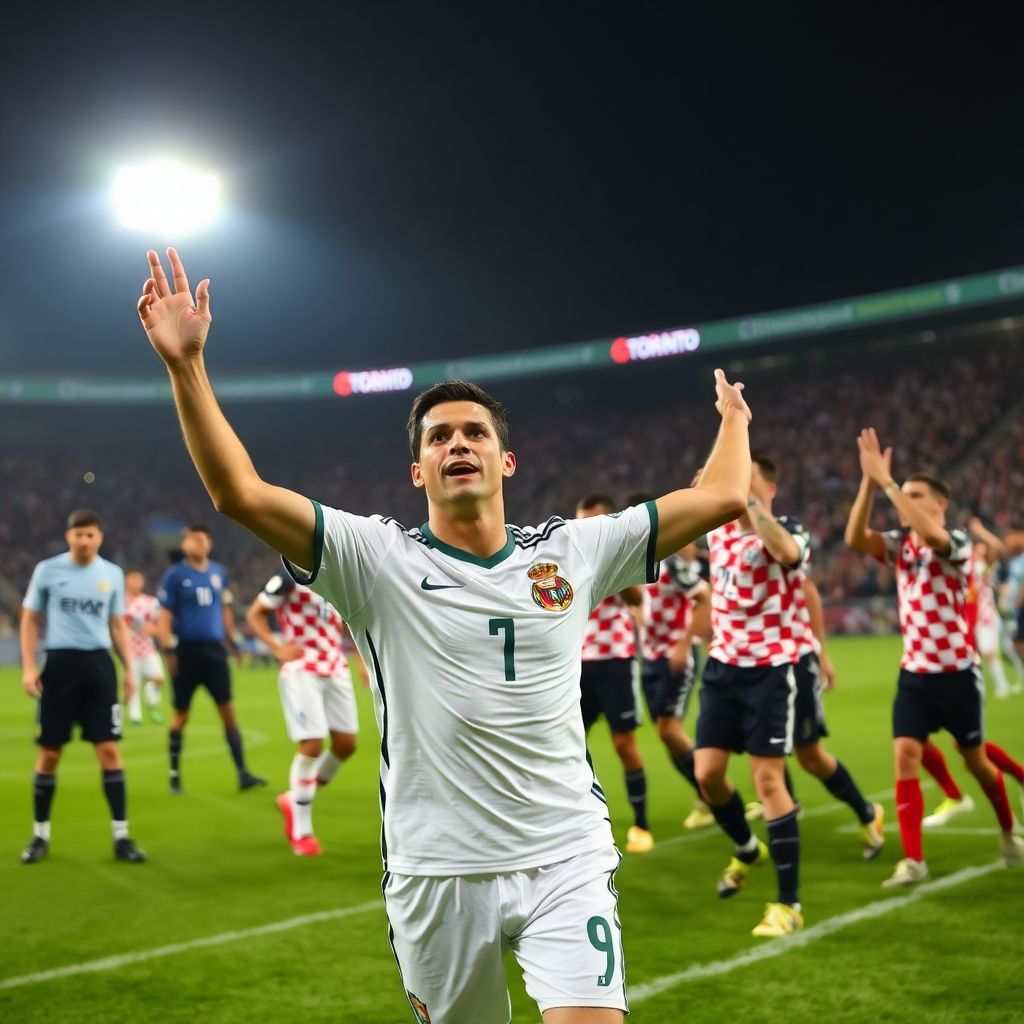
Referee controversy, Ronaldo through – who will carry Portugal past Spain?
The 2026 World Cup delivered one of its wildest nights in Toronto, where Portugal survived a chaotic Round of 32 clash with Croatia to win 2-1 and book a place in the last 16 against Spain. The scoreline looks tight, but it barely hints at the drama: three goals ruled out after lengthy reviews, multiple efforts off the woodwork and a refereeing performance that left Croatia furious and Cristiano Ronaldo walking away as the central figure once again.
A night that had everything in Toronto
From the opening whistle, the game in Toronto looked like the kind of match that would be replayed for years. Both sides went for each other aggressively, the tempo never dropped, and the stakes were obvious: a ticket to face Spain in the round of 16.
The turning point came in the form of several contentious refereeing decisions. Three goals – involving both teams – were eventually disallowed after interventions from the officials. Each stoppage added to the tension, with the Croatian bench visibly incensed and the Portuguese side clinging to the calls that went in their favour.
Portugal rode their luck more than once. Croatia rattled the frame of the goal several times, with the crossbar and posts acting as an extra defender for the European champions. On another night, those chances could easily have swung the tie the other way.
In the middle of it all was Ronaldo. Even when he is not at the peak of his physical powers, the spotlight bends towards him. A disputed foul, a borderline offside position, a penalty claim – every critical moment seemed to involve the Portuguese captain. While the scoreboard will only show the 2-1 win, the narrative coming out of Toronto is that officiating decisions tilted the balance just enough for Portugal to advance.
Spain await: who will step up this time?
If the referee was effectively Portugal’s “silent helper” against Croatia, they are unlikely to get the same margin of fortune against Spain. The next round demands a different type of performance: controlled, disciplined and far less dependent on external factors.
Spain represent a completely different challenge. Where Croatia tried to drag Portugal into a physical and emotional battle, Spain will attempt to suffocate them with possession and structure. Portugal cannot afford another match where they rely on the posts, disallowed goals and marginal calls. Someone other than the referee will have to help Ronaldo and his teammates.
Key questions ahead of the Iberian duel:
– Can Ronaldo still decide games at this level on his own?
He remains a lethal finisher, but over 90 or 120 minutes, Portugal need more than isolated moments from their captain. The burden has to be shared.
– Will Portugal’s younger generation finally take command?
Players in their prime years must offer vertical runs, pressing energy and creativity between the lines. Against Spain’s technical midfield, Portugal’s dynamic attackers and box-to-box midfielders will be vital.
– Can the back line hold without constant last-ditch heroics?
The woodwork and narrow offsides spared Portugal against Croatia. Spain are more ruthless in phase play; repeated defensive chaos will almost certainly be punished.
In other words, against Spain the “help” must come from within: tactical discipline from the coach, control and composure from the midfield, and collective defending rather than reliance on luck and favourable whistles.
Tactical battle: control vs. transition
Portugal’s route past Spain likely lies not in trying to out-pass them, but in controlling the moments between Spain’s possession phases.
– Compact shape without the ball:
Spain live off finding pockets between the lines. If Portugal’s defensive block remains compact, with smart positioning from the double pivot, they can force Spain towards predictable crosses and shots from distance.
– Quick, purposeful transitions:
Croatia exposed themselves at times and still almost equalised. Spain are less chaotic but can be vulnerable when their full-backs push high. Portugal’s speed on the break – if supported by accurate first passes from midfield – could be decisive.
– Set pieces as a weapon:
With Ronaldo’s aerial presence and several strong headers in the squad, dead-ball situations offer a pathway to goals that does not depend on dominating the ball.
In such a match, the “helper” Portugal need is not an external factor but a game plan executed with clarity and discipline for the full duration.
Psychological shift needed after Croatia
Another aspect that must change is mindset. Against Croatia, Portugal oscillated between brilliance and panic. They allowed the game to become frantic, arguing with officials and losing structure whenever a decision went against them.
Spain thrive when opponents become emotional and disorganised; they quietly move the ball, wait for gaps and exploit lapses in concentration. Portugal must show:
– Mental resilience when calls go against them – the Croatia match is unlikely to be the last time technology or referees intervene.
– Leadership beyond Ronaldo – experienced figures in defence and midfield need to calm the team, manage the tempo and keep the focus on football, not the whistle.
– Bench impact – in tournament football, the players introduced in the final 30 minutes often decide games. Fresh legs and intelligent substitutions could be as important as any starting XI choice.
If Portugal manage that, the narrative after Spain will be about their football, not the referee.
—
Turkish football and transfer carousel: what else is happening?
Beyond the World Cup spectacle, the Turkish sports scene is in constant motion, with domestic giants and national teams shaping their futures on multiple fronts.
Galatasaray heading to Austria
Galatasaray are preparing for their pre-season camp in Austria, a crucial phase where Okan Buruk will test new tactical ideas and integrate potential signings. These weeks abroad often determine which young players remain with the first team and which are loaned out.
Fenerbahçe’s roster questions and Serdar Dursun’s confession
At Fenerbahçe, the future of Tarık Biberović is still being debated. The club must decide whether to keep him as part of the core rotation or allow him to seek more regular minutes elsewhere.
Meanwhile, Serdar Dursun has openly spoken about his relationship with coach İsmail Kartal, sharing insights into dressing-room dynamics and the challenges of fighting for a starting spot in a pressure-filled environment.
Beşiktaş move for Kassoum Ouattara
Beşiktaş have completed a notable signing: Kassoum Ouattara is officially a Black Eagle. The transfer underlines the club’s intent to refresh the squad with athletic, modern profiles who can fit into an aggressive style of play. Club representatives have also issued responses to ongoing speculation, attempting to project stability amid change.
July 3 messaging battle: Fenerbahçe vs Trabzonspor
The traditional rivalry between Fenerbahçe and Trabzonspor has found a new front: public statements and messages flying back and forth around the symbolic date of 3 July. The two clubs continue to wage a battle of narratives, using every anniversary and milestone to reaffirm their positions and fuel their supporters.
Icardi’s alleged quote and the search for clarity
Mauro Icardi was dragged into controversy over alleged remarks about “Turks smelling.” After days of rumours, clarifications emerged around what was said, how it was interpreted and in what context. The saga highlighted how quickly a phrase can be taken out of proportion and how star players in Turkey live under a constant magnifying glass.
Simeone pushes, Greenwood vs Garnacho, Fenerbahçe out of one race
On the European front, reports indicate Diego Simeone is pressing hard regarding a specific transfer move, with Fenerbahçe believed to have fallen out of contention in at least one high-profile race. Instead of Mason Greenwood, the focus in some negotiations has shifted toward Alejandro Garnacho, signalling a change in priorities for the clubs involved.
International friendlies: Switzerland 2-0 Algeria
In national-team news beyond Turkey, Switzerland claimed a 2-0 victory over Algeria, a result that serves as another data point in assessing both nations’ trajectories ahead of future major tournaments.
Al-Hilal intervene, Galatasaray chase their dream target
Saudi powerhouse Al-Hilal have reportedly entered the race for a target that Turkish clubs, including Fenerbahçe, had been following closely, complicating the picture and dampening moods in Istanbul.
Galatasaray, on the other hand, are said to be closing in on a deal that would make one of Okan Buruk’s long-standing dreams a reality. The club are working to land a player who fits perfectly into Buruk’s vision of a dynamic, pressing and technically gifted team.
Aziz Yıldırım, Ali Koç and the transfer balance of power
Within Fenerbahçe’s inner politics, Aziz Yıldırım has delivered strong statements, insisting he will not bow to “hitmen” or smear campaigns. At the same time, there is an acknowledgment that, in practical terms, many transfer decisions still hinge on the position and approval of Ali Koç.
Yıldırım has also pointed to a player who impressed him so much that he publicly challenged club management, claiming they had failed to bring in anyone of a similar calibre.
Osimhen in the spotlight: from Nigeria to a possible Galatasaray move
Victor Osimhen’s name has reappeared in connection with Galatasaray. Any move would require navigating his commitments to Nigeria and overcoming enormous financial hurdles, but the mere mention of such a transfer reflects the scale of ambition currently surrounding the club.
Ollie Watkins speaks on Fenerbahçe interest
Ollie Watkins has addressed speculation linking him with Fenerbahçe, offering a formal statement on how he views his career path and current priorities. His words provide some clarity for both the Turkish club and its supporters about the realism of such a move.
Can Uzun dream blocked by Kenan Yıldız
For Okan Buruk, the dream of bringing Can Uzun into his Galatasaray project appears to have collapsed, with the emergence and trajectory of Kenan Yıldız playing an indirect but significant role. As one young star consolidates his place in European football, another potential move to Turkey becomes less likely, forcing Galatasaray to adjust their long-term planning.
—
From a World Cup thriller in Toronto to transfer battles, internal politics and rising stars, football’s narrative is moving on several fronts at once. For Portugal, the key issue remains simple: against Croatia, the referee seemed to tilt the scales. Against Spain, only their own football will be enough – and the true question is who, within the team, will step forward to help Ronaldo carry them any further.