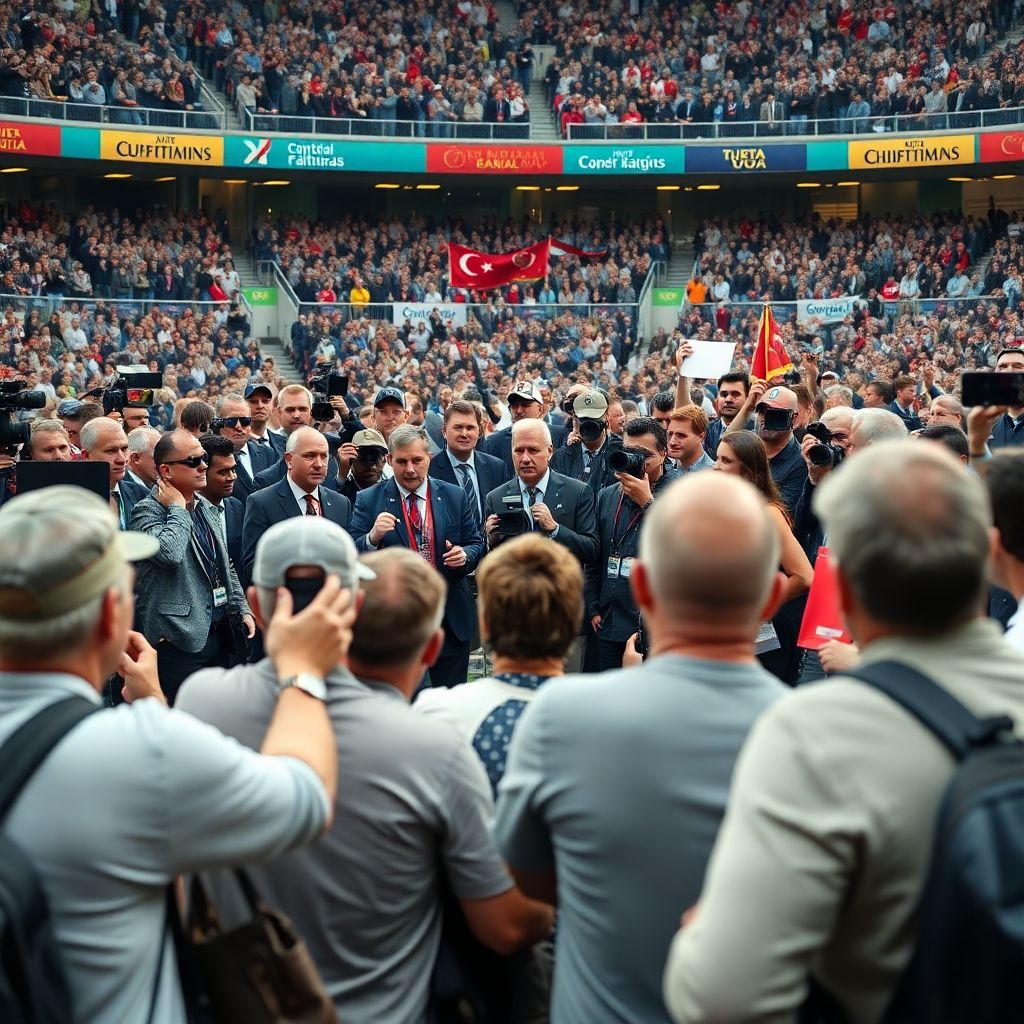
A war of words that eclipsed Türkiye: USA and Australia trade blows before kickoff
The build‑up to the tournament was supposed to revolve around Türkiye’s chances, form and tactics. Instead, a heated verbal battle between the United States and Australia has hijacked the agenda and pushed Türkiye almost completely out of the spotlight.
Everything started when two US legends, Landon Donovan and Alexi Lalas, publicly branded Australia as “the weakest team in the group.” Their comments didn’t stop at a mild assessment of quality; they moved straight into outright provocation. Aiming directly at Australian head coach Tony Popovic, they said in front of cameras and microphones: “Get on your plane and go home.”
It was a line designed to sting, and it had exactly that effect.
“American arrogance” under fire
Australia did not let the accusations slide. From the Socceroos’ camp came a flurry of sharp responses. Midfielder Connor Metcalfe, coach Tony Popovic himself and respected former international Craig Foster all hit back in unison, accusing the Americans of “arrogance” and “talking as if the group had already been decided.”
The tone of their reply was anything but diplomatic. One of the most striking statements from the Australian side summed up the collective mood:
“They’re in for a bitter shock on the pitch.”
Within hours, the narrative changed. It was no longer just about three points or advancing from the group. The USA-Australia clash had become a showdown of egos, pride and national identity, exporting a familiar rivalry dynamic from rugby and basketball into football.
Popovic: from target to focal point
Tony Popovic suddenly found himself at the center of the storm. Donovan and Lalas had dismissed him with the phrase “buy your ticket and go home,” as if Australia’s participation were a formality destined to end in failure.
Popovic responded coolly but firmly, refusing to be dragged into personal insults while still drawing a clear line:
– He reminded everyone that tournaments are not won in television studios.
– He stressed that his team has repeatedly proven it can surprise supposedly stronger opponents.
– He pointed out that being labeled “the weakest” could actually work in Australia’s favor, relieving pressure and sharpening their focus.
Popovic’s message to his players was simple: “Let them talk. We’ll answer when the whistle blows.”
Metcalfe’s defiance: “We’re not here for a holiday”
Connor Metcalfe, one of the new faces of this Australian generation, was far more direct. Responding to the “weak link” tag, he underlined that the squad is motivated by exactly this kind of disrespect.
According to Metcalfe:
– The team has prepared for a high‑intensity tournament, not a friendly tour.
– The players have studied the US in detail and believe they can exploit specific weaknesses.
– No one in the dressing room sees themselves as underdogs in terms of mentality.
“We’re not here for a holiday,” he insisted. “If they think we’ll just roll over, they’re in for that ‘bitter shock’ we’re talking about.”
Craig Foster: warning against dangerous overconfidence
Craig Foster, former international and now one of the most influential voices in Australian football, went even further in his criticism of the American comments. He described the tone coming from the US as “classic overconfidence that often backfires at major tournaments.”
Foster stressed several points:
– Labeling opponents as “the weakest” can create complacency in your own squad.
– Public humiliation of rival coaches and players often ends up on dressing‑room walls as extra motivation.
– Respect is a non‑negotiable principle at this level, regardless of rankings or star power.
His underlying message: arrogance doesn’t win tackles, and it doesn’t guarantee goals.
The US perspective: confidence or provocation?
From the American side, the rhetoric was painted as “honest analysis” and “competitive confidence.” Donovan and Lalas, both known for their outspoken style, argued that:
– In a group stacked with quality, someone will inevitably be seen as the weakest on paper.
– Their assessment was based on squad depth, recent results and individual talent levels.
– Their job as pundits is to tell the truth as they see it, not to sugarcoat opinions.
Yet even in the US, not everyone is convinced that such open disrespect is helpful. Some voices have questioned whether provoking a proud, combative side like Australia is a smart move before a decisive group match-especially in a tournament where one bad day can ruin an entire campaign.
Türkiye pushed into the background
While tensions rose between the USA and Australia, Türkiye-another key team in the group-almost vanished from the main headlines. Training sessions, tactical tweaks, squad selection debates and form of star players were all overshadowed by the trans‑Pacific spat.
Within the Turkish camp, there is an awareness that this may, in fact, be an advantage:
– Less media focus means fewer distractions for players.
– Opponents, busy trading barbs, may underestimate Türkiye’s tactical evolution.
– The pressure that usually falls on Turkish stars is now partially absorbed by this USA-Australia narrative.
Behind closed doors, however, there is no illusion. Türkiye knows that every word fired between Washington and Canberra adds emotional fuel to matches that will directly affect Turkish chances of progressing.
Media firestorm and dressing‑room psychology
Australian media quickly seized on the controversy. US quotes were splashed across headlines, turned into bold slogans and dissected on talk shows. Some outlets reported that the most provocative phrases-“weakest in the group,” “get on your plane and go home”-were printed out and pinned on the dressing‑room wall as a constant reminder and motivational tool.
This is a classic tactic in elite sport:
– Transform external disrespect into internal energy.
– Use perceived injustice to build unity and a siege mentality.
– Convert frustration into intensity in every duel, press and run.
On the American side, the media largely framed the story as a test of whether the team could “back up the talk” with performances. The expectation around the US squad, boosted by recent dominant wins and tactical clarity under their current coaching staff, only increases the risk: a stumble against Australia would not just be a sporting setback; it would be a symbolic defeat of their self‑declared superiority.
Tactical subtext: beyond the trash talk
Behind the loud words, there is a very real tactical clash brewing. The United States come in with a fast, vertical approach, confident after a commanding victory over a physically tough Paraguay that tried-without success-to break their rhythm with aggression and hard challenges.
Key tactical elements for the US include:
– High pressing to suffocate build‑up.
– Quick transitions using dynamic wingers and mobile forwards.
– A midfield structured to recycle possession rapidly and maintain territorial dominance.
Australia, meanwhile, are preparing to counter this with:
– Compact defensive blocks to close central channels.
– Smart fouls and physical duels, but without losing defensive organization.
– Targeted counterattacks, aiming to exploit the space behind the American full‑backs.
Popovic knows that his team may not win a technical shoot‑out, but he believes that discipline, set‑pieces and collective work can be enough to flip the script written by American pundits.
Motivation: when words become fuel
This sort of verbal conflict is not new in football. Coaches and players have long used media comments as tools to:
– Release pressure from their own dressing room by redirecting attention outward.
– Test the mental resilience of opponents.
– Intentionally or not, provide bulletin‑board material that will echo throughout training grounds.
In this case, the US legends’ remarks have clearly crossed that threshold. Australia’s players now have a simple narrative in their heads: “They laughed at us. They told us to book flights home. We answer on the pitch.”
That kind of storyline can be extremely powerful in short tournaments. It turns individual footballers into a collective with a shared mission: not just to win, but to prove everyone wrong.
Hidden winners: can Türkiye capitalize?
Amid the verbal crossfire, one question emerges: who actually benefits from this conflict? The obvious answer might be “no one,” but Türkiye could quietly emerge as the biggest winner.
While the US and Australia trade jabs, Türkiye can:
– Study both teams calmly, noting emotional triggers and weak points.
– Prepare tactical surprises without the pressure of constant media speculation.
– Step onto the pitch with a cooler head, while rivals are fired up and potentially less controlled.
If Türkiye can blend composure with intensity when they face these opponents, they may find themselves exploiting exactly the emotional chaos generated by this off‑pitch drama.
What happens when the whistle blows
Ultimately, every insult and every bold prediction will be measured against 90 minutes of football. If the US dominates and confirms the pundits’ words, their confidence will be seen as justified conviction. If Australia manages even a draw-or worse for the Americans, a defeat-the statements of Donovan and Lalas will be replayed endlessly as a lesson in why underestimating opponents can be dangerous.
For Australia, a positive result would mean more than points:
– It would be a direct rebuttal of the “weakest link” narrative.
– It would harden the team’s belief that they belong at this level.
– It would send a message to the rest of the group-Türkiye included-that the hierarchy is far from settled.
For the United States, the match has become a test not just of tactical quality but of character. Can they handle being the self‑proclaimed favorite? Can they control the game without letting emotions or expectations derail them?
From talking to playing
Right now, the USA-Australia exchange has successfully diverted attention from almost everything else, including Türkiye’s quiet preparation and the tournament’s broader tactical storylines. But once the referee blows the whistle, the microphones and cameras move to the background.
The scoreboard will not care who talked more, who sounded more confident or who insulted whom. It will register goals, tackles, sprints and decisions under pressure.
And when the final whistle sounds, one thing is certain: either the Americans will have to swallow their own words, or the Australians will have to accept that the provocation they used as motivation was, in the end, an accurate prediction. In both scenarios, Türkiye will be watching closely-ready to step out of the shadows the moment the shouting stops and the real football begins.