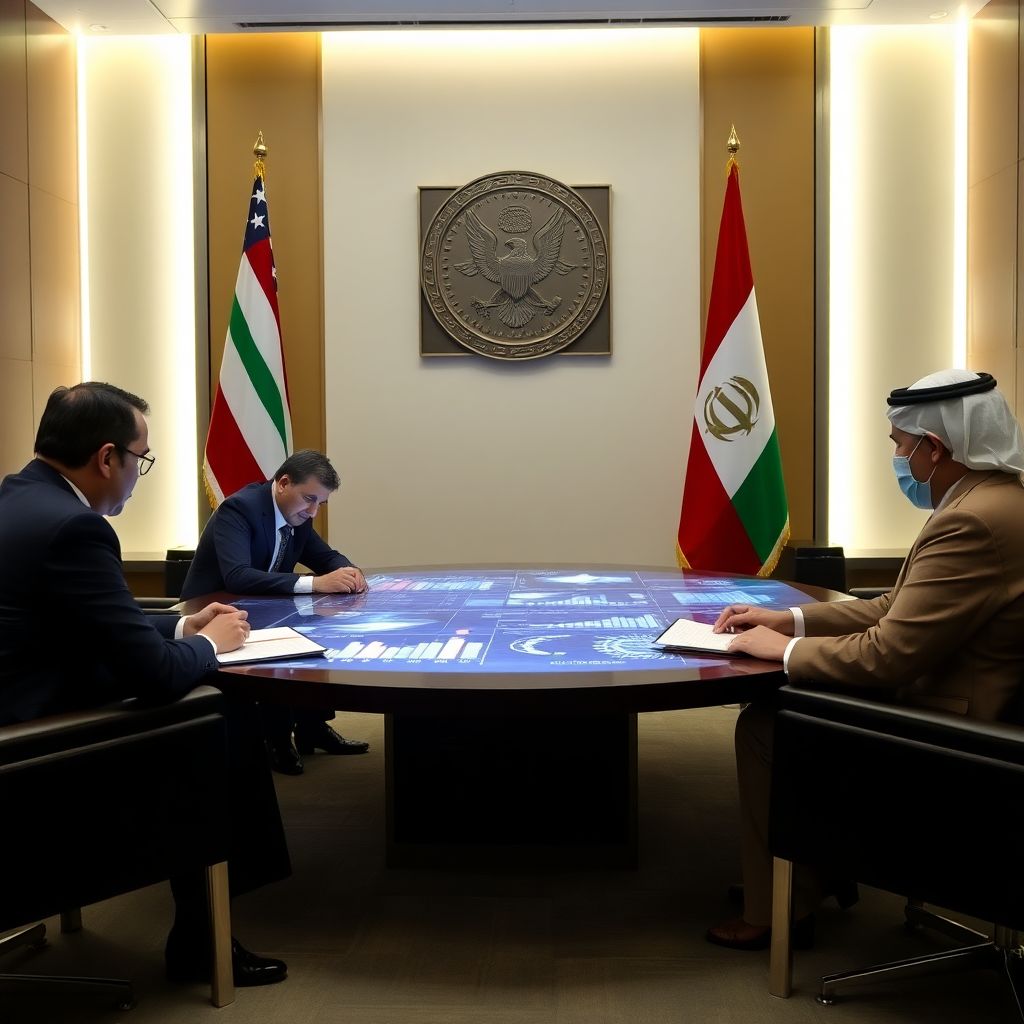
US and Qatar are reportedly exploring a mechanism to unlock part of Iran’s frozen assets, allowing Tehran limited access to billions of dollars strictly for humanitarian purposes.
According to reports attributed to people familiar with the talks, Washington and Doha are drafting what is described as an “early financial incentive” package. The idea is to channel a portion of Iran’s blocked funds into a controlled system that would finance purchases such as food, medicine, and other civilian goods exempt from sanctions.
The proposal, which is said to be still in the discussion phase, would initially target around 6 billion dollars currently held in accounts in Qatar. Over time, the framework could be expanded to cover a fraction of Iran’s estimated 100 billion dollars in frozen cash and assets around the world.
Under the outlined plan, Qatar would act as a financial intermediary rather than handing over cash directly to Tehran. The Iranian Central Bank would submit orders for specific humanitarian items, and Qatari institutions would pay foreign suppliers using money deducted from Iran’s frozen accounts. In this way, the funds would be spent on clearly defined goods and services, rather than flowing freely into Iran’s domestic budget.
Sources indicate that the assets in question largely originate from proceeds of Iranian oil exports that have been stuck in overseas banks due to international sanctions. While humanitarian trade is formally permitted under many sanctions regimes, in practice such transactions are often blocked or delayed by banks’ risk-avoidance policies, leading to recurring debates over how to ensure ordinary civilians are not unduly affected.
The financial proposal is described as one element of a broader diplomatic track that opened after an agreement to pause hostilities and reopen the Strait of Hormuz. The United States is expected to present the plan as one of several confidence‑building measures during negotiations with Iran over the next two months.
Tehran and Washington, through talks facilitated by Pakistan, announced on 14 June that they had reached a 14‑point understanding aimed at halting the fighting and shifting their confrontation to the negotiating table. This framework, known as the “Islamabad Agreement,” was formally activated on 18 June when Iranian President Masoud Pezeshkian and US President Donald Trump signed the document electronically.
The memorandum includes provisions for ending active clashes, not only in the Gulf but also in regional arenas such as Lebanon, reopening the Strait of Hormuz to commercial traffic, and lifting the US naval blockade imposed on Iran. These steps are intended to lower the risk of direct military confrontation and ease pressure on global energy supplies.
Following the entry into force of the Islamabad Agreement, both sides signaled readiness to embark on an intensive, time‑limited diplomatic phase. Within a 60‑day window, negotiators are expected to address some of the most contentious issues in US‑Iran relations: the future of Iran’s nuclear program, the scope and sequencing of sanctions relief, and regional security arrangements.
Within this context, the idea of releasing part of Iran’s frozen funds for humanitarian use is positioned as a test of mutual trust. For Washington, a tightly monitored mechanism could demonstrate that it is prepared to reward de‑escalation, but only under verifiable and reversible conditions. For Tehran, gaining structured access to resources it regards as its sovereign property would be a tangible sign that political talks can translate into economic relief.
A key point of contention is likely to be oversight. US officials are expected to insist on strict controls to ensure that every dollar released is used for humanitarian transactions, potentially involving third‑party audits, detailed reporting requirements, and real‑time monitoring of payments. Iranian officials, on the other hand, traditionally object to what they see as intrusive supervision that undermines their economic sovereignty.
The choice of Qatar as a hub is not incidental. Doha has for years positioned itself as a mediator in regional disputes and has hosted sensitive financial arrangements involving sanctioned states. Its banking system, while integrated into the global financial network, has experience managing accounts subject to special compliance procedures, making it a plausible venue for such a controlled mechanism.
If implemented, the scheme could have practical consequences for Iran’s domestic situation. Access to additional funds for medicine and essential goods could help alleviate shortages and inflationary pressures that have eroded living standards. That, in turn, might reduce social discontent at a time when Iranian leaders are weighing the political costs and benefits of further engagement with the United States.
However, the plan also carries political risks for both capitals. In Washington, critics are likely to portray any relaxation of financial pressure as a concession that strengthens Tehran without securing structural changes in its policies. Opponents may argue that even tightly conditioned humanitarian channels free up other resources in Iran’s budget that can then be diverted to military or regional activities.
In Tehran, hard‑line factions often warn that partial, reversible economic incentives can become a tool of leverage, used to extract concessions without delivering comprehensive sanctions relief. They may press the government to treat such an arrangement only as a short‑term step, insisting that the ultimate goal must remain the full unfreezing of assets and dismantling of core sanctions.
The broader diplomatic calendar adds another layer of complexity. The 60‑day negotiation window envisioned in the Islamabad Agreement sets an ambitious timetable for discussions on highly technical and politically sensitive nuclear and sanctions issues. The humanitarian‑funds mechanism could be deployed early in this period as a goodwill gesture, or held back as a bargaining chip to be offered if talks reach a critical juncture.
Regional actors are closely watching how these initiatives unfold. Countries dependent on stable oil flows through the Strait of Hormuz have a direct interest in consolidating any ceasefire and preventing renewed maritime tensions. For them, a limited financial opening that helps keep Iran invested in diplomatic channels may be preferable to a return to military brinkmanship that could endanger shipping lanes and global energy markets.
From a sanctions‑policy standpoint, the proposed arrangement reflects a recurring dilemma: how to exert pressure on a government while minimizing humanitarian harm. Over the past decade, numerous legal exemptions for food and medicine have been written into sanctions frameworks, yet real‑world implementation has often fallen short. A Qatar‑based structure dedicated to humanitarian trade could serve as a pilot model-either demonstrating that such schemes can work, or underscoring their limitations.
Much will depend on whether the Islamabad Agreement holds in practice. If the ceasefire frays or incidents in the Gulf escalate, political room for financial flexibility will shrink rapidly. Conversely, if both sides avoid provocations and show progress in the nuclear and sanctions discussions, the controlled activation of frozen funds could be expanded, deepened, or replicated with other mediating countries.
In essence, the reported US‑Qatari initiative is not a comprehensive solution to the long‑running dispute over Iran’s frozen assets. It is a narrowly tailored proposal nested inside a larger attempt to change the trajectory of US‑Iran relations-from cycles of escalation and retaliation toward a negotiated, albeit fragile, framework. Whether this approach succeeds will depend less on technical financial design and more on sustained political will in both Tehran and Washington over the weeks ahead.