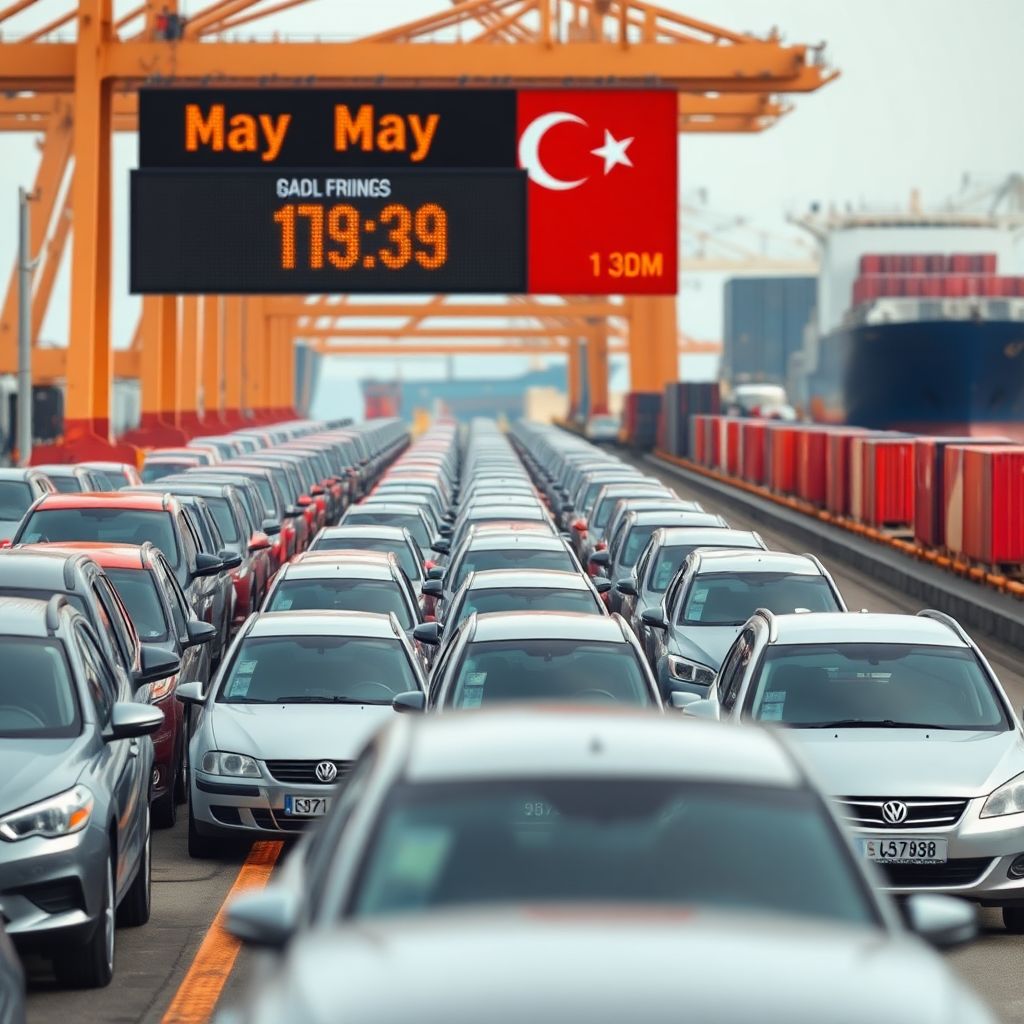
Automotive exports shrink in May despite five‑month growth
Turkey’s flagship export industry, automotive, experienced a noticeable setback in May even as its performance since the start of the year remains positive. According to data from the Uludağ Automotive Industry Exporters’ Association (OİB), the sector’s exports in May fell by 17% compared with the same month of last year, down to 3.264 billion dollars.
Despite this sharp monthly drop, cumulative exports for the first five months of the year still posted an increase. Between January and May, automotive exports rose by 2.6%, pushing the sector’s total foreign sales to the 17‑billion‑dollar threshold. With this result, the automotive industry maintained its position as Turkey’s largest export sector, accounting for 16.8% of the country’s total exports in May.
Fewer working days weigh on performance
OİB Chairman Kemal Yazıcı stressed that the industry’s leadership in Turkey’s export ranking is intact, but underlined the impact of calendar effects. He noted that the lower number of working days in May compared to the previous year was one of the main reasons for the decline in export figures.
Yazıcı also drew attention to the mixed picture in export markets: while 9 of the top 10 export destinations saw contractions, France stood out with strong growth. “The 18% expansion in the French market, along with significant, product‑based increases in strategic markets such as the United States and Norway, is especially important in a month when most key markets posted declines,” he said.
Supplier industry remains largest segment, but exports drop 14%
Within the sector, the automotive supplier industry (components and parts) continued to hold the largest share of exports. In May, supplier industry exports reached 1.215 billion dollars. However, this segment also could not escape the slowdown, recording a 14% year‑on‑year decrease.
Passenger car exports, another major product group, fell even more sharply. Shipments of passenger cars dropped by 23%, coming in at 1.013 billion dollars. Exports of motor vehicles for the transport of goods (light and heavy commercial vehicles) declined by 27% to 543 million dollars.
The bus-minibus-midibus category showed a relatively mild contraction, with exports slipping 2.5% to 269 million dollars. In contrast to these downward trends, tractor unit (truck tractor) exports posted an increase: this group recorded a 13% rise, reaching 168 million dollars.
Germany keeps its lead as top destination
Germany retained its position as Turkey’s largest market for automotive exports. In May, exports to Germany totaled 526 million dollars. Nevertheless, even this leading market was not immune to the general slowdown: exports to Germany contracted by 16% on a yearly basis.
France ranked as the second‑largest export market with 452 million dollars in May. Unlike most other major destinations, exports to France grew by 18% compared to the same month last year. Italy remained in third place, but exports to this market dropped by 8%, falling to 294 million dollars.
Among other important destinations, exports to the Netherlands increased by 15%, to Sweden by 33% and to Egypt by 37%. On the other hand, sharp declines were recorded in several markets: exports to the United Kingdom fell by 49%, to Spain by 27%, to Slovenia by 26%, to Belgium by 33%, to Poland by 27% and to Romania by 29%.
Supplier exports by country: Germany first, broad‑based declines
In the supplier industry segment, Germany was again the largest buyer. However, exports of components and parts to Germany decreased by 11%. Other significant reductions were seen across major European markets: supplier exports to France dropped by 13%, to the United States by 18%, to Romania by 28%, to Poland by 19%, to Spain by 14% and to Belgium by 17%.
These declines show that the pressure on the supplier side is widespread and not limited to a single market. They also reflect both softer demand in some economies and possible adjustments in stock levels among manufacturers and distributors.
Passenger cars: France surges, Northern and Southern Europe diverge
In passenger cars, France emerged as the standout market. Exports of Turkish‑made passenger vehicles to France soared by 48%. There was also a notable increase in exports to Sweden (up 122%) and Greece (up 42%).
However, a number of other key European markets moved in the opposite direction. Passenger car exports to Spain fell by 27%, to Italy by 38%, to Germany by 36%, to Slovenia by 33%, to the United Kingdom by 57%, to Poland by 41% and to Belgium by 43%.
This split performance suggests a rebalancing in European demand, with some countries increasing purchases of certain models or brands produced in Turkey, while others are cutting back or shifting to alternative supply sources.
Commercial vehicles and buses: strong spikes amid general weakness
In the segment of motor vehicles for the transport of goods, the picture was again mixed. Exports to France in this category grew by 40%. In contrast, exports to the United Kingdom fell by 59%, to Germany by 29%, to Spain by 31%, to Italy by 14%, to Slovenia by 30% and to Belgium by 35%.
The bus-minibus-midibus group displayed unusually strong growth in some distant and nearby markets despite a slight overall decline. Exports of these vehicles to the United States jumped by 582%, to Italy by 129% and to Romania by 56%. At the same time, shipments to France fell by 28% and to the United Kingdom by 55%.
In the tractor unit category, Norway was the most striking case. Exports of tractor units to this country soared by 257%. Germany also posted a 50% increase in this product group, while exports to Slovenia rose by 42%. These results highlight how specific niches and product types can buck the overall downward trend when they match demand in certain markets.
EU maintains 75% share in Turkish automotive exports
From a regional perspective, European Union countries continued to dominate Turkey’s automotive exports. In May, EU member states accounted for 75% of total automotive exports, corresponding to 2.453 billion dollars. However, exports to the EU as a group fell by 13% compared with the same month last year.
Other European countries, outside the EU, formed the second‑largest regional group with a 9.5% share. Exports to these “other European” markets declined even more sharply in May, down by 42%. Exports to Middle Eastern countries also fell considerably, with a contraction of 26%.
These figures show that the May slowdown was not confined to a narrow geography; demand was weaker across multiple regions that are traditionally important for Turkey’s automotive industry.
What is behind the May decline?
The contraction in May can be traced to a combination of structural and temporary factors. The most immediate reason, emphasized by sector representatives, is the reduced number of working days compared with the previous year. Holidays and planned shutdowns in production can significantly affect monthly export volumes in an industry where output and shipments are tightly scheduled.
Beyond calendar effects, the global automotive market is going through a transition phase. The shift toward electrification, stricter emission norms, and changing consumer preferences create volatility in product planning and inventory management. Importing countries may adjust orders as they reassess which models to prioritize, which in turn reflects on Turkey’s export statistics.
Another factor is the lingering impact of last year’s economic uncertainties in major markets. High interest rates in developed economies can dampen vehicle sales, as financing becomes more expensive for both consumers and fleet buyers. This often shows up with a lag in orders from export‑oriented plants.
Why is the French market growing while others contract?
France’s 18% growth in total automotive imports from Turkey, and especially the 48% jump in passenger car imports, stands out against the general picture of decline. Several dynamics may support this divergence:
– French distributors and manufacturers may have ramped up orders for specific models produced in Turkey, perhaps due to positive sales performance or replacement of other sourcing locations.
– Local production adjustments or temporary constraints in other supply chains could have led French buyers to rely more heavily on Turkish plants.
– Model cycles and product launches often create short‑term spikes: if new or facelifted models produced in Turkey entered the French market at this time, orders may have increased substantially.
This reinforces the idea that even in a challenging environment, targeted product strategies and strong relationships with particular markets can generate significant growth.
Strategic markets: the significance of the US and Norway
The notable increases in certain product groups exported to the United States and Norway are strategically important for Turkey’s automotive industry. These markets are not just large in size; they are also seen as benchmarks for technology, safety, and environmental standards.
High growth rates in specific categories, such as buses to the US or tractor units to Norway, suggest that Turkish manufacturers are capable of meeting demanding technical and regulatory requirements. Penetrating such markets can enhance the industry’s global reputation and open doors for higher value‑added products. Over the medium term, sustained presence in these destinations can help reduce dependence on a small cluster of markets and diversify export risks.
Outlook for the rest of the year
Despite the weak May figures, the 2.6% growth in automotive exports over the first five months indicates that the sector is still on a moderate upward trajectory in annual terms. If calendar effects normalize and global demand stabilizes, the industry may regain part of the ground lost in May during the remaining months of the year.
However, the broad‑based decline in many core markets is a warning signal. To maintain momentum, companies may need to:
– Focus on higher value‑added segments such as electric and hybrid vehicles, advanced components and smart mobility solutions.
– Deepen their footprint in growth markets outside their traditional European base.
– Enhance flexibility in production to quickly respond to shifts in model demand or regulatory changes.
Policy support can also play a role, particularly in encouraging investment in new technologies, supporting R&D and maintaining competitive logistics and infrastructure.
Logistics and infrastructure: a parallel reminder from the Eurasia Tunnel
On the logistics front, uninterrupted transport is critical for an export‑driven industry like automotive. Any disruption on key routes can quickly translate into delays and additional costs. In this context, an incident in the Eurasia Tunnel on the same morning stands as a reminder of how vulnerable trade flows can be to unexpected events.
A vehicle in the tunnel reportedly collided with a fire control panel, damaging the system and causing a water mains rupture. The resulting water accumulation forced the temporary closure of the tunnel to traffic. While this particular event was limited in time, it illustrates how quickly a single accident can impede one of the main crossings between the Asian and European sides of Istanbul, a crucial logistics corridor for automotive shipments.
Ensuring the resilience of such infrastructure through robust safety systems, rapid response mechanisms and contingency planning is essential to keeping export operations running smoothly, especially for sectors that depend on just‑in‑time delivery.
How the sector can turn a weak month into a long‑term advantage
Although the May figures highlight a challenging month, they also offer valuable information for strategy. A granular look at product groups and country breakdowns shows where Turkey’s automotive sector is gaining traction and where it is losing ground.
Strong growth in markets such as France, the US, Norway, Sweden and Egypt indicates that there is room to deepen ties and expand product offerings in these destinations. At the same time, steep declines in key European markets like the UK, Germany, Spain and Italy point to the need for closer market intelligence, more competitive product positioning and perhaps new partnerships or localization strategies.
If manufacturers and policymakers use the signals from May’s data to reorient strategies-focusing on innovation, diversification and resilience-the sector can not only recover from a temporary setback but strengthen its global position in the coming years.