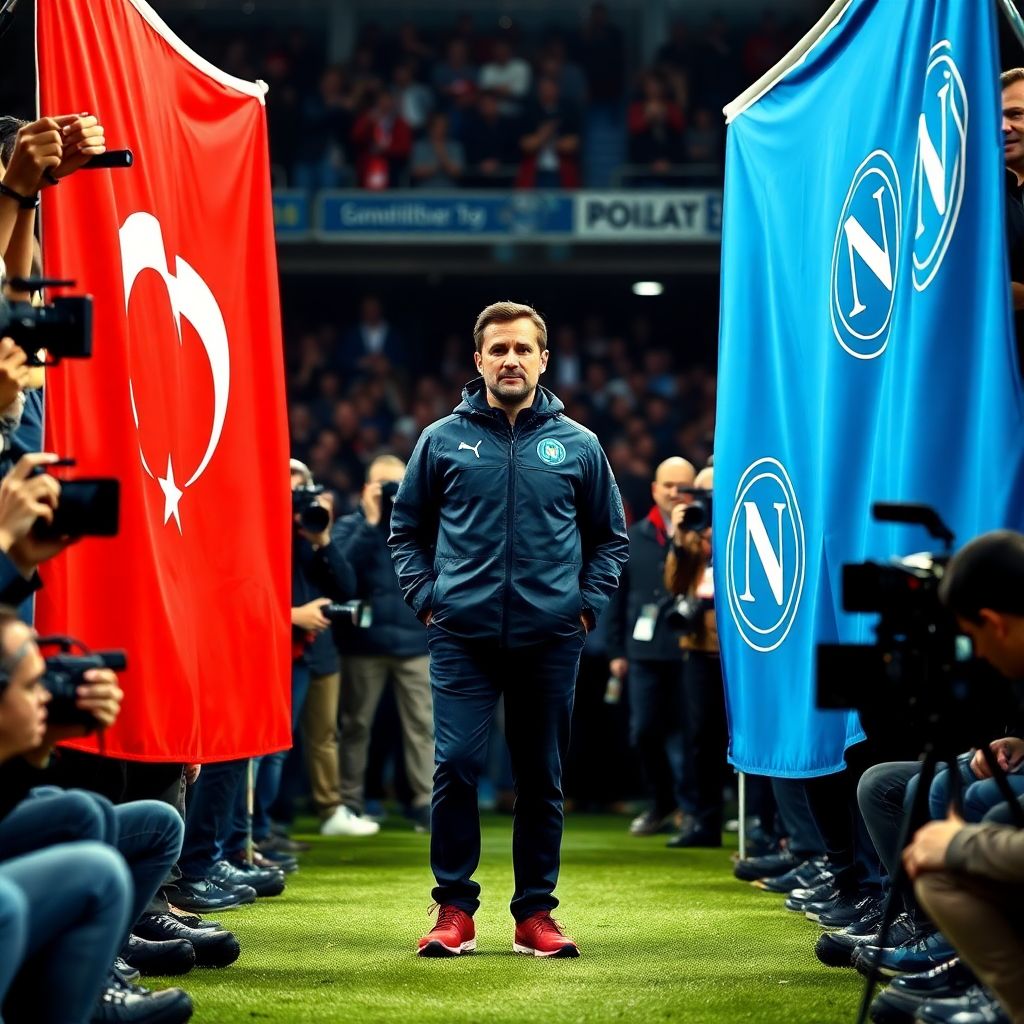
Shock offer for Montella: is he about to walk away from the Turkish national team?
After the World Cup debacle that left fans furious and experts baffled, the future of head coach Vincenzo Montella has become the hottest topic in Turkish football. According to strong claims from Italy and Turkey, the Italian manager is expected to be relieved of his duties after the friendly against the United States, with Napoli already preparing to bring him in as their new head coach.
From “kısmet” to catastrophe
Montella had often spoken about his journey with Turkey as “fate” and “destiny,” but the numbers on the pitch paint a very different story. What was supposed to be a long-term project built around a talented generation has turned into a statistical disaster. Key metrics such as shots on target, expected goals, ball progression and defensive duels have all sharply regressed compared with previous major tournaments.
In crucial matches, Turkey struggled to create clear chances despite long spells of sterile possession. The team frequently finished games with fewer shots on target than opponents who had far less of the ball. Defensive organization collapsed at key moments, with simple long balls and set pieces repeatedly exposing structural weaknesses. The cold figures do not suggest bad luck; they point directly to poor planning and poor in-game management.
A controversial call-up: Salih’s curious inclusion
One of the biggest talking points before the tournament was the inclusion of Salih in the 26-man squad. Inside the federation, the decision was widely interpreted not as a purely sporting choice, but as part of a transfer-oriented strategy. The logic was simple: give the player international exposure with the national team, increase his visibility and market value, and then secure a move to a bigger club.
This kind of thinking infuriated supporters who believe the national team should never be used as a shop window. For many, Salih’s selection symbolised everything that was going wrong: a federation more interested in business and short-term gain than in building a coherent footballing identity or a balanced squad.
Four players frozen out of the national team
In the aftermath of the failure, four names have reportedly been internally marked as “no longer part of the national team plans.” While these players have not been officially blacklisted, it is understood that they will not be called up again in the near future.
The reasons vary: some are considered tactically incompatible with the new direction, others are blamed for disciplinary issues or a lack of commitment at key moments. What unites their cases is the perception inside the camp that the group was never fully cohesive. Fractures in the dressing room, unspoken tensions and competing cliques all contributed to a fragile atmosphere that was quickly exposed under pressure.
The Çalhanoğlu and Merih dilemma
Captain Hakan Çalhanoğlu and defender Merih Demiral became the focus of a key debate about leadership and selection. Montella and his staff faced a difficult balancing act: rely on established names with experience in top European leagues, or phase in younger alternatives and accept short-term pain for long-term gain.
Ultimately, the compromise satisfied no one. Çalhanoğlu often appeared caught between roles, switching from deep playmaker to advanced creator without a clear structure around him. Merih, meanwhile, oscillated between dominant performances and costly lapses in concentration. The decisions to persist with them in certain tactical setups, instead of building a system that maximised their strengths, now stand as one of the major criticisms of Montella’s tenure.
Barış Alper controversy: did he really not want to play?
Another story that caused outrage was the claim that Barış Alper did not want to play in a specific match. According to reports, the player expressed reluctance, citing physical and mental fatigue, at a time when the team desperately needed fresh energy on the pitch.
The incident raised uncomfortable questions about motivation, communication and man-management. Was it a misinterpretation of a player managing his own fitness, or a sign that trust between coach and squad had broken down? Whatever the truth, the episode became a symbol of the wider dysfunction: a national team heading into the biggest tournament in the world without a united front or a shared sense of purpose.
“They will watch me at the World Cup”: words that aged badly
Before the tournament, a number of players publicly promised that the world would “watch them at the World Cup,” projecting confidence and ambition. Those bold declarations now sound painfully ironic. Instead of a global showcase, Turkey’s campaign turned into a cautionary tale about hubris and lack of preparation.
The gap between rhetoric and reality further angered supporters. For many, it felt as though some figures around the team were more focused on building personal brands and securing transfers than on collective performance. This perception has only intensified the pressure on the federation and on Montella himself.
Federation under fire: the circle tightens around TFF
As the dust settles, scrutiny has shifted from the touchline to the boardroom. The Turkish Football Federation now finds itself in an increasingly tight corner. The Ministry has reportedly stepped in, initiating processes that could lead to structural changes and, crucially, early elections.
Calls are growing louder for a complete reset: a new president, a reformed decision-making structure and a clearer long-term vision for Turkish football. Critics argue that constant short-termism, frequent coach changes and politically motivated appointments have created an unstable environment in which even talented squads are doomed to underachieve.
A transfer-market symptom: the centre-forward “ban”
One of the more bizarre consequences of recent failures has been a de facto “ban” on certain types of centre-forward transfers. Clubs, terrified of being left with high-salary strikers who do not fit the national team’s evolving style, are increasingly cautious about traditional target men.
Instead, there is a trend towards more mobile, pressing-oriented forwards. This shift might appear tactical, but it also exposes a deeper issue: a lack of coherent coordination between clubs and the national setup. Without a unified vision of what a “Turkish striker” should look like in modern football, the country risks producing players who shine in domestic leagues but struggle to adapt on the international stage.
The humiliation of dependence
Another painful lesson exposed by the World Cup run is just how dependent Turkey has become on a handful of foreign-based stars. When those players underperform or are unavailable, there is a sharp drop in quality, intensity and game intelligence.
This dependency creates a persistent sense of vulnerability and, as some within the game admit privately, a certain embarrassment. A country with a passionate fanbase, a large population and a proud football tradition should not have to cling so desperately to a small core of names. The failure has reignited discussion about youth development, coaching education and the need to build a broader, more resilient talent pool.
Volkan Demirel steps into the frame
In the swirl of speculation about the next era, former goalkeeper Volkan Demirel has publicly addressed rumours linking him with high-profile positions. He confirmed that he held talks with former Fenerbahçe president Aziz Yıldırım, fuelling speculation about a potential move either at club level or, in time, within the national-team structure.
Volkan, known for his strong personality and emotional leadership, is seen by some as a figure who could eventually galvanise a dressing room. However, questions remain about whether he has enough top-level coaching experience to handle the immense pressure of the national job, particularly in such a politically charged environment.
Transfer market ripples: Trabzonspor and the new economy
The shock of the World Cup campaign has not stopped the transfer carousel. At Trabzonspor, the club is reportedly holding out for around 60 million euros for a key asset, a figure that would have been unthinkable a decade ago. This stance reflects both the inflation of the global market and a strategic decision: if Turkish clubs are to survive and compete, they must sell smartly and resist cut-price offers.
Other moves are also reshaping the landscape. Ouali has, according to reports, completed the signing of a German central midfielder, a transfer seen as part of a broader effort to modernise midfields across the league with more athletic, press-resistant players.
Klopp’s diagnosis: why Turkey exited early
From abroad, respected figures have weighed in on Turkey’s early elimination. Jürgen Klopp, speaking in general terms about tournament football, highlighted issues that resonate strongly with Turkey’s predicament: lack of tactical continuity, poor in-game adaptability and the mental burden of a nation’s expectations on players who are not used to consistently high-pressure environments.
His analysis, though not directed solely at Turkey, has been widely interpreted as a mirror held up to the team’s failings. In a tournament setting, where there is no time to correct structural flaws, a side without a clear identity or rehearsed automatisms is almost always found out.
Galatasaray’s opportunities: João Gomes and Greenwood
Despite the national-team gloom, top Turkish clubs are trying to take advantage of market openings. João Gomes has reportedly “opened the door” to a move and is said to be waiting for Galatasaray to formalise their interest. His profile-dynamic, aggressive, technically sound-matches the kind of midfield upgrade required to compete in Europe.
At the same time, Mason Greenwood has received a fresh offer that could alter existing plans. Whether a Turkish club will seriously push for him remains uncertain, but his name being floated in these circles illustrates how ambitious some of the transfer targets have become, even in the aftermath of a disappointing international showing.
Deniz Undav: the striker who never stops
Amid all the criticism, one name has emerged as a positive story: Deniz Undav. The forward, sometimes described as “the Kurdish kid who conquered Germany,” has repeatedly insisted that he can “always score” when given trust and continuity. His goalscoring form in Europe has backed up those words.
Undav has refused to step away from the national setup, even when rotation or tactical choices have kept him out of the XI. His attitude has impressed many, and he is increasingly seen as the kind of resilient, mentally strong profile that Turkey needs more of if it is to rebuild effectively.
Painful results: Turkey 0-1 Curaçao
Perhaps the most stinging result of all was the 0-1 defeat to Curaçao, a scoreline that many fans still struggle to accept. On paper, Turkey should have had more than enough quality to win comfortably. On the pitch, however, there was a lack of intensity, cohesion and urgency.
For critics, this match summed up the entire Montella era: a team with individual talent but no clear mechanism, outworked and outthought by opponents who simply wanted it more. The question, asked again and again, is whether Turkey “deserved” such a result-or whether the performance was merely the delayed bill for years of structural neglect.
Wilfried Singo’s tears and the fear of serious injury
The tournament also delivered moments of human drama beyond Turkish borders. Wilfried Singo’s emotional exit from a match, leaving the pitch in tears, immediately raised fears of a serious injury. Early reports were worrying enough to make observers say “this looks bad,” a reminder of how quickly fortunes can change for any player.
Incidents like this underline the physical and mental demands placed on modern footballers. For Turkish planning, they also highlight the importance of squad depth and rotation. Relying on a fixed XI across a grueling schedule is no longer realistic at the highest level.
Fatih Terim’s looming response
Whenever there is a crisis in Turkish football, one name always returns to the spotlight: Fatih Terim. A statement or appearance scheduled for 12:00, teasing topics like “vultures and hyenas,” has been widely interpreted as a pointed response to his critics and to those he feels are exploiting moments of chaos.
Terim’s words, whether conciliatory or explosive, could influence public opinion and power dynamics behind the scenes. His presence in the debate, even from the sidelines, demonstrates how deeply personalities and history are woven into the fabric of Turkish football politics.
Montella and Napoli: what happens next?
Amid all this, the central question remains: will Vincenzo Montella leave the Turkish national team to take over at Napoli? The expectation is that his contract will be terminated shortly after the USA match, clearing the way for a return to Serie A.
From Montella’s perspective, Napoli offers a familiar environment, a competitive squad and the possibility of repairing his reputation in a league he knows well. For Turkey, his departure would close a turbulent chapter and open another challenging phase: finding a coach capable of uniting a fractured dressing room, imposing a clear tactical identity and resisting the constant political noise around the job.
Rebuilding from the ruins
If there is a silver lining, it lies in the intensity of the debate now taking place. Structural reform, once a distant slogan, has become an urgent necessity. The federation must decide whether it truly wants long-term stability or will continue to chase quick fixes. Clubs have to align youth development with the needs of the national team, not just short-term financial gains.
A clear footballing philosophy, from under-age levels to the senior team, is no longer a luxury but a requirement. The shock of failure, the painful statistics, the controversial selections and the humiliating results can either be ignored-or used as the foundation for a genuine reset.
For now, all eyes turn to two decisions: Montella’s expected move to Napoli, and the direction the Turkish Football Federation will choose in the aftermath. On those choices may depend not just the next qualification campaign, but the entire trajectory of Turkish football for the coming decade.