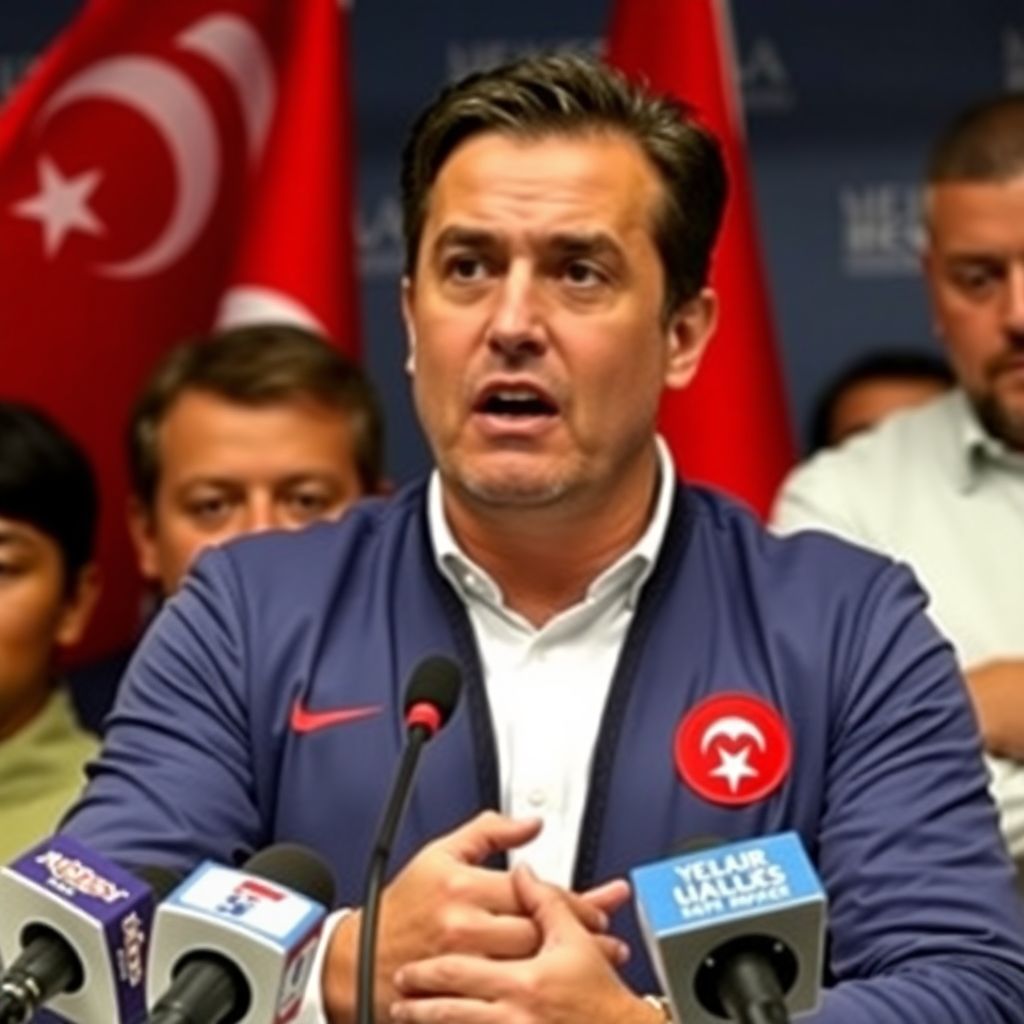
Montella hits back at criticism after Australia defeat
Turkey head coach Vincenzo Montella has delivered a strong response to the wave of criticism that followed the national team’s defeat to Australia, insisting he is fully committed to the country and its footballing success.
Speaking in an interview with TRT Spor, the Italian coach argued that the reaction to the loss went far beyond normal sporting debate and turned into an attempt to create chaos around the team.
Montella underlined that his attachment to Turkey is deeper than many of his critics are willing to accept:
> “In my heart, I feel Turkish. I’ve been here for five years. I understand the emotions in this country, I know what football means here. We were devastated after the Australia match – not only because of the result, but because some people tried to exploit it and stir chaos afterward.”
He stressed that the work done over recent years should not be dismissed so easily after a single bad result:
> “For three years we’ve been doing important things here. Together with the players, we’ve been chasing success and getting recognition around the world. While others appreciate what we do, in our own country we are so far from that appreciation. The existence of a system that tries to destroy everything after the first defeat hurts me deeply.”
Montella also drew a sharp line between constructive criticism and what he sees as deliberate attempts to undermine the national team:
> “Criticism of players should be constructive. I’m not talking about what is said honestly in press rooms, that’s part of the job. But some individuals only want confusion and turmoil. They try to benefit from the chaos. That doesn’t affect me personally, but it harms Turkish football.”
The 49‑year‑old coach insisted that the team’s focus remains intact and that one defeat will not derail their long-term goal:
> “No one should doubt us. As always, we will work very hard before the next match and keep moving towards our targets. Our commitment hasn’t changed because of a single bad night.”
Montella’s Turkish identity and emotional bond
Montella’s repeated statement “I’m actually Turkish” is more than a rhetorical flourish. Since arriving in the country, he has often emphasized his desire to integrate into the culture, learn the language, and understand local sensitivities.
By reminding people that he has spent five years in Turkey, he is not only defending his record but also trying to counter the narrative that a foreign coach cannot fully grasp the national psyche.
In Turkish football, where passion can quickly turn into polarisation, a foreign manager is always under closer scrutiny. Montella’s public insistence on his emotional bond with Turkey is his way of saying: “I’m not a visitor anymore; your pain is my pain too.”
The fine line between passion and destruction
The national team’s defeat to Australia triggered a familiar scenario: intense media debate, harsh television panels, and emotional commentary. Montella’s remarks highlight a deeper issue within Turkish football culture – the speed with which one negative result can erase months or even years of progress.
He is effectively calling for a more balanced environment in which criticism remains firm but fair, instead of becoming a tool to fuel instability. According to his view, the team needs calm and continuity, not a climate in which every setback is treated as a catastrophe.
For players, especially younger ones, this atmosphere matters. Excessively aggressive criticism can create fear of mistakes, which in turn leads to more cautious, less creative football on the pitch. Montella’s plea for “constructive” remarks is also a shield for his squad.
—
Canada pummel Qatar with historic 6-0 win
In Group B of the 2026 FIFA World Cup, Canada delivered a statement performance by dismantling Qatar 6-0, securing the country’s first-ever victory in World Cup history and moving to four points in the group.
Canada started the match on the front foot and imposed their intensity from the first whistle. In the 16th minute, Cyle Larin opened the scoring to make it 1-0, rewarding his team’s high pressing and attacking intent.
The North Americans doubled their advantage in the 29th minute. Tajon Buchanan fired from outside the area, and after the shot deflected off a defender, Jonathan David reacted quickly, collecting the loose ball and finishing clinically to the left of goalkeeper Abunada for 2-0.
Qatar’s hopes collapsed further in the 33rd minute when Homam Ahmed was shown a red card for denying an obvious goal-scoring opportunity. Reduced to ten men and already trailing by two, the Asian side struggled to cope with Canada’s attacking waves.
Just before the interval, in the 45+3rd minute, Alistair Johnston delivered a cross from the right towards the far post. Larin’s header was saved by Abunada, but David was again in the right spot to tuck home the rebound and extend the lead to 3-0.
Qatar’s nightmare worsened in the second half. In the 53rd minute, Madibo received a straight red card for a reckless challenge, leaving his team with only nine players on the pitch against a relentless Canadian side.
In the 64th minute, Canada struck again. From a free-kick just outside the box, Saliba’s powerful effort hit the post and bounced into the net for 4-0.
The fifth goal came in the 75th minute after another attack built down the right side. Johnston’s cross into the area was first met by Buchanan, then fell to Shaffelburg, and finally deflected off Qatari defender Almanai into the net for 5-0.
Deep into stoppage time, in the 90+2nd minute, Saliba tried his luck once more from distance. The shot fell to David, who calmly slotted the ball past Abunada on his right side, completing his hat-trick and sealing a remarkable 6-0 victory.
With this emphatic result, Canada climbed to four points and significantly boosted their goal difference. Qatar, stuck on a single point and with a heavy defeat on their record, face an uphill battle to advance.
Tempers flare after the final whistle
The one-sided scoreline and the two red cards set the stage for a heated finale. At full-time, tensions boiled over between the players, leading to a scuffle on the pitch. Coaching staff from both sides also became involved verbally as arguments erupted near the technical areas.
Security and match officials had to intervene to separate the parties and restore order. While such scenes are unfortunately not unusual in high-stakes tournaments, they are likely to draw disciplinary scrutiny, and possible suspensions or fines may follow.
Tactical dominance by Canada
Beyond the raw numbers, Canada’s tactical display stood out. Their aggressive pressing forced Qatar into mistakes, while quick transitions through wide players like Johnston and Buchanan repeatedly stretched an already under-pressure defence.
Jonathan David’s movement between the lines constantly unsettled Qatari centre-backs, and Larin’s physical presence created space for runners behind him. The red cards certainly influenced the margin, but Canada had already established clear superiority before Qatar went down to nine men.
—
Mexico edge South Korea and secure place in last 32
In Group A, hosts Mexico took a major step by defeating South Korea 1-0 in Guadalajara, guaranteeing their place in the last 32 with two wins from two matches and six points on the board.
The match, officiated by referee Gustavo Tejera, was tightly contested, with both teams struggling to produce clear-cut chances in the first half. Mexico, buoyed by the home crowd, tried to control possession, while South Korea relied on their discipline and quick counter-attacks.
The decisive moment came in the 50th minute. A major mistake from the South Korean goalkeeper gifted Mexico the lead, as Luis Romo capitalised on the error and slotted the ball into the net for 1-0.
After going in front, Mexico focused on managing the game, closing spaces and limiting South Korea’s opportunities. The Asian side pushed for an equaliser, but lacked precision in the final third and failed to break down the well-organised Mexican defence.
The match ended 1-0, a result that secured Mexico’s passage to the knockout phase. They had already beaten South Africa 2-0 in their opening group game, and now sit comfortably atop the group with a perfect record.
South Korea, who started their campaign with a 2-1 win over Czechia, remain on three points and still have a chance to progress, but must now look nervously at the final round of matches. In the other group fixture, Czechia and South Africa drew 1-1, leaving both sides on one point each and keeping the group wide open behind Mexico.
Turkish club players on display
The match also had a special relevance for Turkish football fans. Mexico’s Edson Álvarez, who plays for Fenerbahçe, started the game in the first eleven and contributed to the team’s defensive solidity in midfield.
On the South Korean side, Beşiktaş striker Hyeon-Gyu Oh entered the pitch in the 57th minute, hoping to change the course of the match. Despite his energy and movement, South Korea was unable to find a way past the Mexican defence.
These appearances underline how players from the Turkish league are increasingly visible on the World Cup stage, carrying the experience gained in domestic competition into the biggest tournament in world football.
Celebrations across Mexico
Following the final whistle, scenes of joy erupted across the host nation. Aerial footage showed large crowds gathering around one of Mexico City’s landmark monuments, where thousands of fans celebrated the 1-0 victory over South Korea.
Flares, chants, flags, and spontaneous street parties illustrated what World Cup success means for a host country. For Mexico, securing progression from the group with a game to spare reduces pressure on the team and allows the coaching staff to manage minutes ahead of the knockout rounds.
—
Switzerland cruise past Bosnia and Herzegovina
In another Group B encounter, Switzerland recorded a convincing 4-1 victory over Bosnia and Herzegovina at SoFi Stadium, moving to four points and strengthening their bid to reach the next phase.
The Swiss side, known for their tactical discipline and structured approach, took control of the match early on. Goals from Johan Kula Manzambi, Ruben Vargas and Granit Xhaka paved the way for a comfortable win.
Bosnia and Herzegovina’s task became more difficult when Muharemovic received a red card for denying an obvious goal-scoring opportunity. Reduced to ten men against an efficient opponent, Bosnia struggled to keep the scoreline down.
Late in the game, Beşiktaş midfielder Amir Hadziahmetović was introduced in the 86th minute, adding a familiar name for Turkish fans watching the contest. By then, however, the outcome was already beyond doubt.
The victory lifted Switzerland to four points, placing them alongside Canada at the top of Group B. Bosnia and Herzegovina, with just one point from their opening matches, now face a must-win scenario in their last group fixture.
In the final round of games, Switzerland will face Canada in what could become a direct battle for first place in the group, while Bosnia and Herzegovina will meet Qatar in a match that may decide who keeps their knockout hopes alive.
Group B wide open behind leaders
With Canada and Switzerland both on four points and Qatar and Bosnia stuck at one, the last matchday in Group B promises drama. Goal difference could become crucial, especially after Canada’s 6-0 demolition of Qatar.
Switzerland’s blend of experience, represented by Xhaka, and younger talents like Manzambi and Vargas, contrasts with Canada’s energetic, high-tempo approach. Their head-to-head clash will be a test of discipline versus intensity.
For Bosnia and Qatar, the meeting between them is not only about survival in the tournament but also about restoring pride after heavy defeats. Both will want to show that they can respond to adversity – a theme that connects them, in a different context, to Montella’s words about reaction to criticism.
—
Pressure, criticism and the reality of modern football
Montella’s emotional reaction after the Australia loss must also be seen in the broader context of modern football. National team coaches operate under intense scrutiny, where every decision – from squad selection to in-game substitutions – is dissected in real time.
In a football culture as passionate as Turkey’s, this pressure is multiplied. Expectations are enormous, particularly when the team has shown signs of promise over previous years. Montella’s reminder of “three years of good work” is a call to remember the full picture rather than judge only the latest result.
When results go wrong, the easiest target is often the coach. Yet long-term success requires continuity, clear principles of play and trust in a project. Constantly questioning the coach’s legitimacy after every setback risks creating an endless cycle of instability.
The importance of constructive debate
Montella made a clear distinction between normal criticism and what he called “chaos.” Constructive criticism focuses on tactics, player form, preparation, and selection, and can actually help improve performance by highlighting weaknesses to address.
Destructive criticism, on the other hand, quickly becomes personal, questions loyalty, or fuels conspiracy theories. It generates clicks and reactions but rarely contributes to the team’s progress.
For a national team to thrive, players and staff need a minimum of stability and support. That does not mean they are beyond criticism; rather, it means that criticism should aim to push them forward, not tear them down.
Looking ahead for Turkey and the tournament
While this matchday’s headlines were dominated by Canada’s historic win, Mexico’s secure qualification, and Switzerland’s convincing performance, the debate around Montella shows how fragile the atmosphere can become after a single defeat.
Turkey’s response in their next fixture will be crucial not only for their standings but also for restoring confidence around the project. A strong performance on the pitch is often the quickest way to quiet outside noise.
Across the World Cup, the group stage is beginning to take shape: hosts Mexico already in the last 32, Canada and Switzerland emerging as serious contenders in Group B, and other nations fighting desperately to stay alive. For coaches like Montella, every match is a test not just of tactics and preparation, but of their ability to withstand pressure and keep the dressing room united.
In that sense, his words are both a defence of his own role and a message to the country: passion is essential, but without balance, it can turn against the very team it aims to support.