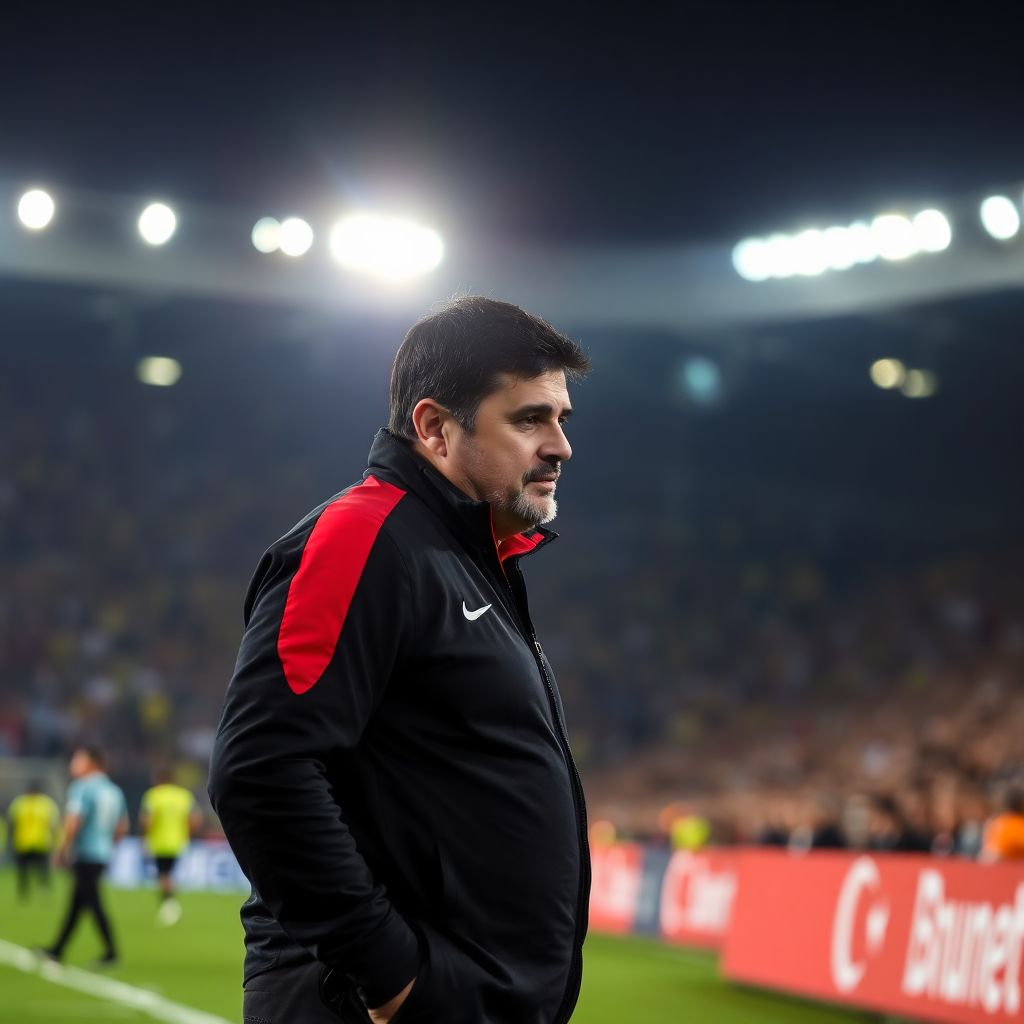
Montella breaks silence after opening World Cup defeat
Vincenzo Montella tried to strike a balance between disappointment and realism after Turkey’s national team opened their 2026 FIFA World Cup campaign with a painful defeat to Australia in Group D. Speaking after the match, the Italian head coach dissected the performance, defended some of his decisions and underlined that qualification chances are still alive despite the early setback.
“The game didn’t go differently from what we expected”
Montella began by stressing that, from a tactical perspective, the match unfolded largely as his staff had predicted.
“Tactically, the game did not go outside of what we expected,” he explained. “We knew they would sit deep, defend in numbers and wait for counter‑attacks. They used their transitions well. We conceded two goals and of course we are very disappointed.”
The coach underlined that Australia’s approach was no surprise. Their compact defensive block, combined with quick breaks, was exactly the scenario the Turkish camp had prepared for – but preparation on paper did not translate into the desired result on the pitch.
Problems in attack: “We tried everything but couldn’t score”
One of the main themes of Montella’s evaluation was the lack of efficiency in the final third. Despite long spells of possession and frequent attempts on goal, Turkey failed to find the net.
“When you don’t have continuity in your playing rhythm, you cannot perform at your full level,” he said. “We tried everything, but we couldn’t score. If we had found that first goal, the game would have looked completely different.”
Montella pointed to a broken rhythm and a lack of fluidity between the lines as key reasons why his team struggled to turn territorial dominance into clear‑cut chances. The build‑up was often too slow, and combinations around the box did not break Australia’s defensive structure often enough.
“Thirty shots” and a question of luck
The Italian coach also highlighted the sheer volume of attempts as proof that his players at least reached finishing positions, even if the end product was missing.
“We had around 30 shots,” Montella emphasized. “If luck is not on your side, you lose these kinds of games. We came very close to scoring, but we couldn’t break their defensive wall. They are very tall, very strong physically, and it’s never easy to face a team like that.”
For Montella, the number of shots was both a sign of attacking intent and a reminder that volume alone is not enough. Australia’s aerial dominance and disciplined defending neutralized many crosses and long balls, leaving Turkey forced to rely on low‑percentage efforts from distance or crowded positions.
Physical battle and style clash
Beyond tactics, Montella underlined the physical mismatch as a decisive factor. Australia’s back line, filled with tall, powerful defenders, repeatedly cleared crosses and long deliveries, reducing the impact of Turkey’s wide play.
In matches like this, where one team defends deep with physically imposing players, patient circulation of the ball, quick combinations and movements behind the defensive line become crucial. Turkey, however, often fell into the trap of predictable patterns: slow build‑up, central congestion and hopeful balls into a crowded penalty area.
Montella’s comments implicitly suggested that the team needs to adapt more quickly to different types of opponents, especially those that prioritize physicality and compact defending over open, expansive football.
Dealing with the backlash: “We must accept criticism”
Fully aware that a World Cup loss triggers an immediate and intense reaction, Montella did not shy away from the subject of public and media criticism.
“When you lose, you have to accept all the criticism, even if you don’t think it is entirely fair,” he admitted. “This is part of the job, part of football at this level.”
By framing criticism as something “natural” after a defeat, Montella implicitly acknowledged the frustration around both the result and elements of the performance. At the same time, he hinted that the staff will have their own internal evaluation, which may differ from outside opinions but will still be harsh and detailed.
Player selections: Kerem, Kenan, Arda and Can Uzun
One of the most debated topics after the final whistle was Montella’s choice of attacking players and his in‑game substitutions. The coach defended his decisions and singled out some names.
“Kerem Aktürkoğlu put his soul on the pitch and fought until the final whistle,” he said, underlining the winger’s work rate and commitment rather than only judging him by offensive statistics.
Addressing questions about Can Uzun, he explained the positional dilemma: “Can Uzun plays mainly as a second striker, behind the forward. I wanted to keep Arda Güler on the pitch for as long as possible in that creative role. Kenan Yıldız was operating on the left side. There simply wasn’t a place to fit everyone in at the same time.”
Montella suggested that the squad’s many attacking profiles, who are most comfortable in similar zones (between the lines or coming in from the flank), make certain line‑up combinations difficult. According to him, future matches will bring new opportunities: “We have more games ahead of us, and we will make further evaluations.”
Tactical stubbornness or continuity?
After the defeat, many observers questioned whether Montella was too rigid with his system and in‑game adjustments. The coach, however, sees continuity as a necessity for building a clear identity.
From his perspective, constantly changing formations or roles under tournament pressure can create more confusion than solutions. Nevertheless, the match exposed several issues: a defensive block that sometimes sat too deep, a midfield that struggled to accelerate the play, and a lack of variety in attacking patterns.
Going forward, Montella will have to find a balance between staying loyal to his principles and introducing timely tweaks – for example, earlier positional changes in midfield, more direct running from deep, or the use of a true penalty‑box striker against deep‑lying opponents.
Mental side and expectations management
Another key aspect in major tournaments is the psychological burden. Hype and high expectations can quickly turn into pressure, particularly for young players and a team described as a “golden generation”.
Montella’s comments about rhythm and continuity also touch on mentality: when a team feels anxious or impatient, it tends to rush decisions in the final third, shoot from difficult angles or abandon the game plan too early. Managing emotions after an early setback in the group is therefore as important as any tactical correction.
In the coming days, the coaching staff will have to rebuild confidence without denying the seriousness of the defeat. Honest internal analysis, clear communication and a renewed sense of purpose are crucial if Turkey is to bounce back.
Team spirit as a foundation: “We’ll do better next time”
Despite the disappointment, Montella insisted that the squad showed unity and desire on the field.
“We reflected our team spirit on the pitch, we played with heart,” he stated. “If we continue like this, we will start getting the results we want. In the next match, we will do better.”
His message was deliberately optimistic: the idea that the underlying attitude is right, and that with a few corrections in execution and finishing, the team can still qualify from the group. The World Cup group stage is not decided in one game, and Montella is clearly trying to protect his players from slipping into pessimism.
What needs to change before the next game?
Looking ahead, several priorities emerge from Montella’s own analysis and the evident problems on the pitch:
1. Sharper final third decisions
Turning volume of shots into quality chances is essential. Better timing of runs, more cut‑backs instead of hopeful crosses, and clearer roles in and around the penalty area can increase efficiency.
2. Faster ball circulation
Against deep defenses, slow, predictable passing allows opponents to reset easily. Turkey needs quicker combinations, one‑touch play and more movement behind the lines to destabilize compact blocks.
3. Adjusting to physical mismatches
When facing tall, powerful defenders, relying mainly on high crosses becomes ineffective. Montella’s staff must design attacking schemes that emphasize low crosses, third‑man runs and shots from optimal central zones rather than forced aerial duels.
4. More flexible in‑game management
Substitutions and positional switches, especially in midfield and the attacking trio, may need to come earlier if the team struggles to create clear chances. Using different profiles – for example, a more physical forward to occupy central defenders – can add variety.
5. Mental reset
Perhaps most importantly, the group must treat this defeat as a warning, not a verdict. A quick reset, focusing on what can be controlled in the next 90 minutes, will decide whether this World Cup campaign can still be turned around.
A campaign still alive
Montella’s first comments after the loss to Australia painted the picture of a coach who is hurt but not resigned. He acknowledged tactical shortcomings, accepted the inevitable storm of criticism and defended his players’ effort, particularly their fighting spirit.
With group matches still to play, Turkey’s fate remains in their own hands. The real test for Montella starts now: can he transform dominance without goals into clinical performances, refine his tactical approach without losing identity, and convert emotional disappointment into fuel for a reaction?
The answers will come on the pitch in the next matches – where, as Montella himself insisted, “we have to do better, and we will try to do exactly that.”