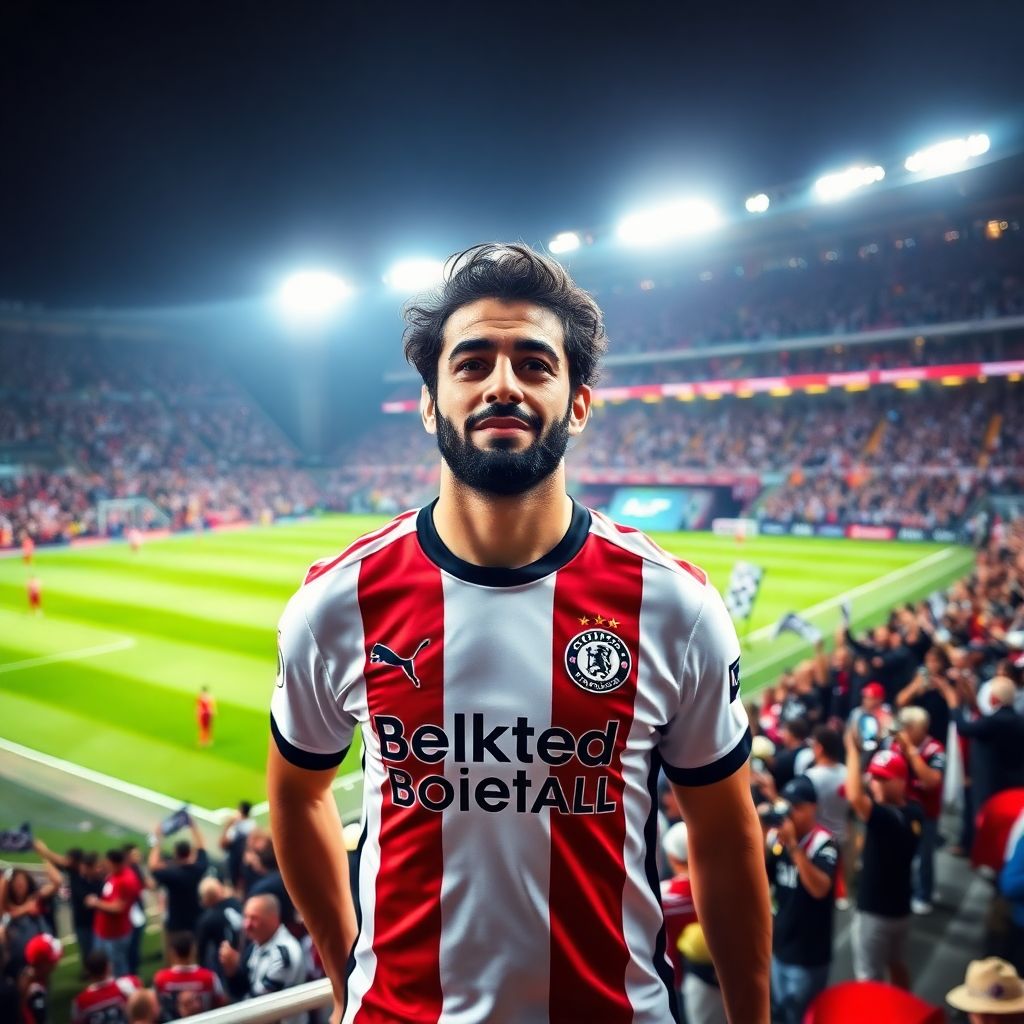
“You Can’t Say No to Mohamed Salah”: Why Beşiktaş Would Change Their Plan for a Once-in-a-Generation Star
Football analyst Erman Yaşar has weighed in on the possibility of Mohamed Salah joining Beşiktaş, describing the Egyptian superstar as a player so special that he could force the club to rethink its entire sporting project. According to Yaşar, Salah does not really fit the original transfer strategy or the tactical roadmap drawn up for the new season, yet the magnitude of his talent makes it almost impossible to turn down such an opportunity.
A Transfer That Breaks the Blueprint
Yaşar underlines that Salah would be a “two-sided transfer” for Beşiktaş: both a blessing and a challenge. From the perspective of the current transfer operation, Salah is not exactly the type of profile around which Beşiktaş were building. The club had mapped out a different structure, and most of their moves so far have been aligned with a specific long-term vision.
He questions whether, if the possibility of signing Salah had been on the table earlier, Beşiktaş would have even gone after Leandro Trossard. In his view, the very existence of such a chance completely reshapes priorities. When a player of Salah’s caliber suddenly becomes available, every other deal is automatically reconsidered, no matter how carefully it was planned.
The Trossard-Salah Dilemma on the Wings
One of the key points in Yaşar’s analysis is tactical. He notes that forming a wing duo of Trossard and Salah may not be the ideal setup for Vincenzo Italiano’s preferred style. Italiano is known for an aggressive, high-pressing game, where both wingers are expected to defend intensely, contribute to pressing triggers, and maintain structure without the ball.
With Trossard and Salah on the flanks, Yaşar suggests that deploying Italiano’s “signature football” becomes much more complicated. To make it work, the center-forward would need to press like a machine, and the midfield would have to sustain an extraordinary level of intensity. In other words, the rest of the team would be forced to compensate heavily for the defensive trade-offs that come with fielding two offensively oriented wide men.
A Star Who Forces You Off Your Planned Path
Despite these tactical doubts, Yaşar openly admits that Salah is the kind of player who can pull a club away from its carefully charted path. Beşiktaş have a plan, a style, and a recruitment profile they are trying to stick to, but some footballers are simply powerful enough to bend the entire project around themselves. Salah, in his eyes, is exactly that type of footballer.
So the key question becomes: Is Salah worth abandoning or at least modifying your initial route? Yaşar’s answer is unequivocal: yes, you step off that path. Any concerns or reservations come second once the name on the table is Mohamed Salah. You take the risk, you accept the disruption, and you try to make the best possible structure around him.
“You Take the Mohamed Salah Risk”
Yaşar describes the potential move as a calculated but necessary risk. Salah would bring global visibility, unmatched experience at the highest European level, and a proven track record of goals and assists. A transfer of this magnitude, especially if announced after the Trossard deal, would instantly turn Beşiktaş into a headline club across Europe.
However, this comes with a heavy responsibility for the club’s executives. By committing to Salah’s wages, status and role, Beşiktaş would be publicly signaling that the short-term objective is not just improvement, but titles. The room for “transition season” excuses would practically disappear.
The Championship Obligation
According to Yaşar, if Beşiktaş decide to bear Salah’s financial and sporting cost, there is an implicit obligation attached: at least one league championship in the period where Salah is still at or near his peak. He estimates that the club would get a maximum of two high-impact seasons from the Egyptian star. Within that window, anything less than a serious title challenge would be viewed as a failure.
Even in a scenario where the team cannot clinch the title in the first year, the expectation would be crystal clear: a season spent very close to the top, followed by a championship in the next campaign. In other words, Salah’s arrival would reset the bar for what constitutes success at Beşiktaş.
How Salah Would Change Beşiktaş on the Pitch
From a tactical standpoint, Salah would likely redefine Beşiktaş’s attacking identity the moment he steps onto the pitch.
– Primary reference in attack: He would immediately become the main outlet in the final third, with build-up patterns often designed to find him in space on the right or in central channels.
– Defensive adjustments: The team would probably shift its pressing structure to protect Salah’s energy in key zones, asking other players-especially the central midfielders and the center-forward-to cover more ground.
– Positional flexibility: While best known as a right winger cutting inside onto his left foot, Salah’s experience as a second striker or even central forward gives the coach multiple options for shape and rotations.
– Set-piece threat: His presence would add another high-level option for direct free-kicks and penalties, further boosting Beşiktaş’s expected goal output.
This transformation would not necessarily fit perfectly into Italiano’s first sketches for the season, but high-level coaches are often judged by their ability to adapt their game model to exceptional individuals. Salah would be exactly that type of challenge.
Can Italiano Say “No” to Salah?
Yaşar admits that Vincenzo Italiano might struggle, at least initially, to fully integrate Salah into the tactical puzzle in his head. The Italian coach’s system is heavily based on structure, synchronised pressing and collective responsibility. Salah, by contrast, is a high-usage attacking star around whom play naturally gravitates.
Yet even with those doubts, Yaşar insists there is no realistic scenario where a coach in Italiano’s position simply refuses a chance to work with Mohamed Salah. Even if the fit is not perfect, you trust your own capacity as a manager to tweak details, adjust the pressing triggers and modify certain roles to accommodate a world-class player.
The Pressure of Saying “No” in Turkish Football Culture
Another dimension Yaşar highlights is the intense public and media pressure in Turkey. If Beşiktaş had a realistic chance of signing Salah and the club-or the coach-chose to pass on it, results would instantly become the only shield they have.
He emphasizes that if you turn down Salah and then, within five league weeks, suffer two defeats, the criticism would be relentless. The decision-makers would be “torn apart” in debates and coverage, not because it would necessarily be objectively wrong to say no, but because the narrative would be unforgiving: you refused a global star and failed to dominate.
In that environment, any coach who declines a player like Salah would need to win game after game, almost flawlessly, to justify such a stance.
Trossard’s Role If Salah Arrives
A major talking point flowing from Yaşar’s comments is what happens to Leandro Trossard if Salah does sign. The Belgian winger was initially brought in as a key piece, presumably to be one of the pillars of the new attacking structure. With Salah in the mix, Trossard’s role would have to be reconsidered:
– He might move from being the main attacking star to a complementary figure.
– The coaching staff could explore using him in multiple roles-left wing, attacking midfielder, or even as a false nine in certain systems.
– His minutes and tactical importance would depend on how effectively Italiano can balance creativity, defensive work and positional discipline across the front line.
Rather than making Trossard redundant, Salah’s arrival could push him into a more flexible, dynamic role-provided the dressing room chemistry is managed correctly and roles are clearly communicated.
Squad Building: Short-Term Stardom vs Long-Term Plan
The potential Salah transfer forces Beşiktaş to confront a classic football dilemma: should you prioritise long-term structure or seize a short-term opportunity for stardom and immediate success? On paper, the club had a coherent path: a system-focused project, signings that fit a pressing-oriented coach, and a gradual climb back to the top.
Salah, however, represents acceleration. He turns a three-year plan into a one- to two-year championship mission. That means:
– The club may need to accept slightly older or more experienced profiles instead of solely focusing on resale value.
– Younger players might get fewer minutes, at least in the short term, as the coach leans on proven veterans around Salah.
– Financial flexibility could be reduced, but commercial visibility and matchday interest would likely surge.
If handled well, those two perspectives-short-term glory and long-term sustainability-do not have to cancel each other out. But it requires clear communication within the club and a realistic understanding of the risks involved.
The Psychological Impact on the Dressing Room
Signing a player of Salah’s stature would also reshape the internal dynamics within the team.
– Hierarchy: A natural hierarchy would form, with Salah immediately at or near the top. Established players must adjust their egos and expectations accordingly.
– Motivation: Many squad members could experience a boost in motivation, eager to prove they can perform alongside a world-class star.
– Responsibility: Leaders in the team would need to ensure that the group does not become over-reliant on Salah, expecting him to solve every game alone.
For a coach like Italiano, the challenge would be to protect the collective mentality while still leveraging Salah’s individual brilliance.
What Salah Would Mean for Beşiktaş’s Image
Beyond the pitch, Yaşar suggests that a post-Trossard announcement of Salah would place Beşiktaş firmly in the international spotlight. The club would go from being a strong regional power to a talking point in global football discussions.
Such a move would:
– Reinforce Beşiktaş’s status as a destination for elite players, not just rising talents.
– Increase attention from worldwide supporters, broadcasters and commercial partners.
– Raise expectations not only domestically but in European competitions, where fans would expect the team to be more than just competitive.
That visibility is valuable, but it is also unforgiving. Big names bring big scrutiny.
The Inevitable Conclusion: You Don’t Turn Salah Down
At the end of his assessment, Yaşar circles back to a simple core idea: you do not refuse Mohamed Salah. Whatever doubts exist about tactical fit, financial weight or project coherence are, in his eyes, outweighed by the rarity of such a chance.
Even if Italiano initially struggles to see exactly how Salah fits into his ideal system, he would still want him. From Yaşar’s perspective, any coach in that situation eventually tells himself: “I will adapt my football around him rather than expecting him to adapt perfectly to me.”
And if, against all odds, the club were to reject this opportunity and then stumble early in the season, the backlash would be fierce. Fair or not, the logic of the football environment is clear: passing on Salah obligates perfection. Accepting Salah gives you a unique weapon-with all the pressure and promise that comes with it.
In the end, that is why Yaşar’s message is so blunt: if you somehow have a realistic shot at signing Mohamed Salah, you take the risk, you reshape your plan, and you live with the consequences. Because in modern football, chances like this almost never come twice.