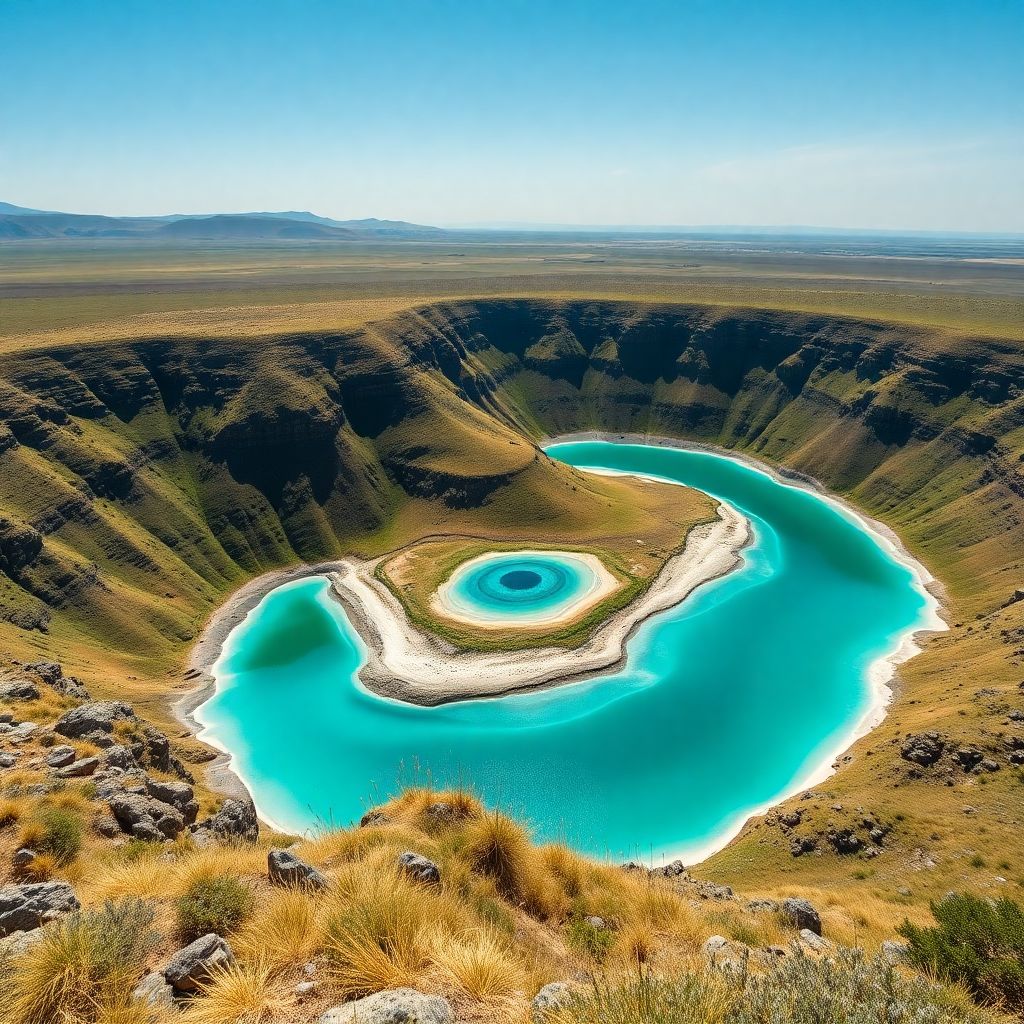
Endless steppe, a turquoise jewel: Kızılçan Lake fills to the brim again
Once on the verge of disappearing, Kızılçan Lake in Türkiye’s Sivas province is now fuller than locals can remember, reclaiming both its water and its famous natural turquoise color. The small lake, often likened to an “evil eye bead” set in the middle of the vast Anatolian steppe, had previously dried up to a critical level and lost much of its distinctive hue due to prolonged drought.
Located near the village of Canova in the Zara district of Sivas, Kızılçan Lake lies about 2 kilometers from the settlement, nestled in a roughly 100-meter-deep natural depression amid seemingly endless grasslands. Its location and striking, naturally turquoise water have long made it a curiosity for travelers and a hidden gem for photographers.
In recent years, however, the picture was far less idyllic. With decreasing rainfall and rising temperatures, the lake receded dramatically. At its lowest point, the water level had dropped so far that much of the basin lay exposed and the once-vivid color had faded into a duller tone. For many locals, it served as a stark visual reminder of the growing impact of climate variability and regional drought.
Everything changed with the last season’s heavy snow and persistent rains. As the snowpack melted and precipitation continued for weeks, the groundwater-fed lake began to rise again. Fed by underground springs, Kızılçan gradually refilled until it reached a level that residents say they have rarely, if ever, witnessed before. Today, the lake is described as “fuller than ever,” with its natural turquoise shade shining back in full intensity.
The transformation is so remarkable that the lake has once again become a magnet for visitors. Aerial footage captured by drone shows a vivid blue-green circle of water set like a gemstone in the brown and yellow tones of the steppe, visually reinforcing its nickname as the “evil eye of the prairie.” From above, the contrast between the lake’s color and the surrounding landscape is even more dramatic, highlighting just how unusual this body of water is in such an arid setting.
Among those drawn back to Kızılçan Lake is visitor Arzu Demir, who has made multiple trips specifically to observe its changing face. She explains that during her earlier visits the waterline had retreated far down the basin and the lake’s color had shifted toward a pale green, far from its famed vibrancy. On her most recent visit, the scene was entirely different: the basin was filled, the water had recovered its original shade, and the lake’s appearance had become, in her words, “truly beautiful” again.
Demir also points out that the exact depth of Kızılçan Lake remains something of a mystery. Locals say its depth cannot be measured easily, adding to the lake’s sense of enigma. Stories circulate about attempts to sound the bottom that yielded no clear result, reinforcing its reputation as a bottomless or immeasurable natural pool nestled in the heart of the plains.
For Sivas, Kızılçan Lake is increasingly viewed not just as a scenic spot, but as one of the province’s most valuable places to visit. Travelers heading to the region often focus on well-known historical and cultural sites, yet this small lake offers a different type of experience: quiet, open space, uninterrupted horizons, and the sudden, almost surreal sight of intense turquoise water in the middle of an otherwise brown and golden landscape.
The lake’s resurgence also raises important questions about environmental change and water management in central Anatolia. Periods of drought had nearly emptied the basin, while a single season of heavy snow and rainfall restored it. This fragile balance underscores how dependent such natural features are on yearly precipitation and how quickly they can shift from abundance to scarcity.
Local observers note that the return of the water has temporarily eased concerns about the lake’s future, but they also emphasize the need for long-term thinking. Protecting the surrounding ecosystem, preventing pollution, and monitoring regional climate trends are seen as crucial steps to ensure Kızılçan Lake remains a living landscape rather than a fading memory on old photographs.
Ecotourism advocates argue that the lake could become a model for low-impact natural tourism in the region. Simple walking paths, carefully planned viewing points, and educational signage explaining the lake’s geology and hydrology could enrich the visitor experience without overburdening the fragile environment. Birdwatchers and nature photographers, drawn by the lake’s setting on the open steppe, could help foster a broader appreciation for the subtle beauty of Anatolia’s interior landscapes.
Seasonality also plays a major role in how Kızılçan Lake presents itself. In spring, as the surrounding steppe greens and wildflowers begin to appear, the turquoise water is framed by soft, fresh colors. Summer often brings a harsher, sun-bleached palette to the surrounding land, making the lake’s color appear even more vivid by contrast. In autumn, changing light conditions and cooler air give the scene a more melancholic, metallic tone. Even in winter, the lake and its basin can offer striking views, with snow-dusted slopes dropping down to the still, blue surface.
Photographers are particularly fond of early morning and late afternoon visits, when the sun sits lower in the sky and the lake’s color deepens. From different angles, the water can shift from an almost milky turquoise to a deeper blue-green, depending on the light, the wind, and the clarity of the atmosphere. Drone operators, when following responsible flying guidelines, are able to capture views that emphasize the lake’s perfect circular shape and its striking isolation in the surrounding terrain.
For residents of Canova village and the wider Zara district, the refilling of Kızılçan Lake has also had a psychological impact. Where there was previously worry and a sense of loss as the water retreated, there is now renewed pride and attachment. Many speak of the lake as a symbol of resilience: a reminder that nature, when given time and favorable conditions, can sometimes heal or at least temporarily recover.
At the same time, local accounts of the lake’s recent history serve as a cautionary tale. The dramatic fluctuation between near-dryness and overflowing fullness in such a short time frame highlights the volatility of contemporary weather patterns. It has become a tangible, local example of broader global discussions about changing climates, water scarcity, and the importance of preserving unique landscapes before they cross a point of no return.
Visitors who make the journey to Kızılçan Lake typically combine it with stops in nearby villages and natural areas, turning a short outing into a full-day exploration. The journey itself contributes to the overall experience: driving or walking across wide, open plains, with distant hills on the horizon, only to suddenly encounter a radiant oval of turquoise set into the earth. That contrast – between monotony and surprise, dryness and water, muted colors and bright blue – is a large part of the lake’s enduring appeal.
As word spreads again about Kızılçan’s renewed beauty, more travelers are likely to seek out this secluded spot. The challenge for the coming years will be to welcome visitors while keeping the lake’s environment intact, so that the “evil eye bead” of the boundless steppe can continue to shine for generations to come.
Powerful earthquake in the Philippines
While Kızılçan Lake in Türkiye experiences a revival, another part of the world has faced a sudden and violent reminder of nature’s power. The United States Geological Survey reported a major earthquake of magnitude 7.8 in the Philippines, striking the Mindanao region.
According to the agency’s data, the quake was recorded in the province of Sarangani, in the Soccsksargen region. The epicenter was located approximately 26 kilometers southwest of the municipality of Kablalan, at a depth of about 55.2 kilometers below the earth’s surface.
The strength and depth of the earthquake triggered concern across the region and led to the issuance of a tsunami warning. Authorities and monitoring centers began assessing potential impacts along nearby coasts and advising residents in vulnerable areas to remain alert and follow official instructions.
Events like this highlight the diverse ways in which natural forces shape our world – from the slow, seasonal refilling of a hidden lake on the Anatolian steppe to the sudden release of tectonic energy beneath the Philippine Sea. In both cases, they serve as reminders of how closely human life and natural processes remain intertwined.