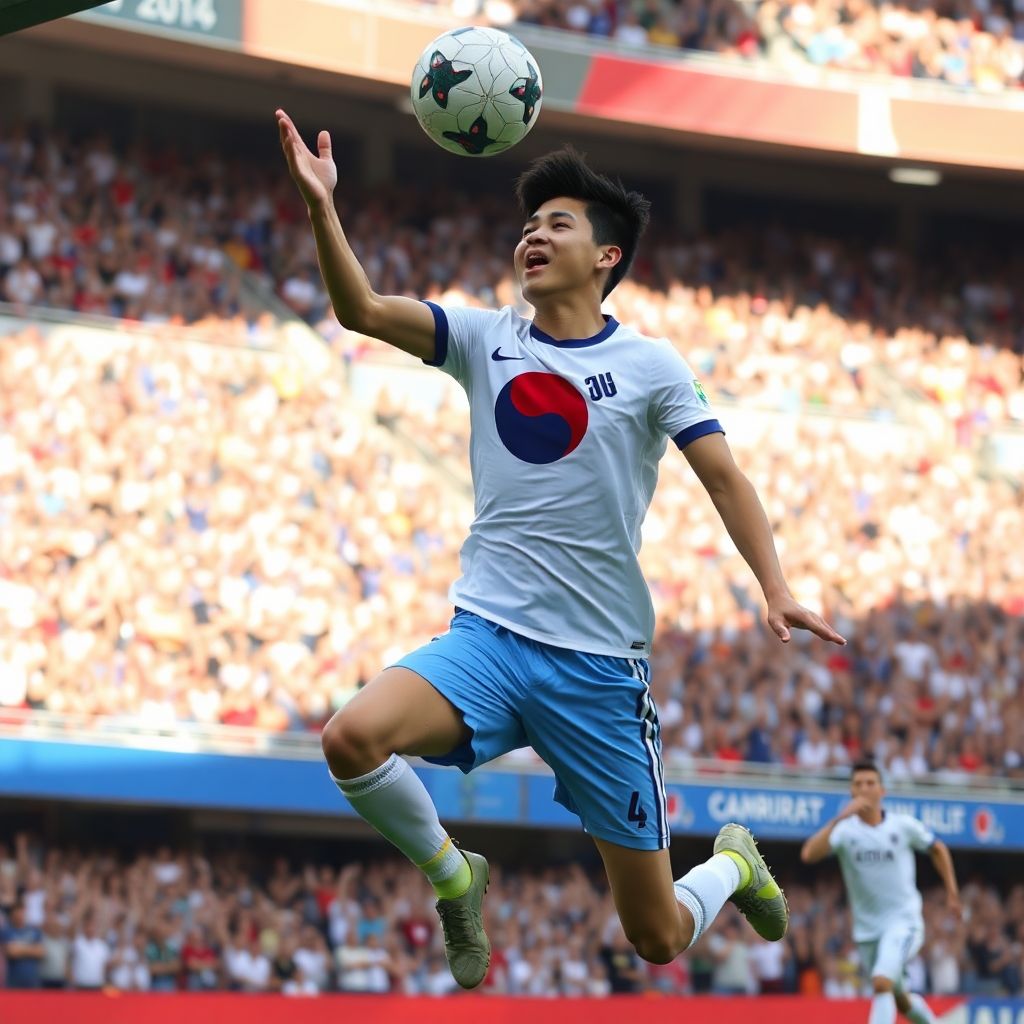
Hyeon-Gyu Oh speaks out after decisive World Cup goal
South Korean forward Hyeon-Gyu Oh, who delivered a dramatic winner against Czechia, shared remarkable details about his physical condition before the match, revealing he had been struggling with a high fever on the very day he became his country’s hero.
The striker came off the bench at the 2026 World Cup and scored in the 80th minute, securing a vital 3 points for South Korea. His late goal not only changed the dynamics of the group but also instantly turned him into one of the key talking points of the tournament.
After the final whistle, Oh admitted that he had felt far from ready in the build-up to the clash.
According to his own words, it was “a feeling that is hard to describe in words.” He explained that, ahead of the game, he had been in poor physical condition and was genuinely unsure whether he would even be able to take part. His body temperature had climbed to 38 degrees, forcing the medical staff to work intensively to stabilize him in time.
Oh highlighted the role of the team’s doctors and support personnel, stressing that without their dedicated care he might not have stepped onto the pitch at all, let alone found the net.
“Before today’s match, I really wasn’t feeling well. My fever went up to 38 degrees. I was seriously wondering whether I could play,” he said. “Thanks to the commitment of all the staff and doctors here, I was able to get on the field and even score a goal.”
From doubt to decisive moment
The forward’s story adds a dramatic layer to what was already a tense World Cup meeting. Entering the game as a substitute, he needed just one key moment to make the difference. His finish in the 80th minute gave South Korea a narrow but priceless victory over Czechia and significantly improved their chances of advancing from the group.
Mentally, the turnaround was just as significant. Hours earlier, Oh had been questioning his ability to compete at all. By the end of the night, he had produced one of the most memorable contributions of his international career.
Performances like this often become defining episodes for a player’s reputation, especially on the World Cup stage, where every minute is watched by a global audience and every goal can transform a career.
Turkish interest: Beşiktaş monitoring the Korean striker
While Oh’s heroics made headlines around the world, his name was already familiar to those following transfer discussions in Turkey. Within Beşiktaş, squad planning for upcoming seasons is taking shape, and the club has been consistently linked with foreign-based talents, including emerging attacking players like Hyeon-Gyu Oh.
Beşiktaş, in search of a reliable centre-forward to lead the line, has evaluated a range of options, from established European names to rising prospects. In that context, Oh’s World Cup performance naturally pushes him further onto the radar of clubs looking for dynamic forwards who can change a game from the bench and potentially grow into a starting role.
Debate around his level: starter or impact substitute?
Among fans and observers, opinions about Oh’s current level are mixed. Many see him as a hardworking, disciplined and well-mannered professional, someone whose mentality and attitude are beyond question. His movement, energy and willingness to press make him an attractive option for teams that demand intensity from their attackers.
At the same time, some voices argue that, for clubs with high ambitions and pressure to compete for titles every season, these qualities alone are not enough. They question whether Oh already has the complete skillset and consistency required to become the undisputed first-choice striker. In their view, he profiles more as a strong rotation player or a powerful substitute who can inject energy in the final stages of matches.
Others take an even more skeptical stance, labeling him a fairly average player who still has a great deal to prove against top defenses in Europe’s most competitive leagues. From this point of view, a big club taking him as its main number nine would be taking a considerable risk.
Comparison with other striker targets
The discussion around Oh often comes with comparisons to other forwards who are seen as more ready-made solutions for a club like Beşiktaş. Names such as Mateta, Vlahović or Kean are frequently mentioned as examples of strikers who already combine physicality, finishing ability and experience at the highest level.
In that hierarchy, Oh is often projected as someone who, at this stage, would realistically arrive as a backup. Supporters who appreciate his qualities tend to position him as a second-choice striker who can cover multiple roles in attack, come off the bench with fresh legs, and attack tired defenses.
Such a role is not necessarily a negative one. Modern football increasingly relies on deep squads and impact substitutes; some of the most memorable goals in major tournaments and title races are scored by players who start the match on the bench but change everything when called upon. Oh’s performance against Czechia is a perfect illustration of that archetype.
Market value after the World Cup
One of the inevitable consequences of a standout display on the World Cup stage is a rapid rise in a player’s perceived market value. Among fans and analysts, there is already speculation that if Oh maintains this level throughout the tournament, his transfer fee could multiply.
There are suggestions that a strong World Cup might push his price into a range that would once have seemed unrealistic for a player of his profile. While numbers like 50 million euros are clearly at the optimistic end of the spectrum and depend on many factors – consistency, opposition strength, club finances, and contract length – the principle is clear: global tournaments are shop windows, and Oh has just placed himself under a very bright spotlight.
From the perspective of any current club he is contracted to, such a scenario would be ideal: a player developed and trusted internally suddenly becomes a major asset in the transfer market. For a buying club, however, it significantly complicates calculations about value for money and long-term planning.
Tactical profile: what does Oh actually offer?
Beyond the emotional story of playing with a fever and the hype around his World Cup goal, it is important to understand what Hyeon-Gyu Oh brings tactically:
– Work rate and pressing: He is known for his willingness to lead the press, harassing central defenders and defensive midfielders. For coaches who prefer proactive, high-intensity football, this is a crucial attribute.
– Physical presence: While not the most imposing striker in the world, he uses his body well, can hold up the ball and link play, and is difficult to knock off balance when receiving under pressure.
– Movement in the box: His goal against Czechia highlighted his sense of timing and positioning. He tends to attack the right spaces rather than rely solely on speed or physical duels.
– Versatility in attack: Oh can operate as a lone striker in a 4-2-3-1 or 4-3-3, but can also work in a two-man forward line, pairing with a more traditional target man or a second striker.
These traits make him an attractive candidate for clubs that want depth in attack, especially where the system demands both defensive contribution and dynamic off-the-ball movement from the central forward.
Is he ready to be a main striker for a club like Beşiktaş?
This is the central question underlying much of the debate. On one side, his mental resilience – showcased by playing through illness and still delivering in a decisive moment – suggests he has the character needed to handle pressure. His willingness to work for the team and his ability to influence matches even as a substitute are further strengths.
On the other hand, the leap from being a promising, impactful player to becoming the standard-setting number nine for a club with title aspirations is enormous. It requires consistency over an entire season, a reliable scoring record, and the ability to perform in high-pressure derbies and European nights.
At present, a balanced view would be that Oh is at an important but intermediate stage of his development. He is clearly capable of big moments and could be an excellent rotation option or second striker in a competitive squad. Whether he grows into a main striker at a top club will depend on his next few seasons: his club choice, coaching, adaptation to higher-tempo leagues, and his own capacity to refine his finishing and decision-making.
Mentality and professionalism
One aspect rarely in doubt is Oh’s professionalism. Stories of him agreeing to play despite being ill, accepting a bench role without visible frustration, and still performing when called upon, shape an image of a player with a strong mentality and team-first attitude.
Coaches often stress that talent alone isn’t sufficient at elite level. Mindset, discipline and the ability to cope with adversity are equally decisive. Oh’s decision to play through discomfort at the World Cup, trusting medical staff and focusing on contributing in whatever way he could, reflects qualities that many managers value highly when building a squad culture.
Symbolic gestures and connection with fans
After scoring his crucial goal, observers noted that Oh appeared to strike a celebratory pose reminiscent of the “eagle” stance often associated with Beşiktaş. Whether intentional or coincidental, such moments inevitably fuel speculation and emotional connections among fans who are eager to see symbolic signs of affinity.
Even if the celebration had no specific club reference, it helped to underline another key element: Oh is starting to build a personal brand on the big stage. Iconic celebrations and emotionally charged images can remain in supporters’ minds for years, adding to a player’s appeal beyond pure statistics.
What comes next for Hyeon-Gyu Oh?
For now, Oh’s immediate focus will remain on the World Cup. Maintaining his physical condition after overcoming a high fever, continuing to respond when given minutes, and possibly adding to his goal tally will be crucial both for his national team and for his own career trajectory.
After the tournament, attention is likely to shift to his club situation and potential transfers. If interest from clubs like Beşiktaş intensifies, he will face an important decision: stay in a familiar environment and build steadily, or take a risky but potentially career-defining step to a bigger stage with higher expectations.
Whatever path he chooses, the night against Czechia – when he turned illness into inspiration and delivered a winning goal for his country – will remain a milestone in his story. It has already changed how he is perceived internationally and ensured that his name will feature prominently in transfer discussions and tactical debates in the months to come.