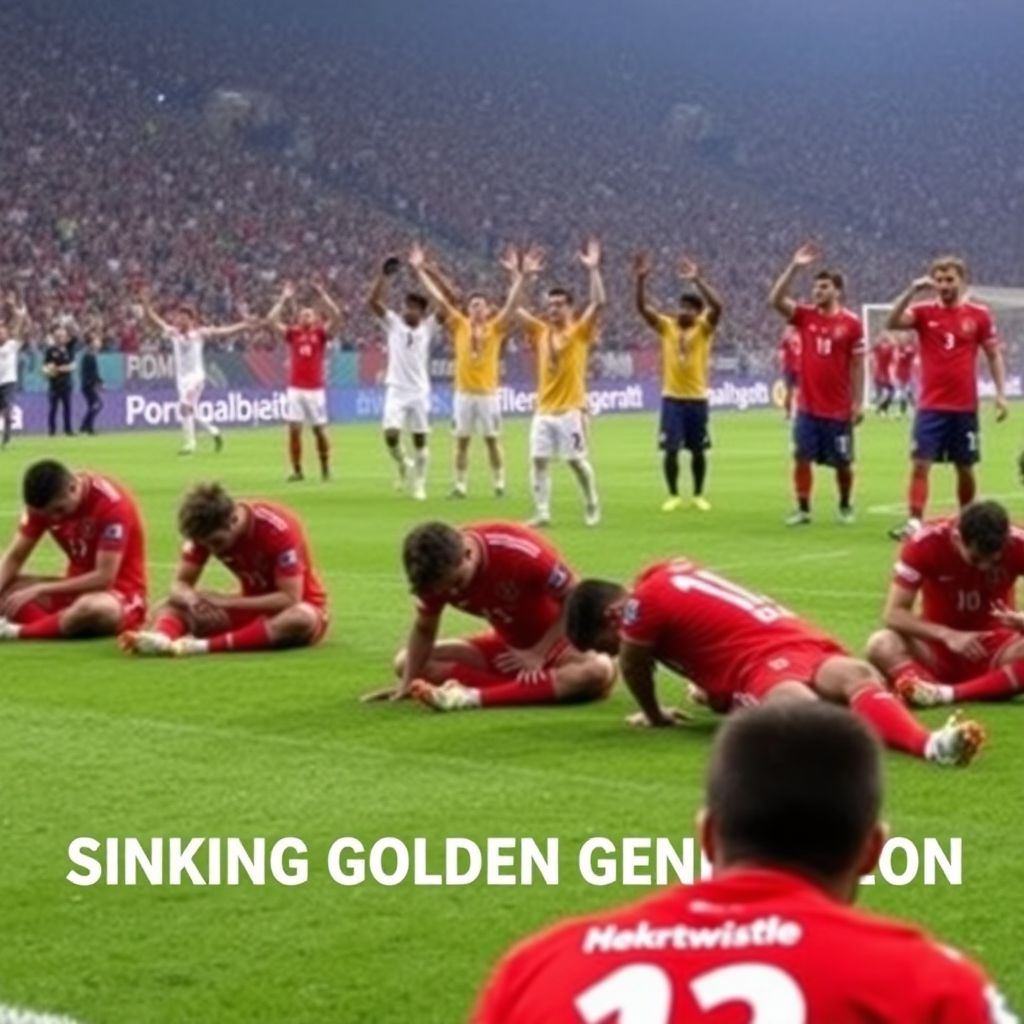
“Golden generation has sunk!” Turkish national team mocked worldwide after Paraguay shock
Dreams of a historic World Cup run for Turkey have turned into a nightmare. Traveling to the tournament with huge expectations and a squad widely described as a “golden generation”, the national team crashed out of the group stage after a painful 1-0 defeat to Paraguay.
The result itself was bad enough, but the manner of the exit made it even worse. Despite producing a total of 62 shots during the group phase, Turkey failed to score a single goal. That astonishing statistic became the main headline across international media, which branded the team as “toothless Turkey” and “the sinking golden generation”. For a squad packed with players starring in top European leagues, the criticism has been unforgiving.
A shock exit: Paraguay defeat seals early elimination
The decisive blow came against Paraguay. Turkey needed at least a win to keep their hopes alive, but instead they succumbed to a narrow 1-0 loss. Montella’s side once again dominated possession, created half-chances and set up promising positions around the box, but lacked composure and clarity in the final third.
Paraguay, by contrast, were patient and pragmatic. They absorbed pressure, waited for Turkish mistakes, and struck clinically when the opportunity arrived. After conceding, Turkey’s frantic attempts to respond degenerated into rushed long shots and chaotic attacks. The final whistle didn’t just end the match – it effectively ended Turkey’s World Cup adventure.
“62 shots, 0 goals”: a damning global narrative
Global outlets focused on one brutal number: 62 shots, 0 goals. For many neutrals, this became the symbol of Turkey’s campaign – a team full of talent but empty in execution. Commentators spoke of a side that looked impressive on paper yet failed to translate its potential into results.
Headlines described Turkey as a “blunt weapon”, a team that could reach the edge of the penalty area but suddenly ran out of ideas. The phrase “golden generation” started to appear in sarcastic quotation marks, with pundits arguing that reputations alone cannot win matches.
Vincenzo Montella on the brink
The main target of domestic criticism is head coach Vincenzo Montella. Reports suggest he is almost at the point of resignation, with federation officials already considering alternatives. Internally, questions are being asked about nearly every aspect of his management:
– Conservative substitutions in must-win games
– Reluctance to adjust the tactical system when it clearly wasn’t working
– Persistent trust in out-of-form players
– Failure to build a stable structure around the key stars
Montella’s calm, almost fatalistic tone in press conferences – often summed up by the notion that “what is written will happen” or “there is no road beyond fate” – has been perceived by many fans as a kind of “learned helplessness”. This spiritual, resigned attitude has clashed with a public demanding urgency, accountability, and visible anger after such a collapse.
Hakan Çalhanoğlu’s honest admission and a rare first
Captain Hakan Çalhanoğlu did not try to sugarcoat the situation. In post-match interviews he admitted that the team simply failed to rise to the occasion, acknowledging that with this level of talent, an early group-stage exit is unacceptable. His candid words reflected a dressing room that understood the magnitude of the disappointment.
The Paraguay match also saw an unusual first for Turkey at this level: an immediate red card flashed early in the game. The dismissal changed the entire tactical landscape, forced Montella into emergency adjustments and left Turkey chasing the game with numerical disadvantage. Even so, many argue that a team of this quality should be able to react, reorganize and still pose more threat than what was on display.
Misused squad and unanswered selection questions
The squad list itself has become a subject of debate. One of the hottest talking points is Deniz Undav. Critics argue that a forward in such form at club level should have been integrated more centrally into the attacking plan. The question echoes everywhere: could he really not have been persuaded, trusted or tactically accommodated?
Another contentious topic surrounds Arda Güler’s “double” – the back-up profile that was supposed to offer similar creativity and unpredictability. Why was that player ultimately not used or not even present when needed most? Rumors about travel issues and missed flights, including talk about an American connection, only fuel the perception of chaos and poor planning.
Stars under scrutiny: Kerem Aktürkoğlu and others
Kerem Aktürkoğlu, one of the brightest domestic-based stars, visibly suffered on the pitch. Repeatedly isolated on the wing and crowded out by two or three opponents, he struggled to make any meaningful impact. Cameras captured his frustration, while Montella remained passive on the touchline, rarely adjusting the structure to give him support or to free him from constant double-teams.
This pattern was typical of the entire campaign: individual talents trying to solve systemic problems alone. Without clear automatisms, rehearsed patterns of play or coordinated pressing, even the most gifted players looked ordinary, spending more time fighting the game state than exploiting their strengths.
Goalkeeping debate reignites: where is Berke Özer?
The goalkeeper situation has also become a flashpoint. Some fans have been asking: “Where is Berke Özer?” – a symbol of the lost or underused potential in this generation.
Instead, Uğurcan Çakır took the role between the posts and delivered a personal positive record of “3 out of 3” in terms of his performance ratings, making several crucial saves and often keeping the scoreline respectable. For many observers, the problem was never in goal; it was the broken structure in front of him and the inability of the attack to convert chances that doomed the campaign.
Fenerbahçe angles and domestic pressure
At club level, the fallout has also reached Fenerbahçe’s orbit. Ederson, heavily linked with the club, is said to have cooled on a move, while names like Aziz Yıldırım and Nathan Aké pop up in debates over transfer strategy and future squad building.
Sarunas Jasikevicius and Dusan Alimpijevic, figures from the basketball side, have spoken about “real character” and “a beautiful feeling” after their own successes, creating a sharp contrast with the atmosphere around the football team. This comparison only intensifies the sense that Turkish football is failing to follow the professional, winning culture that other branches of Turkish sport are starting to embody.
The federation under fire: elections on the horizon
The crisis has inevitably reached the Turkish Football Federation. Rumors suggest that Yıldırım Demirören’s successor framework is under strong pressure and that a change in leadership has become almost unavoidable. The phrase “his water is boiling” has been used to describe the precarious position of key officials, hinting that their time in charge may be coming to an end.
Calls for early elections at the federation are growing louder. Fans and experts demand a long-term project, transparent planning, and a coherent philosophy from youth development to the senior national team. Without structural reforms, many fear that another “golden generation” will simply be wasted.
Montella’s future and contract question marks
Montella’s contract terms have become a topic of intense speculation. Figures around his potential compensation have been widely discussed, accompanied by suggestions that he might even remain abroad and not return to continue in his role.
At the same time, there is talk that the federation has been hesitant to extend certain deals precisely because of this tournament. Was the delay in contract renewal a deliberate attempt to keep options open in case of failure? With the “batan Altın Jenerasyon” narrative now dominating headlines, changing the coach seems almost inevitable unless a radically convincing plan is presented.
Other nations move forward as Turkey stands still
While Turkey stumbles, other teams in the group are writing a very different story. Morocco climbed to the top of their group, placing Scotland in a difficult situation and showcasing the benefits of clear identity and continuity in coaching. Brazil, meanwhile, continued to collect wins, sending Haiti home and underlining once again that pedigree, when combined with structure and discipline, still counts at this level.
These contrasts are harsh reminders that talent alone is not enough. Organization, tactical flexibility, long-term planning and mental resilience all must come together – otherwise “golden generations” turn into golden disappointments.
What needs to change for Turkey?
The collapse invites deeper questions that go beyond one coach or one tournament:
1. Clear football philosophy – Turkey needs a defined style that runs from youth teams to the senior side, allowing players to grow into a familiar system rather than improvising every few years under a new coach.
2. Better use of attacking talent – Forwards and creative midfielders must be integrated into structures that generate high-quality chances, not just hopeful long shots.
3. Mental preparation – The team too often looks paralyzed in key moments. Psychological preparation, leadership training and coping mechanisms for pressure games are crucial.
4. Transparent selection criteria – Debates about who was called up, who stayed home and why must give way to a merit-based, clearly communicated approach that reduces speculation and frustration.
5. Federation reform – Stability and competence at the top are necessary to support any long-term project. Without it, every new coach will be another short-term experiment.
Beyond the wreckage of a “golden” dream
Turkey’s World Cup story this time will be remembered not for glory, but for a painful paradox: a generation described as golden, finishing its journey at the bottom of the group, goalless despite dozens of attempts, and ridiculed across the footballing world.
Yet football history is full of teams that learned from humiliation. The question is whether Turkey will use this moment as a turning point or simply move on, change a few names, and repeat the same cycle. If this truly is a golden generation, it deserves more than a headline about sinking – it deserves a structure, a vision, and a plan that finally matches its talent.