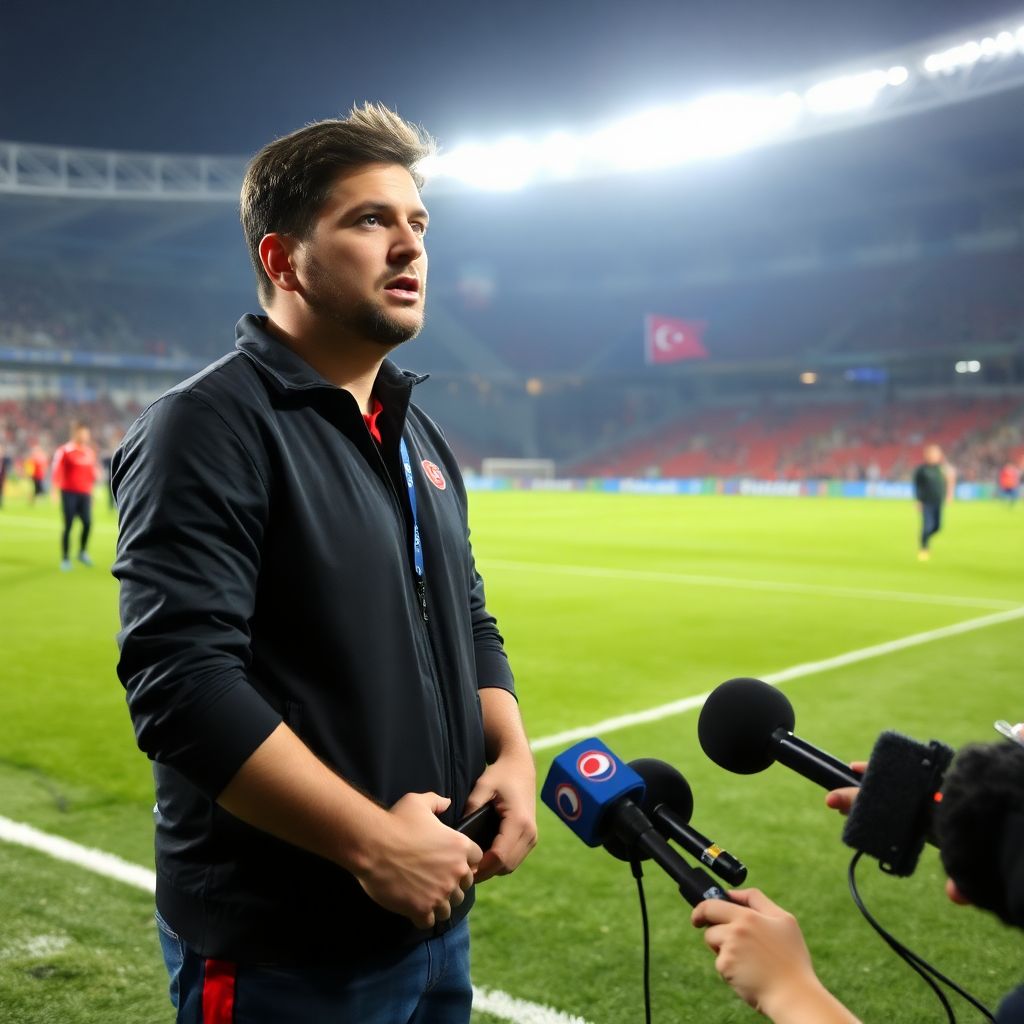
Ferdi Kadıoğlu: “We’ll bounce back” – Turkish national team under fire after Australia defeat
Turkish international Ferdi Kadıoğlu spoke after the 2-0 defeat to Australia at the 2026 FIFA World Cup, delivering a clear message: despite the disappointment, the squad is determined to recover and respond in the next matches. His short but pointed statement, “We will regroup,” has become the symbol of a team trying to shake off both the scoreline and the rising wave of criticism.
“We will recover” – Ferdi’s message after a bitter night
Kadıoğlu did not hide his frustration with the result, but focused on the future rather than excuses. According to him, the performance on the pitch did not reflect the team’s true quality. The players, he stressed, are aware of what went wrong and are ready to correct it:
– They conceded at key moments when concentration should have been at its highest.
– The team failed to find the right rhythm between defense and attack.
– Decision-making in the final third was rushed and predictable.
Ferdi underlined that the most important task now is mental: to stand up, take responsibility, and show that this match was a setback, not a verdict on the team’s overall potential.
Merih Demiral: “Sometimes it just doesn’t happen”
Defender Merih Demiral summed up the mood with a sentence that quickly echoed around Turkish football: “When it doesn’t happen, it just doesn’t happen.” Behind that simple phrase lies a recognition that football is not only about tactics and quality, but also about moments and momentum. Demiral admitted that the team made individual and collective mistakes and that these errors were punished ruthlessly by Australia.
He pointed out that:
– The defensive line lost its compactness at critical times.
– The communication between defenders and midfielders was not sharp enough.
– Australia exploited gaps with efficiency and physical power.
Demiral’s words reflected a sense of regret, but also an awareness that continuing to dwell on the loss will only deepen the psychological blow.
Captain’s verdict: “We conceded avoidable goals”
The captain of the side focused on the nature of the goals conceded: unnecessary, preventable, and the product of lapses that have been discussed many times before. According to him, Turkey did not lose simply because Australia was superior for 90 minutes, but because Turkey helped them with cheap mistakes.
He highlighted that:
– The team switched off in transitions, especially when losing the ball.
– Second balls and rebounds were often won by opponents.
– Defensive discipline waned whenever the team pushed numbers forward.
The captain also stressed that this pattern has appeared in previous matches, turning it from an accident into a worrying trend.
Kerem Aktürkoğlu: taking responsibility on his shoulders
Kerem Aktürkoğlu openly accepted his share of the blame. He admitted that his decisions in the final third were not sharp enough and that he failed to turn promising situations into real danger. In his own words, he must be more efficient, more determined, and more intelligent in his play when the team needs a spark.
Kerem’s gesture of accountability stood out at a time when critics are quick to look for scapegoats. Instead of hiding behind tactical discussions, he placed himself under the spotlight, promising a stronger, more decisive version of himself in the upcoming fixtures.
Montella under scrutiny: “We must keep playing like this”
Despite the 2-0 loss, head coach Vincenzo Montella insisted that there were elements of the performance he was satisfied with. His comment that “we must continue to play this way” raised eyebrows, as many observers felt that the game called for tactical self-criticism rather than optimism.
The main points of contention around Montella were:
– The insistence on a certain possession style even when it does not produce clear chances.
– Late or questionable substitutions that failed to change the flow of the match.
– Selecting players out of their natural positions and expecting them to adapt instantly.
Some argue that Montella prepared “everything we should not have done” in a single match: an unbalanced lineup, experimental roles, and a game plan that did not match the physical nature of the opposition.
The center-forward debate: Kerem is not a striker
One of the loudest criticisms centers on the use of Kerem Aktürkoğlu in a role resembling that of a classic center-forward. Analysts insist that Kerem’s qualities lie in his mobility, his ability to cut inside from wide areas, and his creativity between the lines – not in playing with his back to goal or battling central defenders in the box.
Pushing him into a striker role:
– Weakens his natural strengths.
– Limits Turkey’s ability to create from the wings.
– Makes the attack more predictable, with fewer runs in behind the defense.
The conclusion from many observers is blunt: Kerem is not and will not be a pure number nine, and the team cannot afford to persist with an experiment that clearly does not work.
“We ruined our energy and courage with politics around the team”
Beyond tactics, there is also a growing feeling that off-pitch issues and “political” decisions around the team have affected morale. The phrase “we ruined our energy and courage with a political team” captures the perception that factors other than pure sporting merit may have influenced squad choices and roles.
This criticism is not only about individual call-ups, but about:
– The sense of hierarchy within the group.
– The way some players feel indispensable, while others feel disposable.
– The pressure surrounding certain names, both those who were selected and those who were left out.
Such an atmosphere can erode unity, making it harder for the team to defend and suffer together when under pressure.
The Arda Güler question: “Why didn’t you bring him?”
One of the sharpest questions after the match revolved around Arda Güler and his absence or limited involvement. Many believe that a player with his creativity and vision could have altered the dynamics of a match in which Turkey struggled to break lines and create clear chances.
Whether or not this is entirely fair, it reflects a broader frustration:
– Talented players are seen as underused.
– There is a fear of overprotecting rising stars instead of trusting them on the biggest stage.
– The team seems to lack a true playmaker when the game becomes stuck.
The demand is clear: when you have a player capable of unlocking defenses with a single pass or dribble, you cannot keep him far from decisive minutes.
“Stars are not enough”: Turkey’s exam in world football
The tournament has underlined a hard truth: having a squad full of well-known names, strong in their clubs and praised in the media, is not enough to pass the exam of world football. What is missing is a consistently functioning system that allows these stars to shine together rather than as isolated individuals.
Against Australia, Turkey showed:
– A gap between individual talent and collective coherence.
– Difficulty in adapting the game plan once the team went behind.
– A tendency to rely on heroic individual moments instead of structured attacks.
The question is no longer whether Turkey has good players. It is whether the team can become a unit that reads the game, adjusts on the fly, and controls the tempo against physically and tactically disciplined opponents.
The contrast: transfer market brilliance vs. national team underachievement
One of the more bitter ironies raised in the aftermath is that while the national team stumbles, the transfer activity of Turkish players looks “brilliant.” New deals, rising market values, and high expectations at club level contrast sharply with the drab national team performances.
This gap suggests:
– Players may be more comfortable and better utilized in club systems built around their strengths.
– The national team has yet to find a tactical identity that integrates these different profiles.
– Public expectations, inflated by transfer headlines, collide with the reality of an unfinished project.
The risk is that the national team becomes an arena where frustration accumulates, overshadowing individual progress elsewhere.
Barış Alper Yılmaz: spectacular energy, mixed end product
Barış Alper Yılmaz once again drew attention with his relentless running and fearless duels, reminiscent of the dynamic, all-action style of past Turkish wide players. However, his performance also symbolized the team’s night: enormous effort, limited result.
His display could be summed up as:
– Hairstyle rated “10”, football finishing at “minus 5” – visually impressive, statistically disappointing.
– Constant involvement but inconsistent decision-making in the final phase.
– A sign of passion and commitment, but also of a team that runs a lot without clear patterns of play.
If his raw attributes can be channeled into a more structured attacking framework, Barış could become one of the team’s most decisive weapons. For now, he reflects the energy without direction that plagued Turkey against Australia.
Montella’s blind spot: when the coach stops seeing clearly
Even commentators who previously defended Montella now speak of “a curtain over his eyes.” They argue that he seems attached to ideas and lineups that are no longer justified by performances on the pitch.
Key concerns about his current approach:
– Sticking with out-of-form players while leaving game-changers on the bench.
– Reading the match too slowly, making changes after the momentum has already shifted permanently.
– Confusing “stability” with stubbornness, resisting necessary adjustments in shape and roles.
For the project to move forward, Montella must show that he can question himself as much as he questions his players. Otherwise, the feeling will grow that this team is trapped in a cycle of repeating the same mistakes.
“We will regroup”: from promise to concrete plan
Ferdi Kadıoğlu’s promise to “bounce back” will only carry weight if it is followed by visible changes on the pitch. To turn words into reality, Turkey needs:
– A clearer, more pragmatic game plan that suits the players available.
– Roles that reflect natural positions and strengths, especially in attack.
– A mental reset that transforms frustration into controlled aggression and resilience.
This defeat to Australia does not have to define Turkey’s entire World Cup campaign or its future in international football. It can instead become the turning point that forces everyone – coach, players, and decision-makers – to face uncomfortable truths.
If that happens, Ferdi’s short sentence might become more than a post-match cliché. It could mark the beginning of a genuine revival, where Turkey finally aligns its talent, mentality, and tactics to compete at the level its supporters expect.