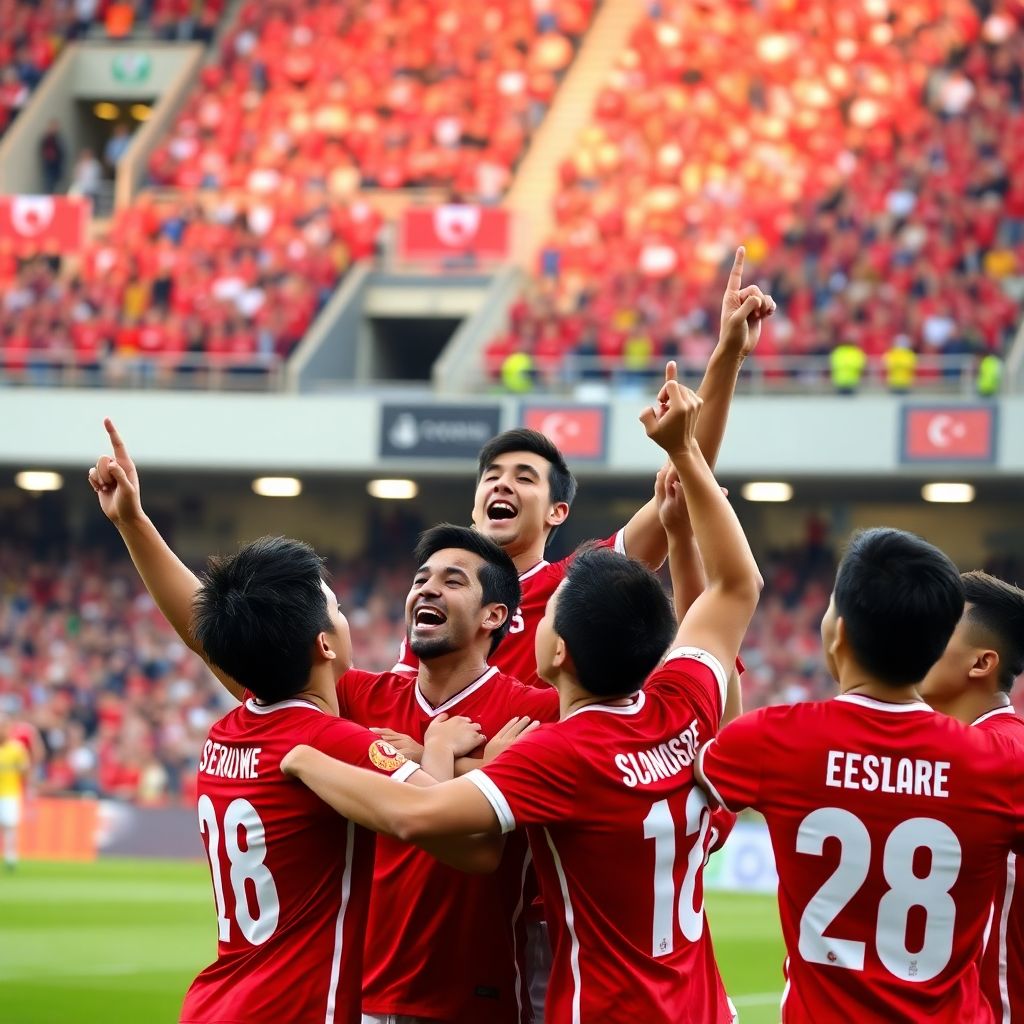
Can, Oğuz, Orkun, Deniz… Names that until recently were footnotes in squad lists are suddenly at the center of a very different story: one of hope, freshness and timing. Against North Macedonia, “our boys” delivered exactly the kind of performance a country wants to see right before a major tournament. It wasn’t just a routine friendly win; it was a statement from the so‑called fringe players to Vincenzo Montella.
The tone was set almost instantly. In the opening minute, Can Uzun announced himself with a thunderous shot that crashed off the woodwork, a warning of what was to come. Moments later, Oğuz Yılmaz carried the ball decisively down the flank and found Orkun Kökçü, who finished clinically. Turkey had barely settled into their shape, and the scoreboard was already pointing in the right direction.
Not long after, it was Can’s turn to finish the move and shake the net. His goal left the Macedonian backline stunned and chasing shadows for a long spell. The early storm, orchestrated by Can and Orkun, did more than give Turkey a lead; it forced the opposition into survival mode and gave Montella a clear reminder of the quality sitting outside his traditional core.
Can Uzun and Orkun Kökçü are not unfamiliar names, but they are undeniably underused ones at national team level. Both have often watched from the sidelines while more established figures were trusted ahead of them. This match felt like a turning point: their collective display was less a polite knock on the door and more a firm bang, a direct message to Montella that they are ready for bigger roles when the real games begin.
The support cast around them deserves mention as well. Until his injury-enforced exit, Eren’s overlapping runs down the wing were relentless, constantly creating overloads. On the opposite side, Oğuz combined power and balance with an impressive ability to use both feet, driving at his marker and stretching the pitch. For a team that has so often relied on quick but one‑footed wingers like Kerem and Yunus, this match reopened a tactical debate: is it time to prioritize physically strong, two‑footed wide players who can go inside or outside with equal danger?
From a structural perspective, a front unit with Can on the left, Oğuz on the right, Orkun between the lines, Arda operating in the pocket behind the striker, and either Kenan Yıldız or Deniz Gül as the spearhead, offers an intriguing blueprint. It’s a setup built on technical quality, positional interchange and youth. Whether Montella fully embraces that configuration is his choice, but the raw material he saw against North Macedonia is too compelling to ignore.
Behind this offensive firepower stood a goalkeeper who quietly did exactly what a tournament keeper must do: inspire calm. Altay Bayındır, often scrutinized at club level, produced one of those saves that linger in memory – a reflex stop from Alioski’s close‑range effort near the end of the first half. It was the kind of intervention that shifts narratives. In a single moment, Altay sent a clear signal: he is ready for the demands of the cup, both mentally and physically.
The second half began with a wave of substitutions. On Turkey’s side, İrfan, Kaan and Samet were introduced; North Macedonia also rotated heavily, testing their depth. Samet naturally slotted into central defence in place of Ozan, while İrfan took over wing duties from Yunus. Up to that point, everything followed the usual friendly script – until Montella tried something unusual: using Kaan Ayhan in Orkun’s advanced role.
That experiment raised eyebrows. Kaan is many things – versatile, disciplined, intelligent – but a like‑for‑like replacement for a creative playmaker he is not. The decision felt odd from a positional logic point of view. Fortunately for Turkey, this curious tweak did not disrupt the rhythm enough to alter the outcome, but it did spark questions about squad hierarchy and substitution patterns when the matches begin to truly matter.
Any tactical doubts were overshadowed early in the second period by another moment from Can Uzun. This time, instead of finishing, he turned provider. His precise cross found Deniz Gül in the box, and Deniz applied a deft, looping header that sailed gently over the keeper and into the net. It was a striker’s finish: calm, calculated, and executed with a soft touch. For a young forward trying to prove he can be more than a bench option, it was invaluable.
When the final whistle blew, the broader picture was clear: just before the tournament, the national team has given genuine reasons for optimism. The squad looks deeper, the competition for places more real, and several previously overlooked players have grabbed their chance. This wasn’t merely a comfortable win; it was a rehearsal that showed chemistry, hunger and tactical flexibility.
Yet the implications of this performance don’t end with the national team. The names that shone – Can, Oğuz, Deniz, İrfan – are also at the center of a much louder conversation around club football, particularly for Beşiktaş. For years, the club has been criticized for slow decision‑making, conservative transfer strategies and a disconnect with its own supporters. Expensive mistakes, short‑term fixes and repeated gambles on fading stars have led to stagnation rather than progress.
In contrast, the players who impressed against North Macedonia represent the exact profile Beşiktaş has often failed to secure in time: young, dynamic, hungry, and still within a financial range that makes sense if approached early. The argument is simple: if you are going to spend significant money, spend it on footballers whose trajectory is upward, not downward.
Take Altay Bayındır as an example. A proven domestic goalkeeper with international experience, still in his mid‑20s, and potentially available under realistic conditions. For a club that has struggled to stabilize its goalkeeping position, hesitating on such a profile is hard to justify. Delay too long, and the door opens for others; suddenly the conversation becomes why Trabzonspor or Fenerbahçe moved quicker.
The same logic applies to names like Salih Özcan or Ozan Kabak. In modern football, securing national‑team‑level domestic players on free transfers or under favorable contracts is a competitive advantage. It reduces foreign quota pressure, stabilizes the spine of the team and raises the squad’s resale value. Ignoring such opportunities isn’t caution; it’s negligence.
Then there is the next tier of talent: players like Aral Şimşir, Can Uzun, Deniz Gül, Oğuz and İrfan. These are not just promising individuals; they are building blocks. Aral, for instance, has the profile to occupy the left wing for a decade – strong, technical, with an eye for goal. Pairing him with a modern, powerful striker such as Franciluno Dju, a young forward who combines the physical presence of a classic target man with mobility and finishing, could reshape Beşiktaş’s attack for years, not months.
When two forwards routinely contribute 50-60 goals and assists together over a season, clubs in major European leagues start circling. Once that level of attention arrives, the price explodes and the window closes. That is why moving for a duo like Aral and Dju as a “package” in the 30-35 million euro band might sound bold, but over a ten‑year span it could prove cheaper than the endless cycle of short‑term stopgaps, failed gambles and mid‑season emergency signings.
If Beşiktaş truly wants to break this cycle, the strategy has to shift now. The squad clearly needs reinforcement in very specific zones: two left wingers to guarantee constant competition, one right winger of genuine quality, a proven centre forward, and at least one midfielder capable of playing both as an “8” and a “10”. Instead of chasing scattered names at the last minute, the club could focus on a coherent core: Can, Aral, Deniz in attack; Oğuz and İrfan on the flanks or as hybrid creators.
Such a recruitment plan does more than fill positions on a tactics board. It changes the identity of the team. A front line built around Can, Aral and Deniz offers goals, versatility and local identity. Adding Oğuz and İrfan increases creativity and balance on both sides of the pitch. These are players who know each other, share language and culture, and can grow together – an underrated factor in building a dressing‑room spine.
There is also the psychological dimension. Supporters have grown weary of seeing the same patterns: delayed negotiations, missed opportunities, and the sense that other clubs are always one step ahead. A transfer window built around bold, targeted moves for rising domestic and young foreign talents would send the opposite message – that the club is awake, alert and thinking beyond tomorrow’s headlines.
Of course, identifying talent is only half the job; trusting it is the other half. The national team’s performance against North Macedonia illustrated what can happen when young players are given real responsibility rather than token minutes. Can Uzun didn’t just decorate the match; he shaped it. Deniz Gül’s header wasn’t an accident; it was the product of a player comfortable enough to take a risk in a key area. Oğuz’s two‑footed aggressiveness changed the geometry of the attack. These are precisely the qualities that clubs must be brave enough to lean on.
For Beşiktaş, the challenge is not just to sign these profiles, but to construct a tactical system that amplifies their strengths. That means wide players who are allowed to attack their full‑backs, a midfield that can support high pressing without leaving the defence exposed, and a striker who can both finish and link play. The national team’s template offers clues: flexible front fours, technical midfielders capable of quick combinations, and full‑backs who support without abandoning defensive duties.
In the end, the message from this match and the broader debate around it converges into a single idea: the future belongs to those who recognize talent early and act decisively. For the national team, that means integrating Can, Orkun, Oğuz, Deniz and others into a genuine rotation, not as late‑game ornaments but as central figures. For Beşiktaş, it means abandoning half‑measures, stepping away from nostalgia‑based transfers and finally building a squad whose prime years lie ahead, not behind.
Right now, the evidence is on the pitch. A new generation is ready. It is up to coaches and club executives to prove they see what everyone else already can: if you are going to invest, invest in players like Can Uzun – footballers who combine talent, mentality and upside. You do not rebuild a club or a national team by dreaming of the past; you do it by recognizing the Rafa‑like figures of tomorrow before the rest of Europe does.