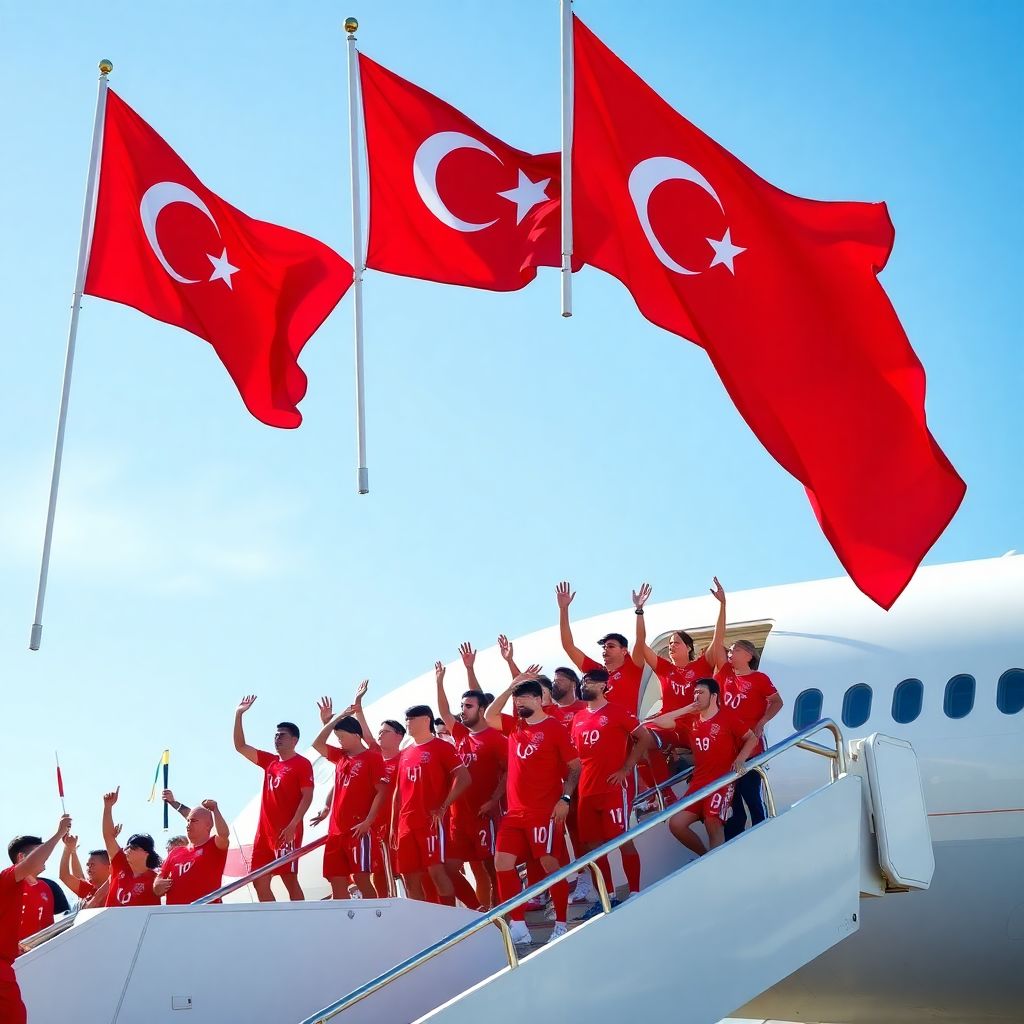
Bizim Çocuklar ready to storm the world: Turkey embark on World Cup journey after 24 years
After nearly a quarter of a century away from football’s biggest stage, Turkey’s national team has officially launched its World Cup campaign. The squad flew to the United States yesterday, marking the beginning of a mission that the country hopes will once again make “Bizim Çocuklar” a global story.
The tournament, hosted jointly by the USA, Canada and Mexico from 11 June to 19 July, will see Turkey compete in Group D alongside the United States, Australia and Paraguay. For a generation that only knows the 2002 bronze medals from highlights and archives, this World Cup is more than a sporting event – it is a chance to write a new chapter.
Final 26-man squad confirmed
The Turkish Football Federation announced the final 26-man squad after head coach Vincenzo Montella cut down an initial expanded list of 35 players. From that preliminary group, the following names did not make the final tournament roster:
– Ersin Destanoğlu
– Mustafa Eskihellaç
– Atakan Karazor
– Yusuf Sarı
– Yusuf Akçiçek
– Demir Ege Tıknaz
– Muhammet Şengezer
– Ahmetcan Kaplan
– Aral Şimşir
However, the story for some of them does not end there.
Standby players travel with the team
In line with World Cup regulations, which allow squads to replace injured players before their first match (and goalkeepers even during the tournament), the Federation confirmed that three names from outside the official 26 have nonetheless travelled with the delegation to the USA.
Goalkeeper Muhammet Şengezer, midfielder Demir Ege Tıknaz and attacking player Aral Şimşir have joined the team in Fort Lauderdale as standby options. They will train with the group and stay ready in case injuries force late changes to the official list. This approach gives Montella extra flexibility while maintaining cohesion in training sessions.
Emotional send-off from Riva to the airport
Following the final squad announcement and last training sessions at the Hasan Doğan National Teams Camp and Training Facilities in Riva, the national team was sent off with a ceremony befitting the scale of the occasion.
The team bus departed the complex in a convoy and made its way to Istanbul Airport, accompanied by a celebratory escort. At the terminal, the crescent-and-star delegation was welcomed with flowers, while a band created a festive atmosphere that underlined how much this World Cup means to the country.
After the brief ceremony, the players and staff boarded a specially arranged flight bound for Fort Lauderdale, their base in the United States during the tournament build-up.
Last friendly before the World Cup: Venezuela test
Before stepping into the World Cup spotlight, Turkey will play one final preparation match. The national team face Venezuela on Sunday, 7 June, at Inter Miami Stadium. Kick-off is scheduled for 01:00 (Turkish time).
This final friendly is expected to serve as a dress rehearsal: Montella is likely to test his preferred starting XI, fine-tune pressing schemes and possession patterns, and make last adjustments in set-piece routines. For players still fighting for a place in the first team, it will be an invaluable final opportunity to convince the coaching staff.
Club breakdown of the national team squad
The 26 selected players offer a balance between domestic league talent and stars based abroad. The distribution by club is as follows:
From the Turkish Süper Lig – 15 players
– Galatasaray: 6 players
– Fenerbahçe: 7 players
– Beşiktaş: 1 player
– Çaykur Rizespor: 1 player
From foreign clubs – 11 players
– Real Madrid: 1 player
– Juventus: 1 player
– Inter: 1 player
– Roma: 1 player
– Brighton: 1 player
– Manchester United: 1 player
– Borussia Dortmund: 1 player
– Eintracht Frankfurt: 1 player
– Hoffenheim: 1 player
– Porto: 1 player
– Al Ahli: 1 player
This blend underlines a long-standing feature of the modern Turkish national team: a strong core playing in the Süper Lig, complemented by individuals competing in Europe’s top leagues and beyond.
Ambition vs. realism: expectations around “Bizim Çocuklar”
Slogans such as “We will conquer the world” capture the passion surrounding the national team, but they also spark debate. Within the country, some supporters embrace these bold declarations as a sign of confidence; others prefer a more measured tone, warning that overly grand statements can sound arrogant and increase pressure on the players.
What is clear is that the team will have to earn respect on the pitch. Group D is tricky rather than glamorous: the United States will enjoy home advantage and athletic depth, Australia are known for their relentless physical game and collective discipline, while Paraguay traditionally bring South American intensity and defensive toughness. For Turkey, navigating this group will demand tactical maturity and mental resilience rather than slogans.
Montella’s vision: between control and courage
Vincenzo Montella has gradually shaped the team around a proactive idea of football: building from the back, drawing the press and using technically gifted midfielders to progress the ball. At the same time, he is well aware of the criticism often directed at Turkey’s defensive line – especially concerns about concentration, individual errors and aerial duels.
In recent matches, Montella has experimented with different centre-back pairings and full-back profiles: sometimes opting for ball-playing defenders to help in the build-up, sometimes for more traditional stoppers to secure the box. The final squad suggests he aims for a hybrid solution: defenders who are comfortable with the ball, but first and foremost able to withstand pressure when the team has to defend deep.
How well this balance works will likely decide whether Turkey merely participate or truly compete in this World Cup.
Key roles: goalkeepers, midfield creators and attacking sparks
The choice of goalkeeper will be one of the most scrutinised decisions. A World Cup campaign often turns on a few crucial saves, and Turkey’s recent history includes both heroic goalkeeping performances and painful mistakes. Montella will have to weigh experience, recent form and chemistry with the back line.
In midfield, creative players who can break lines with passes or dribbles will be essential against opponents who may choose to sit compact. Box-to-box midfielders capable of pressing high, then supporting transitions into attack, can give Turkey an edge, especially against teams that struggle under pressure.
Up front, Turkey will rely on versatile forwards who can both finish chances and stretch defences by moving wide, dropping deep or attacking the space behind. The presence of players from elite clubs abroad suggests that, at their best, “Bizim Çocuklar” have enough individual quality to trouble any defence in the tournament.
Pressure, criticism and the reality of modern football
Every major tournament brings controversy over squad selection. Some fans question why certain homegrown players were omitted, while others argue that footballers who are not regular starters at their clubs should not feature for the national team. There are also recurring accusations that the national team is used to boost the market value of players from specific big clubs.
Such debates are almost impossible to avoid. In modern football, national coaches must navigate a complex landscape: club politics, media narratives, financial interests and public emotion. Ultimately, their job is to build the most coherent group possible, not necessarily to pick every crowd favourite. The real judgment will come on the pitch, not in reaction to preliminary lists.
Beyond football: a rare moment of shared focus
While the country continues to wrestle with serious issues such as unemployment, social inequality, questions of justice, migration and security, the World Cup offers a temporary common focus. A good run will not solve these problems, but it can provide moments of collective joy and relief in a tense environment.
At the same time, it is worth remembering that most national team players already live financially secure lives; they travel in comfort and have access to world-class facilities. The emotional link many fans feel with “Bizim Çocuklar” often comes from the idea that the players represent the everyday worker, farmer or student who cannot be on that pitch. Keeping this perspective in mind can temper both blind idealisation and harsh cynicism.
What will define success for Turkey?
Reaching the knock-out stages after a 24-year absence would already be a significant achievement. Anything beyond that would be a bonus and a new fairy tale to place alongside the 2002 legend. However, success should not be measured only by results.
If the team can:
– Compete as equals against physical and tactically disciplined opponents,
– Show a clear playing identity,
– Avoid collapses marked by heavy defeats,
– And give younger players real tournament experience,
then this World Cup could become the foundation for a more stable future rather than a one-off peak.
The mission begins in Fort Lauderdale
For now, all eyes turn to Fort Lauderdale, where Turkey will prepare, adapt to conditions and play that final test against Venezuela. The send-off from Riva and Istanbul Airport has already created powerful images: a team surrounded by music, flowers and expectation, boarding a plane to chase a dream that has been 24 years in the making.
Whether “Bizim Çocuklar” will truly “conquer the world” remains to be seen. What is certain is that, once the first whistle blows, the slogans will no longer matter. Only discipline, courage and ninety minutes of football at a time will decide how far Turkey can go on this long-awaited return to the World Cup stage.