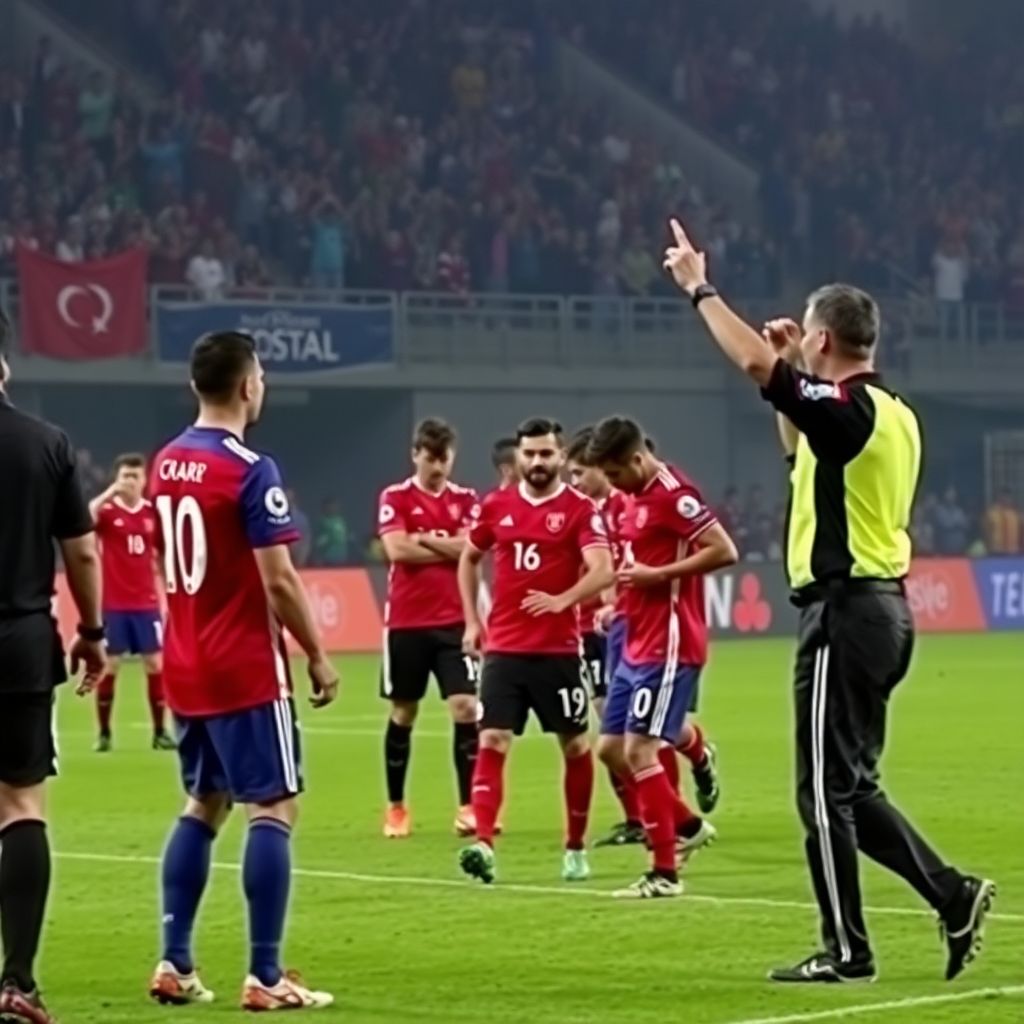
VAR controversy grows in Süper Lig as Hacıosmanoğlu’s promise comes under scrutiny
The refereeing crisis in the Süper Lig has intensified just weeks into the 2026-2027 season. A series of disputed decisions involving both on-field officials and the Video Assistant Referee system has triggered strong reactions from clubs, supporters and football commentators. Attention is now focused on the Turkish Football Federation and the Central Refereeing Board, which are expected to respond to growing concerns about consistency and accountability.
The debate has also brought back earlier remarks by TFF President İbrahim Hacıosmanoğlu. In a previous statement, he said that mistakes made by an on-field referee could be understood as part of the human element of football, but that errors in the VAR room would not be tolerated. His words have gained renewed importance after several controversial incidents were not corrected through video review.
Disputed decisions in the opening two rounds
The first major controversy emerged during the Gençlerbirliği-Fenerbahçe match. Referee Oğuzhan Aksu and VAR official Andrew Dallas faced criticism over their evaluations of several key incidents. The decisions quickly became a major talking point and raised questions about the standards being applied during VAR interventions.
A similar situation followed in the second week of the campaign. Decisions made during the Alanyaspor-Beşiktaş fixture by referee Adnan Deniz Kayatepe and VAR official Bülent Birincioğlu sparked another wave of debate. Supporters and club representatives questioned why certain positions were not reviewed or why the video evidence did not lead to a different decision.
The consecutive controversies have created the impression that the problem is not limited to one match or one referee. Instead, concerns are increasingly being directed toward the wider structure of officiating, including communication between the referee and VAR team, the criteria for intervention and the transparency of disciplinary procedures.
MHK preparing an assessment report
The Central Refereeing Board is reportedly preparing a detailed report on the performances of the officials involved in the disputed matches. The report is expected to examine the most controversial decisions, the communication between referees and VAR operators, and whether the available technology was used correctly.
Officials judged to have made serious mistakes could be excluded from appointments for a period of time, commonly referred to as being “rested.” However, such a measure may not be enough to calm the reaction unless the reasoning behind the decisions is clearly explained.
An official statement from the board is expected in the coming days. The content of that statement could be decisive in determining whether the current tension decreases or develops into a broader institutional crisis.
Clubs demand stronger action
The controversy has also prompted club administrators to take a more direct stance. Beşiktaş deputy chairman Hakan Daltaban called on the federation president to consider the position of MHK chairman Ferhat Gündoğdu. His remarks reflected the growing belief among clubs that confidence in the current refereeing structure has been seriously weakened.
For clubs, the issue is not only the existence of mistakes. The central concern is whether similar standards are applied to all teams and whether officials face meaningful consequences when serious errors occur. In a highly competitive league, a single decision can influence a match, alter the standings and affect financial or sporting targets.
Supporters have expressed similar frustration. Calls for the resignation of the MHK chairman and demands for sanctions against referees involved in major errors have become increasingly common. Some fans have even called for officials to be removed from active duty altogether, arguing that repeated mistakes damage the credibility of the competition.
Hacıosmanoğlu’s previous remarks return to the agenda
The silence from TFF President Hacıosmanoğlu has become one of the main topics of discussion. His earlier promise not to forgive mistakes made in the VAR room is now being compared with the federation’s response to the latest incidents.
Critics argue that a strong statement was required after the disputed decisions in the opening weeks. They believe the federation should explain whether the relevant VAR reviews were conducted according to protocol and whether any officials will be held responsible.
At present, Hacıosmanoğlu has not made a public statement specifically addressing the latest controversies. This lack of communication has led to comments that the federation president has failed to follow through on his earlier commitment. Supporters of the federation, meanwhile, may argue that an assessment should be completed before conclusions are announced.
Why VAR decisions create such a strong reaction
VAR was introduced to reduce major refereeing errors, but its presence has not eliminated controversy. In many cases, the dispute has shifted from whether an incident was missed to why the technology was not used, why the referee was not sent to the monitor or why different matches appear to be judged by different standards.
The system depends on several stages: the initial decision by the referee, the review conducted by the VAR team, the threshold for intervention and the final interpretation of the incident. If any stage lacks consistency, the technology can create further confusion rather than certainty.
Another problem is the limited information available to the public. When no detailed explanation is provided, fans are left to interpret television images and unofficial comments. This environment encourages speculation and deepens distrust between clubs, referees and the federation.
Transparency could help reduce tension
One possible solution would be to publish clear explanations for major VAR decisions. This would not eliminate disagreement, since football incidents often involve subjective interpretation, but it would show that decisions are being reviewed according to defined criteria.
The federation could also provide regular performance assessments, outline the conditions under which referees are temporarily removed from appointments and clarify how VAR officials are evaluated. Consistent communication would make it easier to distinguish between an honest mistake, a technical failure and a failure to follow procedure.
Training and international comparison may also play an important role. VAR officials need continuous instruction, especially on handball, offside, penalty incidents and serious foul play. The aim should be to ensure that similar positions produce similar responses throughout the season.
Pressure on the federation is increasing
The opening weeks of the season have already placed significant pressure on the TFF and MHK. If further controversial decisions occur without a clear response, the issue could affect the credibility of the league as a whole.
The federation now faces two immediate challenges: determining whether the officials involved made serious procedural errors and communicating the findings in a convincing manner. Merely resting referees may be viewed as an attempt to calm the reaction rather than a genuine reform unless the reasons are made public.
For Hacıosmanoğlu, the latest developments represent a test of leadership. His earlier statement created a clear expectation that VAR mistakes would receive firm treatment. Whether that promise will result in concrete action remains one of the most closely watched questions in Turkish football.
Until an official explanation is released, discussions over the Gençlerbirliği-Fenerbahçe and Alanyaspor-Beşiktaş matches are likely to continue. The controversy is no longer limited to individual positions; it has become a wider debate about refereeing standards, institutional responsibility and trust in the VAR system.