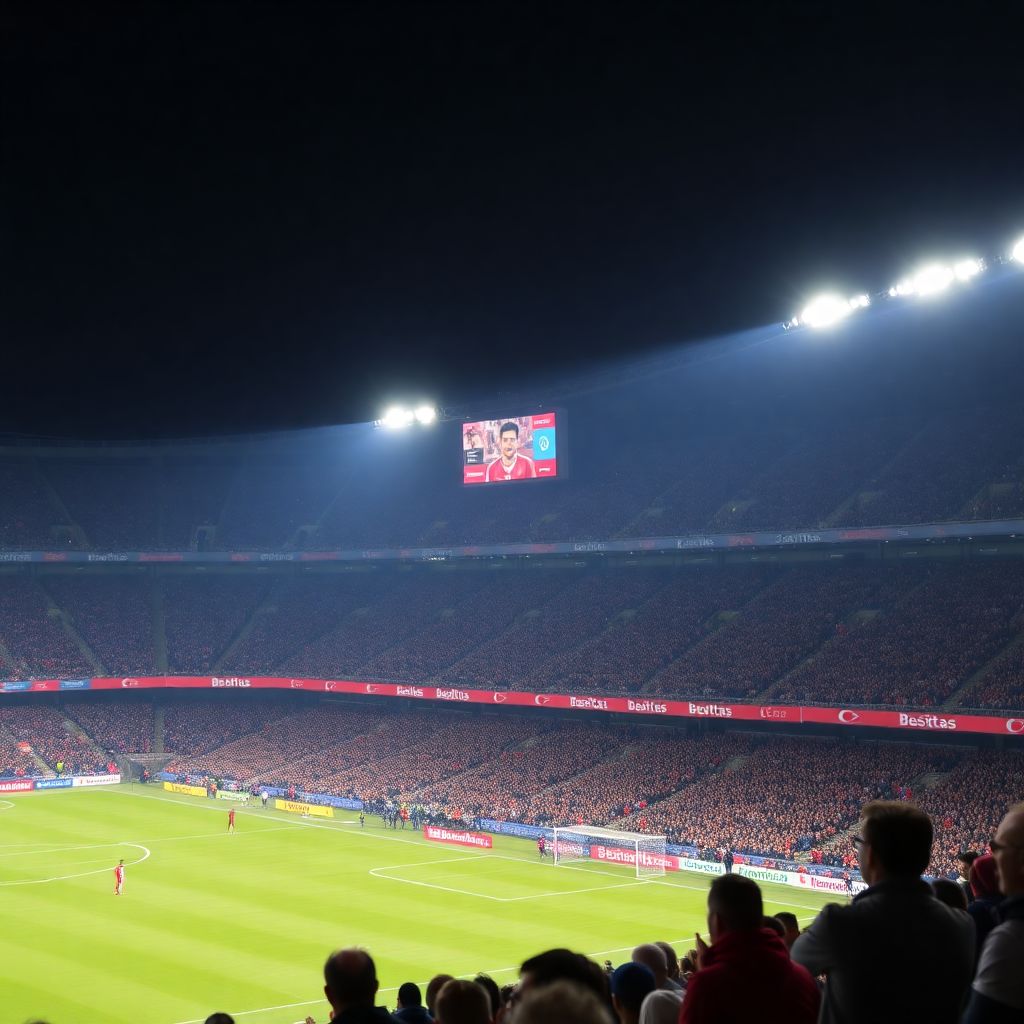
When Olaitan Plays, The Whole Story Changes
In a league weekend where every heavyweight stumbled, all eyes inevitably turned to Beşiktaş. Galatasaray, champions of the last four seasons, were held to a draw by newly promoted Çorumspor. Trabzonspor, parading their blockbuster signing Mohamed Salah, could do no better than share the points with Kasımpaşa. Fenerbahçe, starting a new era under a fresh president and head coach, slipped up in Ankara against Gençlerbirliği. With the traditional contenders misfiring, the focus naturally shifted to Beşiktaş’s clash with Eyüpspor.
That attention was not misplaced. Across four European qualifying rounds, Beşiktaş had looked like the most complete and physically prepared team in the country, even without their star Serbian striker Dušan Vlahović yet making his debut. The question hanging over the match was simple: would the team’s European fluency translate to the league opener, or would they follow the pattern of their rivals and drop points in a game they were expected to control?
A Line-up That Raised Eyebrows – But Made Sense
On paper, Vincenzo Italiano’s starting eleven contained several changes that might have surprised the casual observer. İlhan Fakılı was left on the bench with Leandro Trossard preferred, Hyeon-Gyu Oh ceded his starting role to Semih Kılıçsoy, and Emirhan Topçu was omitted from the line-up altogether. Yet these choices fit a clear tactical logic.
Italiano seemed determined to inject more mobility and creativity in the final third. Trossard offers experience and intelligence between the lines, while Semih brings sharper movement in the box and more aggressive pressing from the front. The coach’s decisions suggested confidence in his squad depth and a willingness to rotate rather than stick rigidly to a “first eleven” so early in the season.
In hindsight, those calls were justified. Beşiktaş imposed themselves from the opening whistle, pinning Eyüpspor into their own half and dictating both tempo and territory.
Eyüpspor’s Deep Block and the Need for a Lockpicker
Eyüpspor arrived with a single, very conservative plan: survive. For much of the first half they retreated into a compact low block, defending with ten and often eleven men behind the ball. Their priority was not to build attacks but to close spaces, deny central passing lanes and frustrate Beşiktaş’s more talented individuals.
This kind of opponent often requires something different – a creative spark, a moment of vision, or a player willing to take responsibility in tight areas. Beşiktaş bombarded the Eyüpspor half with wave after wave of attacks, but for a long stretch the final pass was either missing or easily read by the defence.
That was where Junior Olaitan stepped in.
Junior Olaitan’s Best Game in Black and White
Since arriving at the club, the Beninese midfielder had flickered with promise but lacked consistency. Against Eyüpspor, however, he delivered what was arguably his most complete performance in a Beşiktaş shirt.
What set him apart in this match was not just his energy, but his decision-making. Olaitan played with his head up, constantly scanning before receiving the ball, and choosing his passes with a clarity that had previously been intermittent. On the decisive move, he pierced Eyüpspor’s block with a smart, incisive ball that found Vaclav Černý in the right channel. Černý did the rest, finishing clinically to give Beşiktaş the lead.
The goal was the product of more than a single pass. It reflected an entire evening of disciplined work from Olaitan – tracking back, pressing, offering himself as a passing option and, crucially, taking the responsibility to break the deadlock when the game threatened to drift into stalemate. If the match had a headline, it was this: when Olaitan truly plays, the whole system around him comes to life.
Territorial Dominance and the Quiet Giant at the Back
Beşiktaş’s first-half control was almost total. Eyüpspor found themselves trapped inside their own half, and any rare attempts to break forward were swiftly shut down. In that territorial siege, Emmanuel Agbadou stood out as a model of stability.
The central defender imposed himself in duels, read the game with assurance and helped maintain the high defensive line that allowed Beşiktaş to keep the opposition under constant pressure. His interventions may not make highlight reels, but without his calm presence, the team’s attacking risk would have been harder to sustain.
Of course, perfection was never on the cards in an opening league fixture. Misplaced passes, occasional positional lapses and moments of miscommunication all appeared here and there. But in August, that level of imperfection is normal even for a well-coached side. The foundations, more than the details, are what matter – and those foundations looked strong.
Eyüpspor’s Brief Awakening and a Tactical Question Mark
The second half began with a curious shift. Almost as if someone had reminded them that football includes attacking as well as defending, Eyüpspor ventured higher up the pitch. They pressed a little more, pushed more men forward and tried to contest midfield rather than simply form a wall in front of their box.
This experiment, however, was short-lived. Without a balanced plan or clear transitional structure, their attempts to be more adventurous quickly fizzled out. The underlying issue remained: Eyüpspor never appeared to truly believe they could overturn the scoreline. Once you’re trailing, the calculation changes – whether you lose by one or two goals is largely irrelevant. That is a question best directed at coach Özhan Pulat: if defeat is already looming, why not commit more decisively to attack?
Beşiktaş, for their part, didn’t fully capitalise on this brief opening. There was space to exploit, but the killer second goal never arrived.
A Red Card That Changed Almost Nothing
The match did include one significant disciplinary incident: Oliveira Furtado Costa’s dismissal following a second yellow card. Reduced to ten men, Eyüpspor might have been expected to collapse. Instead, very little changed.
The reason was simple. Even before the red card, Eyüpspor had seldom threatened. Their plan had never been to contest possession or chase the game. Going down to ten simply made their existing approach even more cautious. Beşiktaş continued to dominate the ball and territory, but the numerical advantage did not translate into the ruthless finishing that would have killed the contest beyond doubt.
Finishing Woes and Wasted Crosses
If there was a clear flaw in Beşiktaş’s performance, it lay in the final action. The team created promising situations, especially from the right flank where Vaclav Černý was a constant outlet. Yet the end product often disappointed.
Time and again, Černý delivered crosses into dangerous zones, only for no teammate to meet them. In the first half, Semih Kılıçsoy failed to convert those deliveries into shots on target; after the break, Hyeon-Gyu Oh faced the same problem. The timing of runs, the anticipation in the box and the conviction to attack the near and far posts were all lacking at key moments.
In a league campaign, these fine margins matter. Against stronger opponents, such inefficiency can be punished. Beşiktaş took three points here, but the missed opportunities offer Italiano and his staff a clear training ground focus: turning territory into goals, and half-chances into high-quality finishes.
İlhan Fakılı’s Difficult Cameo
The introduction of İlhan Fakılı in the second half brought a different kind of concern. Eager to make an impact, the young player instead strung together a series of errors – poor first touches, misplaced passes, and hesitant decisions. For a talent previously tipped as a starter, it was a disappointing cameo.
Psychology may be part of the explanation. Losing your starting place to a new, high-profile signing like Trossard can weigh heavily, particularly on a young player still carving out his status in the squad. Fakılı looked more tense than relaxed, more anxious to prove himself than focused on the basics.
The club’s challenge now is to manage this situation wisely. A single bad performance does not erase potential, but the coaching staff must ensure that competition for places remains healthy, not destructive. Confidence, especially for emerging players, is fragile currency.
Orkun Kökçü: Captain’s Talent, Captain’s Responsibility
In contrast, another name raised questions of a different kind: captain Orkun Kökçü. His technical ability is beyond dispute. He is capable of dictating rhythm, striking from distance and delivering set pieces with precision. Yet against Eyüpspor, his decision-making from dead ball situations prompted debate.
Orkun appeared determined to take almost every free-kick and corner, as if all creative responsibility rested solely on his shoulders. That attitude, while born from a desire to lead, can become counterproductive. In a team chasing collective success, making others score is as important as scoring yourself.
Beşiktaş’s future on the pitch cannot and should not be exclusively tied to Orkun’s individual brilliance. Leadership also means recognising when a teammate is better placed to take a particular set piece, or when variation itself is the key weapon. Sharing responsibility doesn’t diminish a captain; it strengthens the team.
The Referee: No Decisive Errors, But Incomplete Control
In a football culture where almost nothing functions flawlessly, expecting flawless refereeing may be unrealistic. Oğuzhan Çakır did not make a mistake that altered the final outcome of the match. The major decisions, particularly those potentially influencing the scoreline, were largely sound.
However, that does not mean his performance was beyond criticism. There were at least three situations where Beşiktaş players clearly committed yellow-card offences yet escaped booking. Those missed cautions did not immediately change the result, but they affected the tone of the game and the sense of fairness.
Refereeing is not just about avoiding catastrophic errors; it is about managing the match with consistent standards. When clear yellow-card challenges go unpunished, players quickly sense that the limits are flexible. Over time, that inconsistency undermines trust in the system.
Beşiktaş as the “Most Ready” Team – What That Really Means
Despite the imperfections, one conclusion emerged clearly: among the traditional powerhouses, Beşiktaş currently look the most prepared. While their rivals dropped points and struggled to find rhythm, Beşiktaş showcased a recognisable structure, high fitness levels and clear tactical principles.
Being the “most ready” in mid-August, however, is only a starting advantage, not a guarantee of a title challenge. The team still needs sharper finishing, more variation in attack, and better use of its creative assets. The integration of absent stars like Dušan Vlahović will further reshape the attacking dynamics and expectations.
What this match demonstrated is that the base is there: a functioning collective, coordinated pressing, and a midfield capable of both breaking lines and protecting the back four. From this platform, improvements in the final third could transform narrow wins into comfortable ones.
The Broader Picture: Style, Not Just Scoreline
The headline will say that Beşiktaş secured three points. Yet the deeper story lies in how they did it. They did not rely on a lucky deflection or a solitary moment of chaos. They controlled the match, suffocated the opponent and finally found the breakthrough through structured play.
In modern football, results alone are no longer enough for big clubs. Supporters and analysts alike look for identity – a clear idea of how the team wants to play. Against Eyüpspor, Beşiktaş showed precisely that: a willingness to dominate the ball, push their full-backs high, and ask their midfielders to take responsibility in tight spaces.
There is still a long season ahead, and tougher exams await. But if one lesson emerged from this weekend of stumbles at the top, it is that Beşiktaş, with all their flaws and unfinished pieces, look closer to a coherent team than their rivals.
And when Junior Olaitan plays with his head up and his courage intact, that coherence suddenly looks a lot more dangerous.