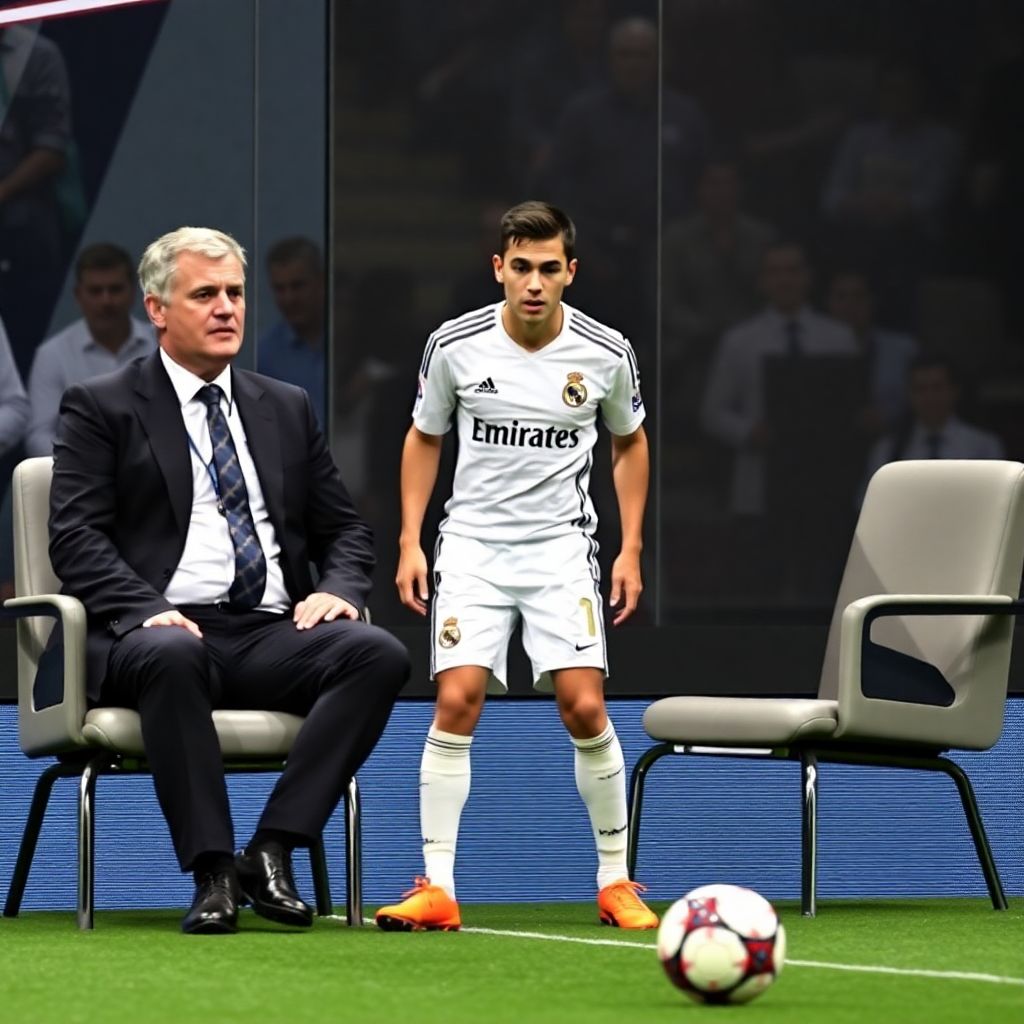
Brahim Díaz’s future: Mourinho’s Diomandé move triggers a Real Madrid domino
The summer market was already tense at Real Madrid, but José Mourinho’s surprise move for Ousmane Diomandé has pushed the situation into a full-blown strategic crisis in the Spanish capital. What looked like a routine negotiation window is turning into a complex puzzle that could redraw the careers of at least five major players, with Brahim Díaz right at the center.
Leipzig say “no” to 100 million – Real prepares a counterstrike
Real Madrid’s priority has been clear for weeks: sign a powerful, modern defender who can secure the back line for the next decade. Their chosen target at Leipzig was met with an uncompromising response. The German club rejected an offer in the region of 100 million euros, signaling they are under no pressure to sell and are prepared to wait for an even higher fee or keep the player entirely.
Inside Real, that refusal has not been interpreted as a dead end, but as a starting point. The board is ready to raise the offer, aware that any additional tens of millions paid will have immediate consequences on the rest of the squad planning. A record defensive transfer doesn’t just eat into the budget; it reshapes the internal hierarchy and the pecking order of existing players.
Mourinho steps in: Diomandé deal that rattles Madrid
Just when Real were calculating how far they could stretch for Leipzig’s star, Mourinho entered the scene from another angle. By launching a decisive move for Diomandé, he didn’t just strengthen his own team – he disrupted Real Madrid’s path.
Diomandé had been tracked by several top European clubs, including Real. For Madrid, he was a Plan B or C: a more affordable option if Leipzig refused to negotiate at a realistic price. Mourinho’s acceleration in talks for the Ivorian defender effectively closes that door.
With Diomandé slipping away, Real face an uncomfortable choice:
– Either go all-in on Leipzig’s defender and push the transfer over the 100 million euro threshold,
– Or pivot to a completely different market opportunity, most of which would require time they don’t really have.
That push toward an even bigger investment in defense is exactly what puts the futures of several players – especially Brahim Díaz – on thin ice.
Why Brahim Díaz is suddenly vulnerable
On paper, Brahim Díaz has done little wrong. He accepted his squad role, delivered when called upon, and proved he can change the rhythm of a game with his technique and creativity. Yet modern football is not just about performance; it is about profiles, balance, and, crucially, accounting.
If Real spends significantly more than planned on a new defender, the club will look for ways to:
– Lighten the wage bill
– Open space in the squad
– Generate transfer income from players who are considered “sellable assets”
Brahim falls into that category:
– Still relatively young
– On a reasonable salary
– Good resale value in Spain, England and Italy
– Not guaranteed a starting spot in Real’s ideal XI
All these factors mark him as one of the first names that might be sacrificed if Madrid need to compensate financially for an oversized defensive signing.
Five stars at risk: the Real Madrid transfer chain reaction
Brahim Díaz is not alone. The potential mega-deal at the back impacts at least four other players in addition to him:
1. A versatile attacking midfielder who is already juggling between a starting and rotational role could be loaned out or sold with a buy-back clause to create room and funds.
2. A promising winger from the academy may be pushed toward a loan, losing his shot at regular Bernabéu minutes this season.
3. A central midfielder nearing the end of his contract may see renewal talks cool dramatically if the budget is reallocated to defense.
4. An experienced defender might be put on the market in order to avoid having an overpopulated back line and to reduce the wage load.
Brahim’s situation is emblematic: not a failure, not a star, but exactly the kind of profile that gets caught in the crossfire when a club decides to make a huge investment in one position.
Arda Güler: the “Mourinho happiness” and what it means for Brahim
While Brahim’s future darkens, another name is quietly gaining leverage: Arda Güler. The young Turkish playmaker, long seen as one of the most gifted talents of his generation, has reasons to be pleased with Mourinho’s arrival in his own orbit and with the broader tactical environment.
Mourinho’s approach at his new club emphasizes structure but still relies on flashes of individual genius in the final third. Güler fits that profile perfectly: intelligent between the lines, technically refined, and able to unlock deep blocks with a single touch or pass.
For Real, Güler’s rise presents both a sporting opportunity and a strategic argument:
– If Arda is ready for a bigger role, Brahim becomes slightly more expendable in the rotation of creative players.
– Marketing value also matters: Güler, as a rising star from Turkey, opens doors in a huge football market, which is never ignored in high-level boardroom decisions.
In short, Güler’s happiness and trajectory indirectly add pressure on Brahim, even if both players have completely different styles and personalities.
Boey, departures and the broader defensive puzzle
While all eyes focus on the giant fees and marquee names, another storyline is unfolding revolving around fullbacks like Sacha Boey. A departure statement surrounding him underlines a broader trend: clubs are increasingly forced to choose between depth and financial reality.
For Real and other contenders, this matters because:
– The more money is committed to a central defender, the less flexibility there is to upgrade fullback positions.
– Players like Boey, who can offer energy and modern wing-back attributes, become attractive targets but also complicated deals in a tight financial ecosystem.
The domino continues: if clubs invest heavily in one defensive sector, they are tempted to let others go, or to trust internal options, making the market even more volatile for players in Brahim’s situation, who might be used as bargaining chips or included in swap-style talks.
Gonzalo García and Mourinho’s strict filter
In parallel, Mourinho’s decision on Gonzalo García is another sign of how unforgiving this summer is for borderline players. The Portuguese coach is known for his clear-cut evaluations: either a player fits his idea immediately, or he is rapidly moved aside.
This has two implications:
– For Mourinho’s own squad, some established names may find themselves on the exit list faster than expected.
– For clubs like Real, a shake-up elsewhere can open unexpected doors: loan opportunities, cut-price signings, or even direct exchanges.
Gonzalo García’s assessment is a reminder that coaches like Mourinho, with very strong preferences, can suddenly alter the map for many outside players, including Brahim, if their decisions trigger chain sales and new tactical needs across Europe.
Turkish market subplots: Demirbağ, Watkins, Muriqi and the reality of choices
The uncertainty around Real Madrid intersects with a broader turbulence in the Turkish and European markets:
– Adil Demirbağ’s confession about choosing between Trabzonspor and Fenerbahçe illustrates how players must weigh playing time, project stability and financial proposals. Brahim Díaz is facing a similar mental process, albeit at a much higher level: stay and fight in a crowded Real squad, or move to a club where he can be central.
– Ollie Watkins being suddenly showered with attention raises an obvious question for Fenerbahçe: how aggressive should they be in chasing a Premier League forward when they are already juggling other big targets?
– Vedat Muriqi’s domestic status debate – whether he counts as local or foreign – shows how regulations can be almost as important as talent. For Brahim, different countries’ foreign-player rules will influence which clubs can realistically take him and guarantee regular minutes.
All these cases highlight a single truth: the market is not just about who is good, but about who fits a specific box at a specific time.
Salah, sponsorships and the financial shadow over every decision
When a superstar like Mohamed Salah is discussed in terms of a possible move, the sporting angle is only half the story. The other half is the gigantic sponsorship ecosystem that follows him. A potential arrival of Salah is being framed as a gateway to partnership deals worth billions of dollars over the long term.
Why does this matter for Brahim Díaz and Real Madrid? Because it underlines how:
– Clubs are increasingly thinking of players as economic platforms, not just athletes.
– When a board sees the chance to sign a “brand player”, they may be more willing to sacrifice solid, mid-tier squad members for budgetary reasons.
If Real decide in the near future to chase another galáctico forward or midfielder with enormous commercial pull, someone like Brahim becomes financially vulnerable again. His value is real, but not transformational at the sponsorship level.
Italian, Spanish and MLS pressures: Darwin, Italiano and new coaching laws
In another corner of the market, Beşiktaş’s “Italiano laws” and their aggressive interest in players like Darwin highlight how coaches set the tone for recruitment. When a coach arrives with a clear footballing ideology, he rarely tolerates passengers. The message is simple: adapt instantly or be moved on.
Brahim Díaz, at any club he might join, would have to pass this immediate compatibility test. A tactician like Italiano, for instance, demands high pressing and positional discipline – qualities that Brahim possesses, but which need to be showcased consistently, not in flashes.
MLS and Barcelona hovering around similar profiles to Darwin also demonstrate that big-name European sides are no longer the only attractive destinations. If Brahim does leave Real, he will have to choose carefully between leagues: a move outside the traditional top five could give him star status, but at the cost of visibility.
Injuries, MRIs and squad planning stress
Okan Buruk’s “prince” getting injured and scheduled for an MRI reflects a quiet but crucial dimension of all these decisions: risk management. Clubs live in fear of building a squad around players who might spend months in the treatment room.
Brahim’s relative reliability fitness-wise is a point in his favor. A team considering him as a key signing can argue:
– He has not been plagued by recurrent major injuries.
– He can cover multiple positions, reducing the need for extra signings.
Yet even this can be flipped: Real may calculate that losing him would hurt less structurally than losing a more injury-prone star, pushing him again to the front of the exit line.
Domestic politics: stadiums, authorities and the need for “lifeline money”
Nihat Özdemir’s final word on stadium construction and football company structures, alongside Aziz Yıldırım’s readiness to inject around 75 million euros as a lifeline, shows another important backdrop: clubs are wrestling not just with transfers, but with infrastructure and financial regulations.
When a club president considers pumping tens of millions in, he also wants control: the “keys” to the institution, as it’s often framed. That level of political and financial maneuvering indirectly affects players like Brahim because:
– Clubs with fresh capital can afford to hold on to squad players instead of selling them.
– Others, under stricter constraints, are forced to cash in on assets who are not absolute cornerstones.
In this environment, Brahim’s fate may be tied as much to boardroom negotiations as to what happens on the pitch.
So what happens next for Brahim Díaz?
Brahim Díaz stands at a crossroads shaped by forces far bigger than his individual performances:
– If Real Madrid closes a mega-transfer with Leipzig, the odds tilt toward him being sold or loaned with an option to buy, to rebalance finances and squad depth.
– If the Leipzig deal collapses or a cheaper defensive alternative is found, Brahim has a stronger chance of staying as a key rotation player, especially if he shines in preseason and early competitive matches.
– If another club steps forward with a clear project – a guaranteed starting role, faith from the coach, and a serious long-term plan – he might choose to leave voluntarily rather than risk another season on the margins in Madrid.
For now, his destiny is suspended between these scenarios. The only certainty is that Mourinho’s Diomandé move, Leipzig’s rejection of 100 million, and the complex web of parallel negotiations have transformed Brahim Díaz from a quiet squad member into one of the most intriguing names of this transfer window.