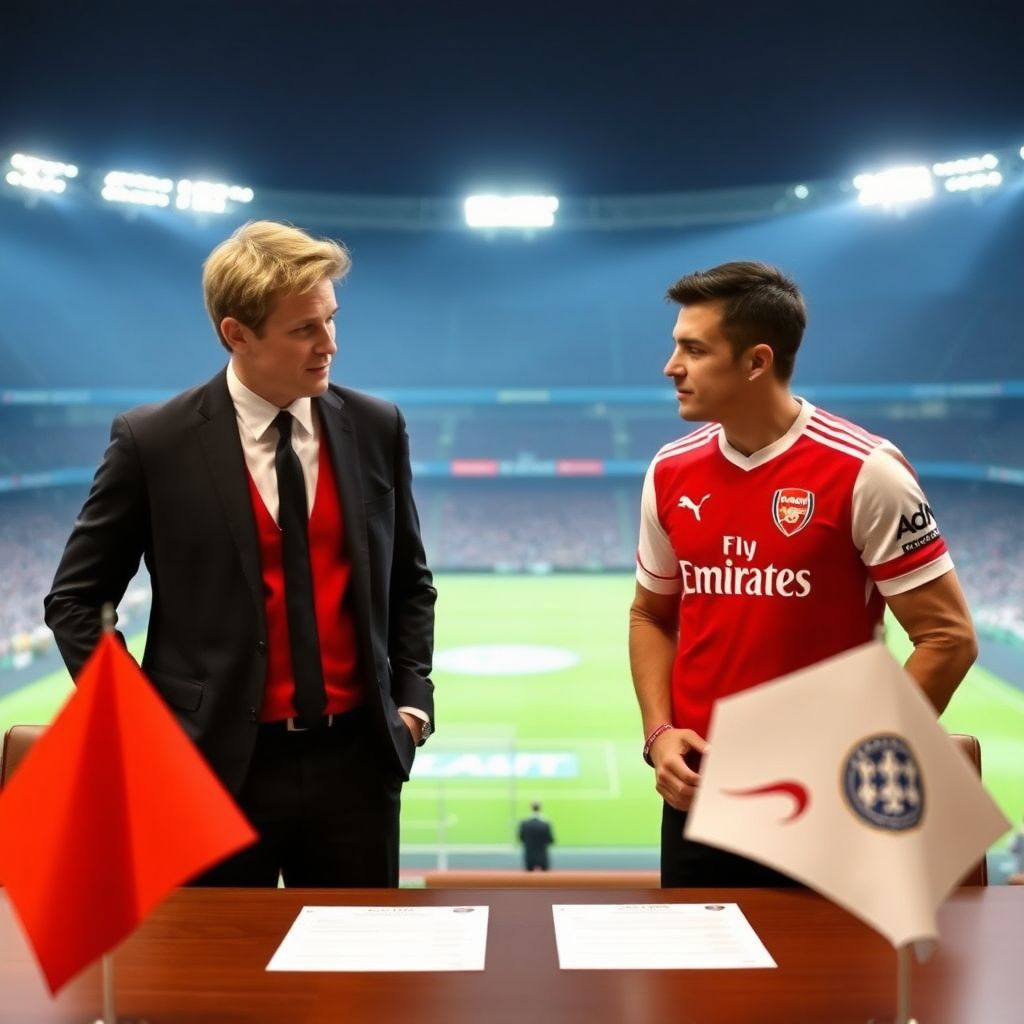
Galatasaray receive major boost in pursuit of Martin Ødegaard
The ongoing contract saga between Martin Ødegaard and Arsenal has opened a door that Galatasaray have been watching closely. With two years left on his current deal and no agreement in sight with the Premier League club, the Norwegian playmaker is now seriously contemplating a future away from London. This situation is being followed with great interest in Istanbul, where Galatasaray’s management are preparing for the possibility that concrete offers for the Arsenal captain could soon be on the table.
At Arsenal, Ødegaard’s importance is unquestioned: he wears the armband, is central to the attacking buildup and has become one of the leaders of Mikel Arteta’s project. Precisely for that reason, the inability to finalise a new contract has alarmed the English club. Normally, top European sides try to extend such deals well before the final two‑year window to avoid losing leverage. As negotiations stall, Arsenal are increasingly forced to consider whether to cash in now rather than risk a depreciating asset or, in the worst case, losing him later on less favourable terms.
For Galatasaray, this is where opportunity meets ambition. The club has not hidden its desire to add a top‑class attacking midfielder capable of deciding big Champions League nights and dominating the domestic league. Ødegaard perfectly fits that profile: a creative number 10 with elite passing, pressing intelligence and experience at the highest level in England and Spain. Internal reports in the Turkish club suggest that, should Arsenal officially open the door, Galatasaray’s board are ready to explore every financial and sporting avenue to make the deal viable.
The key question now revolves around the nature of potential offers. Arsenal, aware of Ødegaard’s market value and status, will not simply let their captain leave for a modest fee. Any club interested, including Galatasaray, must weigh a substantial transfer sum plus a high salary package. However, the Turkish champions have shown in recent years that they are willing to structure creative deals, including performance‑related bonuses and instalment payments, to attract headline names. The board’s eyes are firmly fixed on London, waiting for the moment when Arsenal clarify their stance.
Behind the scenes, Galatasaray’s strategy is clear: position themselves early as a serious candidate, underline the sporting project and highlight the atmosphere and status the player would enjoy in Istanbul. The club’s management know that competing with the financial power of the Premier League and other top leagues is difficult, but they are betting on different strengths: guaranteed key role, passionate fanbase, regular title contention and Champions League football. For a player who thrives under pressure and in big stadiums, that combination could prove tempting if he truly decides to move on.
While Ødegaard dominates the headlines, the Istanbul football scene is buzzing on multiple fronts. In another corner of the city, technical director Vincenzo Italiano recently confessed that he was blown away by the intensity inside Dolmabahçe. He admitted that, seeing the atmosphere in the stands, he caught himself thinking, “I wish I could be out there playing.” That kind of comment is a telling reminder of how Turkish stadiums, with their noise and energy, have become a major selling point when clubs try to convince high‑profile players to move to the Süper Lig.
Several players who know these arenas well have been voicing similar sentiments. Orkun Kökçü, after stepping back onto a familiar pitch, openly stated how much he had missed playing in that stadium, underlining the emotional pull that Turkey’s biggest grounds exert on footballers. Salih Özcan, another name on the rise, has emphasised how quickly he has adapted to his new team, attributing much of that ease to the support in the stands and the strong dressing‑room culture that characterises the country’s top clubs.
Goalkeeper Alexander Nübel has added his own perspective, referencing Italiano’s awe at the local atmosphere and confirming that this environment pushes players to deliver more than they ever thought possible. When combined with ambitious transfer projects, such testimonials strengthen the narrative that the Süper Lig is no longer just a retirement stop, but a serious platform for athletes at or near their prime.
The transfer market reflects that shift. Galatasaray are also actively scouting and negotiating for Real Madrid’s highly rated 18‑year‑old talent, a move that has developed into a full‑blown transfer battle. Bringing in such a young prospect alongside, or even instead of, a star like Ødegaard would signal a dual strategy: mixing immediate impact players with future cornerstones. For a club that wants to dominate domestically and remain competitive in Europe, that balance between experience and youth is crucial.
Elsewhere, Mason Greenwood’s situation has had a domino effect. With his departure on the horizon, multiple clubs are maneuvering to fill the eventual gap. One of the most prominent names mentioned as a replacement is Kerem Aktürkoğlu, whose performances have not gone unnoticed abroad. For Turkish fans, there is a certain pride in seeing a local attacking talent linked as “the one who comes in instead of Greenwood,” as it underscores how far homegrown players have come in terms of international reputation.
Across the city, Fenerbahçe are also making waves in the market. The club have been linked with a new left‑sided centre‑forward, perceived as an even bigger name than Greenwood in terms of profile and impact potential. Reports suggest that this signing would not only lead the line but also transform Fenerbahçe’s attacking structure, allowing them to adopt a more fluid and aggressive style. There is talk that this striker will arrive together with an established centre‑forward partner, a package that could fundamentally change their offensive output and spark celebrations among the fanbase.
Raphinha’s name has surfaced too, with indications that Al‑Hilal’s stance could open the door for a move benefiting Fenerbahçe. If the Brazilian winger were to enter the Turkish market, it would further raise the level of the league and intensify the traditional rivalry with Galatasaray on yet another front: star power on the flanks. Every such rumour feeds into the narrative of a Süper Lig slowly but steadily becoming a magnet for players who previously would look only to England, Spain, Italy or Germany.
Individual club politics are also influencing the bigger picture. Within Fenerbahçe, long‑time figure Mahmut Uslu has attracted attention by, for once, not immediately choosing the path of resignation amid internal turmoil. This unusual stance is a sign that the club is “boiling from within,” with debates about direction, investments and sporting leadership growing more intense. Simultaneously, an important meeting between Ederson and Aziz Yıldırım has been widely discussed, hinting at potential changes or new plans in the goalkeeping department and reinforcing the impression that major decisions are coming.
Aziz Yıldırım’s name appears in another context as well: his view on Mauro Icardi. Speculation that Icardi could one day move across the great divide and become Fenerbahçe’s new centre‑forward has stirred debate. While still hypothetical, such a switch would be one of the most explosive transfers in Turkish football history, fanning the flames of an already fierce rivalry and challenging notions of loyalty and identity in the modern game.
Away from the transfer carousel, broader themes continue to shape Turkish sport. The national women’s volleyball team, the “Sultans of the Net,” have once again climbed back to third place in the world rankings, reinforcing their status as a genuine powerhouse. Their consistency at the top contrasts with the volatility often seen in football, and serves as a model of long‑term planning, investment in youth and continuity in coaching.
In the realm of football governance and ethics, Hacıosmanoğlu has issued a strong call for Fair Play, urging all stakeholders to lower the temperature, respect officiating decisions and prioritise the integrity of the game over short‑term gains. Such appeals are particularly important in a climate where tension runs high and every referee mistake can become a national talking point within minutes.
Even the traditional racing venue of Veliefendi is on the verge of transformation, as a large‑scale operation is about to begin there. The project is described as “big” for a reason: it aims not only to modernise facilities but also to expand the surrounding infrastructure, tie the area more closely to the city’s sports ecosystem and attract new spectators who might previously have felt detached from horse racing.
Commercial dynamics are shifting as well. After years of association with one major telecom brand, stadium naming rights and sponsorship deals are moving toward new partners, with Türk Telekom giving way and Türkcell stepping into the spotlight. These changes are not just cosmetic; they represent new revenue streams and altered power balances between clubs, sponsors and broadcasters, all of which will ultimately affect transfer budgets and squad building.
Amid this whirlwind of rumours, negotiations and structural changes, the Ødegaard situation remains one of the most closely monitored storylines. For Galatasaray, securing the Arsenal captain would be more than just signing a talented midfielder; it would be a statement that the club can still compete for top‑tier names despite the financial gulf with Europe’s richest leagues. It would reinforce the message that playing in Istanbul, in front of one of the world’s most passionate fanbases, is a privilege capable of seducing even established Premier League stars.
The coming weeks will be decisive. If Arsenal formally admit that contract talks have broken down and invite offers, Galatasaray will have to move with precision and speed, balancing financial prudence with sporting ambition. Whether the transfer materialises or not, the fact that such a move is even being seriously discussed shows how far Turkish football has come-and how much higher its leading clubs are now aiming.