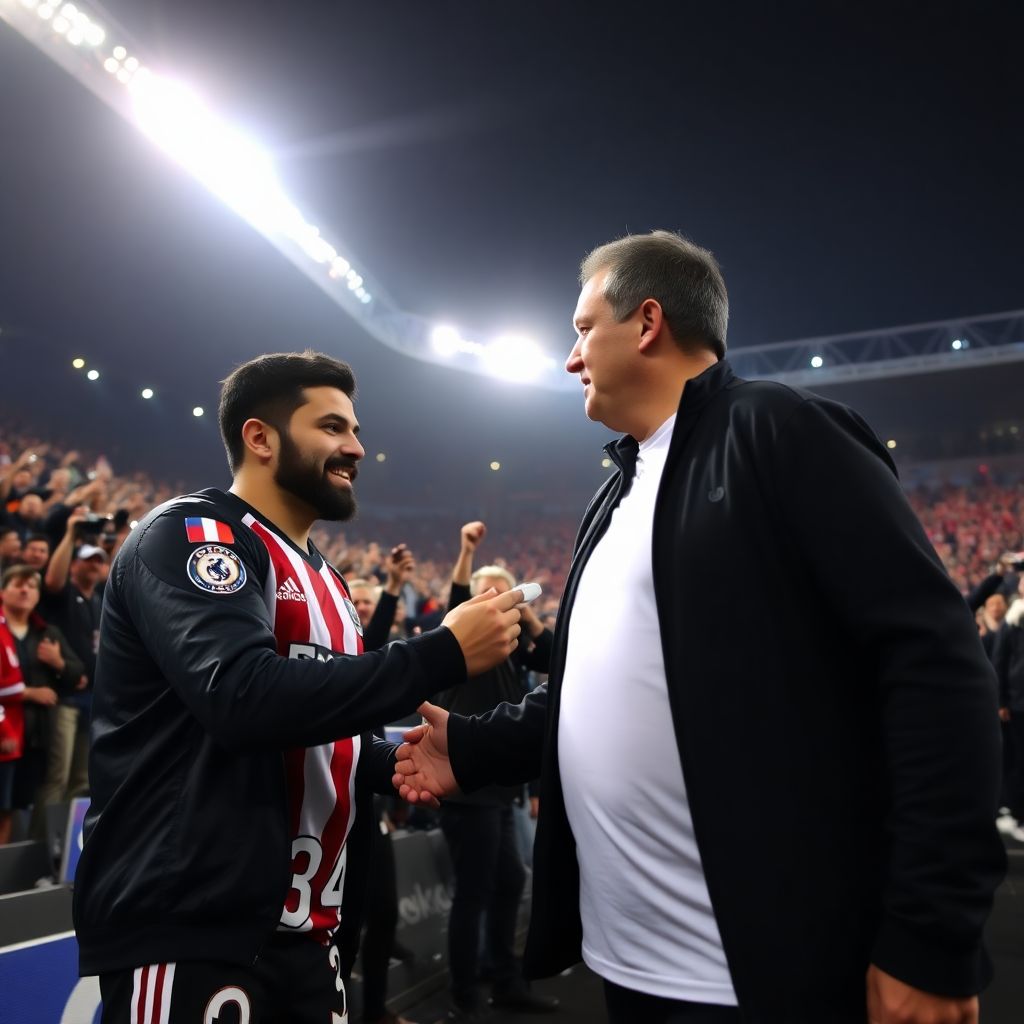
National team star gives green light to Beşiktaş move
Beşiktaş’s pursuit of Salih Özcan has gained serious momentum, with the Turkish international reportedly open to continuing his career in Istanbul and new head coach Vincenzo Italiano giving his approval after closely monitoring the midfielder’s recent performances.
Out of contract at Borussia Dortmund and now a free agent, Özcan is seen as one of the most attractive options on the market in his position, especially for clubs that need to strengthen without paying a transfer fee. His display for the Turkish national team in the friendly against the United States was carefully analysed by Italiano, who is understood to have been highly impressed by both his work rate and tactical discipline.
Italiano, known for his emphasis on an energetic and aggressive midfield, is said to value Özcan’s ability to contribute on both sides of the ball. The 28‑year‑old’s capacity to break up play, press high, and then quickly support the build‑up is considered a key asset that could inject much‑needed dynamism into Beşiktaş’s central areas. The Italian coach reportedly believes that Özcan fits perfectly into the modern profile of a two‑way midfielder capable of dictating the tempo without sacrificing defensive responsibility.
Although several Bundesliga clubs have added Özcan to their shortlists, the player himself is leaning towards returning to Turkey and “starting a new chapter” in his career. After several seasons in Germany’s top flight and appearances in European competitions, the midfielder is thought to be attracted by the prospect of playing a leading role at a club where he can be a cornerstone rather than a rotation option.
Within Beşiktaş, the idea of pairing Salih Özcan with Orkun Kökçü in midfield is increasingly popular. Many see this potential duo as a complementary partnership: Özcan providing balance, defensive coverage and ball recovery, while Kökçü contributes creativity between the lines, progressive passing and late runs into the box. Such a double pivot could give Beşiktaş a more flexible structure, allowing the team to easily switch between a 4‑2‑3‑1 and a 4‑3‑3 during games.
The move also makes sense from a squad‑building perspective. Since the departure of Atiba Hutchinson, Beşiktaş have struggled to find a midfielder who combines leadership, stamina and tactical intelligence in the same package. Özcan, who is eligible under the local player rule, offers a rare combination: he strengthens the starting XI while also helping the club meet domestic quota requirements. The lack of a transfer fee further enhances the value of the deal, making it a financially smart move in a market where prices continue to rise.
Inside the club, there is an understanding that the midfield has lacked the kind of engine that can run for 90 minutes, press relentlessly and set the tone for the entire team. Özcan’s style – intense, combative, but also tactically measured – is viewed as an answer to that problem. He is not a luxury playmaker, but rather a connector who enables others to shine, similar in spirit to Atiba’s role during Beşiktaş’s most successful recent seasons.
Discussions around the player also underline an important strategic point for Beşiktaş: the need to prioritise quality in the attacking five while ensuring defensive stability through intelligent rather than merely physical defenders. In this context, a midfielder who shields the back line effectively can indirectly reduce the pressure on central defenders, allowing the club to avoid overinvesting in that area and instead allocate more resources to forwards and wingers capable of deciding matches.
There is also a recognition that the era of purely “simple” central midfielders is over. The modern game demands players who can press, carry the ball, pass under pressure and maintain high intensity for the full match. Özcan’s profile, combining physical endurance, tactical awareness and solid technique, aligns well with these demands. While not considered a global superstar, he is viewed as the type of player who raises the team’s floor – the minimum level of performance – which is often just as important as signing headline‑grabbing names.
From a financial standpoint, club insiders believe the deal must remain within “reasonable” wage boundaries. Özcan is seen as an important piece of the puzzle, but not a player who should command a salary on par with top European stars. If negotiations result in a contract aligned with the club’s new wage structure, the transfer would be considered a strong value proposition: a prime‑age international, costing no transfer fee, and capable of immediate contribution.
Tactically, Italiano is likely envisioning Özcan as the heartbeat of his pressing scheme. In possession, he can drop between the centre‑backs to help build from the back or step higher to form a triangle with the attacking midfielder and right‑sided central midfielder. Out of possession, his job would be to close passing lanes, lead the counter‑press after turnovers and protect the spaces that often hurt Beşiktaş in transition last season. This role demands both discipline and intelligence, traits the coach believes Özcan possesses.
For Beşiktaş, there is also a symbolic dimension. Bringing in a national team player in his peak years sends a clear message about the club’s ambition to return to the top of Turkish football and compete more convincingly in Europe. Signing someone like Özcan, who knows both the German football culture and the expectations around the Turkish national team, could also help raise standards in the dressing room, particularly in terms of professionalism and training intensity.
The expectation is that the transfer will be finalised after the summer break, once all formalities are completed and the player has had time to disconnect mentally from the previous season. Beşiktaş’s technical staff would like Özcan to join the pre‑season camp as early as possible so that he can adapt to Italiano’s demanding system, build chemistry with potential partners like Kökçü, and integrate into the new‑look midfield before the competitive fixtures begin.
In summary, the deal brings together sporting logic, financial sense and the player’s own wishes. Beşiktaş get a box‑to‑box midfielder with international experience, local status and no transfer fee attached. Vincenzo Italiano gains a key piece for his high‑energy football idea. And Salih Özcan gets the opportunity to become a central figure at a club ready to hand him responsibility at a crucial stage of his career. All signs point to green; now the final signatures are awaited to turn this promising scenario into reality.