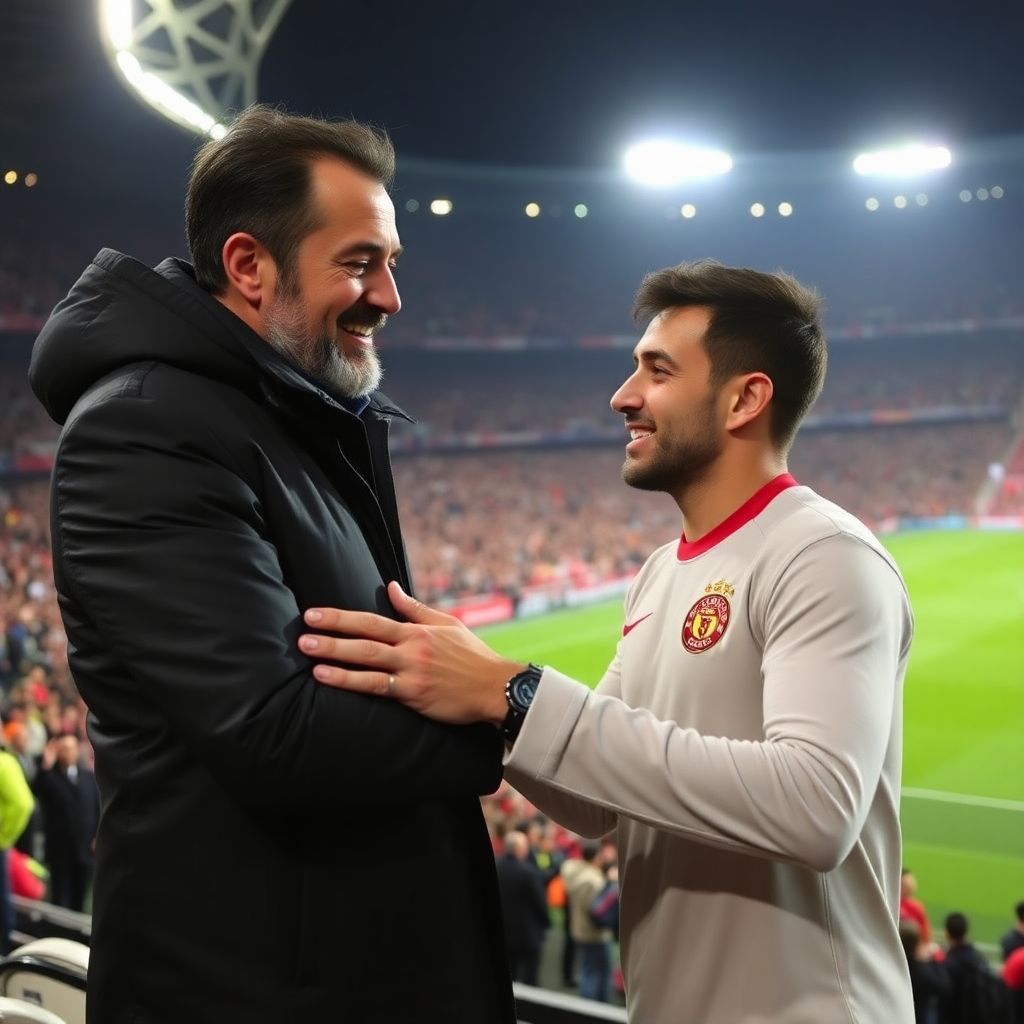
“Say goodbye to Hakan, hand the keys to Orkun”: Ümit Özat calls for a new midfield era in Turkey
Former Turkish international and coach Ümit Özat has sparked fresh debate around the national team by arguing that the midfield must be restructured around a new leader. In his view, the time has come to close the chapter on Hakan Çalhanoğlu’s central role and trust Orkun Kökçü with running the game.
Özat underlined that any change must begin with respect: according to him, the captain deserves a proper, emotional send‑off, but the future can no longer be built on his shoulders.
“You need to organize a great farewell for Hakan Çalhanoğlu,” he said. “This area now has to be entrusted to Orkun. Let that zone belong to him from here on.”
The former midfielder did not stop there. He also argued that Salih Özcan is being underused and should become a more integral part of the national setup.
“Do whatever it takes, sit down and talk with Salih,” Özat insisted. “With all due respect, Salih is a better player than İsmail. This must be acknowledged and reflected on the pitch.”
A call to renew the core of the national team
Behind Özat’s statements lies a broader sentiment: the belief that the current national team has reached a point where a serious overhaul is unavoidable, especially after a deeply disappointing World Cup campaign. Many observers feel that only a clear break with certain names and habits can erase the memory of that failure.
Voices close to the team argue that the squad has grown stale. Players such as Hakan Çalhanoğlu, Mert, Kaan, Çağlar, Merih and İrfan Can are frequently mentioned as figures who no longer offer the same impact yet continue to be called up out of habit and hierarchy. According to this view, their age is advancing, their influence is fading, and the team is paying the price for delayed decisions.
In their place, a new generation is being put forward: Aral, Şimşir, Adil Demirbağ, Emirhan Topçu, Demir Ege and Berk Özer are some of the names fans and pundits alike want to see integrated. The demand is clear – if the national team truly wants to move on from its recent “World Cup disgrace”, it must give genuine chances to players hungry to prove themselves rather than clinging to established but stagnant figures.
The debate around Hakan: respect vs. performance
Hakan Çalhanoğlu sits at the heart of this debate. For a sizeable part of the public, his club career cannot be questioned, but his impact in the national shirt is fiercely disputed. Detractors argue they have “never seen him dominate a national team match”, questioning whether his reputation is being protected more than his actual performances deserve.
The age factor is another argument. At 32, Hakan is unlikely to feature at the next World Cup and is far from guaranteed to be at his peak for the following European Championship. Those who advocate for a generational shift say that national team planning must look two tournaments ahead, not one match at a time. From that long‑term perspective, building the midfield around younger options becomes less a bold gamble and more a necessity.
Orkun Kökçü at the center of the storm
If Hakan represents the outgoing era, Orkun Kökçü embodies the future in many people’s eyes. For his supporters, he is not just another talented midfielder; he is the natural metronome who should dictate tempo and link defense with attack.
There is also frustration about how his club situation has affected his status in the national team. Critics claim that while he was a regular starter abroad at a young age and a valuable asset, his brand and influence were unfairly diminished once he moved to a domestic giant. The accusation is that certain decisions and media narratives are driven more by club politics and power balances than by sporting merit.
In that context, comparisons with players like Kaan Ayhan or Samet Akaydin pop up frequently. Some argue that neither of them should be considered above Orkun in the pecking order. “This is Orkun Kökçü we are talking about,” the argument goes. “How can he be treated as if he is just another squad player?”
The case for Salih Özcan
Alongside Orkun, Salih Özcan is emerging as another pillar in the proposed new structure. Those who have closely watched the national team emphasize how naturally he links up with Orkun when they share the pitch. Their understanding, passing patterns and mutual reading of the game are highlighted as reasons to build a double pivot around them.
Observers point to recent matches where the Orkun-Salih duo appeared to “speak the same football language”: anticipating each other’s movements, covering spaces in tandem and transitioning the ball effectively. For many, it is precisely this sort of chemistry that the current team lacks in other areas.
There is also concern that Salih’s potential is being wasted by irregular playing time at club level. The consensus among his supporters is that he should prioritize a move to a team where he can be a regular starter, which would naturally strengthen his position in the national squad.
Who should make way?
A genuine rebuild always involves difficult goodbyes. In the minds of many fans and analysts, several names should now step aside. Hakan, Kerem, İsmail and Merih are often mentioned as players whose constant presence does more harm than good, either due to perceived underperformance, off‑field issues or dressing‑room influence.
The criticism is harsh: some are accused of benefiting from favoritism and “guaranteed places” regardless of form, while others are blamed for disruptive behavior or questionable professionalism. The argument is that as long as they remain untouchable, younger players will be blocked and the same patterns will repeat themselves.
As potential replacements, suggestions abound:
– Aral instead of İrfan in attacking roles
– Ozan stepping in where Merih has long been a mainstay
– A midfield rotation where Hakan’s minutes are split between İsmail, Salih and Demir Ege, with clearly defined roles
The ultimate goal is not to discard experience for its own sake, but to ensure competition is real and selection is based on current contribution, not past status.
Coaching under fire: Montella, Sergen and alternatives
Such a radical on‑field change inevitably leads to questions about the man on the touchline. Vincenzo Montella’s management is widely criticized by those who feel he failed to get the best out of the available talent and stuck too long with out‑of‑form regulars. The consensus among the more impatient voices is that the national team needs a new start at the coaching level as well.
However, not every popular figure is seen as the right solution. While the chant “Sergen in charge” still appeals to some, others adamantly oppose the idea. Detractors paint him as too emotional, too driven by personal grudges and obsessions, lacking the cold, systematic approach international football demands. In their eyes, swapping Montella for Sergen would be “the biggest possible mistake”.
Alternative ideas are floated, such as a structure in which a strong, experienced figure heads the federation football operations, while a younger coach leads the team. One scenario being discussed imagines a veteran legend in a presidential or director role, with a successful club coach stepping in as head coach – a tandem expected to bring both authority and tactical clarity.
Structural problems beyond the touchline
The unrest goes beyond tactics and line‑ups. Many critics tie the national team’s stagnation to deeper institutional and political issues. Club presidents are accused of weakness and of allowing opaque interests to shape decisions, from player branding to transfer policies. Some believe that certain players’ reputations are deliberately undermined once they join specific clubs, while others are protected regardless of performance.
The federation leadership is also under heavy scrutiny. Decisions on discipline, squad selection and communication are portrayed by critics as inconsistent and tone‑deaf. They complain that controversial behaviors by some players and staff go unpunished, while those who raise their voices in criticism are met with harsh responses. This imbalance, they argue, erodes public trust and affects the national team’s atmosphere.
According to this view, as long as the same leadership style prevails, any attempt at sporting reform will be incomplete. New names on the teamsheet may offer short‑term excitement, but without structural accountability, the cycle of disappointment will repeat.
The role of character and discipline
Another recurring theme is the importance of character. Several players are singled out not only for on‑field inconsistency but for gestures, statements and off‑field episodes that have made headlines. Supporters who demand higher standards argue that the national jersey should be reserved for those who combine talent with discipline and a sense of responsibility.
Incidents ranging from provocative gestures towards the stands to alleged involvement in betting matters or careless public remarks are cited as evidence that some squad members do not grasp the weight of representing the country. Critics insist that turning a blind eye to such behavior for the sake of short‑term results sends the wrong message to younger players.
In their ideal vision, the next generation of the national team is built around a different profile: ambitious, focused, ready to earn their minutes, and willing to put the team above individual ego. For many, Orkun and Salih are precisely the type of professionals who could set that tone in midfield.
What a realistic transition could look like
Transforming a national team overnight is impossible, but a phased plan is feasible. A pragmatic roadmap often suggested by analysts would include:
– Organizing a dignified farewell phase for long‑serving figures like Hakan, phasing down their minutes while giving them the recognition they deserve.
– Making Orkun the primary creator in central areas, giving him responsibility for set‑pieces and build‑up, and surrounding him with runners and ball‑winners.
– Establishing Salih as a regular starter or first‑choice rotation player in defensive or box‑to‑box roles, depending on formation.
– Clearly defining hierarchy among defenders, with aging or inconsistent names gradually replaced by in‑form younger options such as Ozan or promising center‑backs from the domestic league.
– Creating real competition in wide and attacking positions, where players like Aral and others can challenge traditional starters who have been inconsistent at international level.
Such a transition would require courage from the coach and clear backing from the federation. It would also demand patience from fans, as a younger team inevitably goes through ups and downs before reaching maturity.
A crossroads for Turkish football
In the end, Ümit Özat’s message – “Say a proper goodbye to Hakan and pass the role to Orkun” – is more than a comment about a single position. It captures a broader feeling that Turkish football is standing at a crossroads. One path clings to old certainties, familiar names and entrenched hierarchies; the other embraces risk, meritocracy and long‑term vision.
Whether decision‑makers choose continuity or renewal will shape not only the midfield, but the identity of the entire national team. What is clear is that a growing portion of the football public no longer wants cosmetic tweaks. They are calling for a genuine reset – one that starts in midfield with players like Orkun Kökçü and Salih Özcan, but ultimately reaches every level from the dressing room to the federation offices.