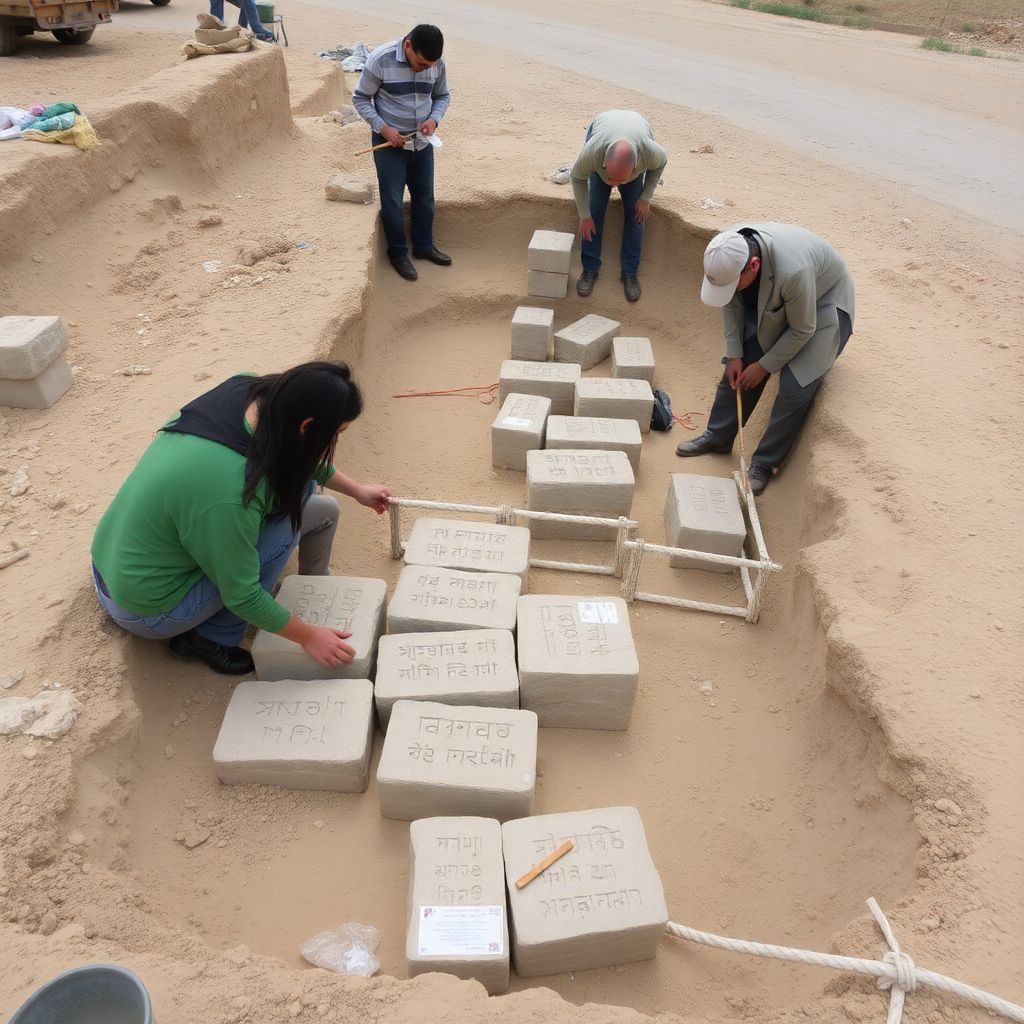
Ancient Syriac stone inscriptions discovered during routine roadworks in the Midyat district of Mardin have revealed a remarkable historical treasure: the oldest of the texts has been dated to the year 722. The find, made in the rural Ortaca neighbourhood during paving and ground-levelling works, has opened a new window onto the Christian past of the Tur Abdin region, long known as a stronghold of Syriac culture.
During the works carried out by Midyat Municipality, a construction machine levelling the ground uncovered 11 stone blocks. Shortly afterwards, teams working nearby identified two additional blocks bearing clearly visible inscriptions. Recognising their potential importance, the municipality immediately halted the construction activities in the area and informed the Mardin Museum Directorate.
Under the supervision of specialists from the Mardin Museum, the inscribed stones were carefully documented, detached from the soil and transferred to the museum for conservation and detailed study. The discovery site itself was placed under protection to prevent further damage and to allow for possible future archaeological investigations.
Initial analyses show that the inscriptions are written in Syriac and can be dated broadly between the 8th and 14th centuries. Some of the stones have been identified as gravestones, most likely belonging to clerics who served in the local church. Despite being found during modern infrastructure work, these blocks once formed part of a much older sacred complex.
Mervan Yavuz, art historian and head of the Conservation, Implementation and Supervision Offices of Midyat Municipality, explained that the stones emerged during mandatory infrastructure and paving works ordered by Midyat Mayor Veysi Şahin. Once the inscriptions were recognised, the municipality treated the area as a heritage site rather than a construction zone and moved swiftly to ensure that the blocks were preserved.
According to Yavuz, the inscriptions and their stylistic features indicate that the stones were originally located in the garden of Mor Aday Church, a Syriac church believed to have been built in the 4th or 5th century. After examination, the stones will be put on display at the Mardin Museum, allowing visitors and researchers to see them up close. Yavuz underlined that Midyat has hosted numerous civilisations since before the Common Era and that this new discovery adds another important layer to the district’s long and complex history.
Syriac scholar Adem Coşkun, director of the Telkari Museum of Midyat Municipality and coordinator of the Turabdin Institute, believes the connection to Mor Aday Church is highly probable. Historical written sources also mention this church in the very area where the stones were unearthed, supporting the hypothesis that the site once formed part of a significant Christian complex.
Coşkun notes that the inscriptions are written in the Estarngelo (Estrangelo) form of the Syriac script, one of the oldest and most elegant calligraphic traditions of the Syriac language. Detailed analysis shows that the texts were carved at different times between the 8th and 14th centuries, reflecting a long period of use and reuse of the burial space associated with the church. Such a chronological span suggests that the site remained an active religious centre for many generations.
In line with customs of Syriac Christianity, distinguished clerics and religious scholars were often buried within the church itself or in its immediate vicinity. Coşkun explains that several of the newly found blocks served precisely this function: they are gravestones marking the resting places of churchmen whose names are still legible on the stones. Among the names identified are Gabriel, Daniel, Shimuel and Saliba, figures who would once have played important roles in the local Christian community.
The inscriptions also preserve the name of the stonemason or scribe responsible for carving at least part of the texts: a man named Muşe. The presence of the artisan’s name is a valuable detail for historians, as it shows pride in craftsmanship and provides a rare personal trace from more than a millennium ago.
The most striking find among the stones is an inscription dated according to the so‑called “Greek year” (Yunan year) system. The oldest text gives the date as year 1083 in this calendar. When converted, this corresponds to 722 AD. Coşkun emphasises that this makes it, as of now, the earliest known Syriac inscription discovered in the area, significantly enriching the corpus of early Christian epigraphy in southeastern Turkey.
Examination of this oldest inscription has yielded particularly important information. According to Coşkun, the text describes a difficult episode in the church’s history: it records that Mor Aday Church had been damaged or destroyed and that, in the year 722, local priests and community members joined forces to restore and rebuild it. The stone thus serves not only as a funerary or commemorative marker, but also as a written testimony to resilience and collective effort in the face of destruction.
Coşkun adds that photographs of the church existed in the early 20th century. Images of Mor Aday Church from 1911 are preserved in historical archives, showing the building still standing, albeit already worn by time. Oral history interviews conducted in the region further suggest that the ruins of the church and some of its inscriptions remained visible at least until the 1960s. Only later, with modern development and changing land use, did the visible remains gradually disappear beneath the surface.
For local residents, the discovery confirms stories passed down through generations. Neighbourhood resident Hacı Çevik recalls that elders always spoke of a large, ancient church that had once dominated the area. He says that even as a ruin, the building’s skeleton remained standing when they were children, and that some villagers remembered playing among its walls. According to him, what has now been found is only a fraction of what still lies underground.
Çevik and other residents are calling for professional archaeological excavations to be carried out at the site. They believe that a systematic dig would bring to light further architectural remains, additional inscriptions and perhaps liturgical objects associated with Mor Aday Church. In their view, uncovering and restoring the church would not only protect their heritage but also contribute to regional tourism.
Local authorities and experts likewise recognise the touristic potential of the discovery. Midyat is already known for its stone architecture, monasteries and churches, and for its role as a historical centre of the Syriac Christian community. Adding a restored or at least archaeologically explored Mor Aday site, supported by the exhibition of the inscriptions in the Mardin Museum, could enrich cultural routes and draw visitors with an interest in early Christianity and Near Eastern history.
From a scientific standpoint, the stones offer multiple avenues for research. Epigraphers can study the evolution of the Estarngelo script across the centuries represented on the blocks, while linguists may analyse the vocabulary and formulas used in the funerary texts. Historians of religion can compare the names and titles mentioned on the stones with known lists of clerics and saints, possibly identifying local hierarchies or previously unknown figures.
Archaeologists, meanwhile, can use the find as a starting point to reconstruct the layout of the church and its surroundings. Gravestones and inscribed blocks often shift position over time due to reuse of materials, collapses and later construction, but their presence in a concentrated area strongly indicates that the core of the church complex lies close by. Geophysical surveys could help map sub-surface structures before any excavation, minimising disturbance.
The discovery also highlights a wider issue: the archaeological wealth that frequently lies unnoticed beneath modern settlements and infrastructure. Routine works such as road building, sewer installation and paving often cut through layers of history. The Midyat case illustrates how crucial it is that municipalities and construction firms have mechanisms to pause work and involve heritage authorities whenever unexpected remains appear.
There is also a broader cultural dimension. Syriac Christianity, with its liturgy, language and architecture, is one of the oldest continuous Christian traditions in the world. Each new inscription or artefact adds nuance to our understanding of how these communities lived, prayed, mourned their dead and responded to crises such as the destruction mentioned in the 722‑dated stone. Preserving and studying these traces is not only important for the Syriac community itself, but for the historical memory of the region as a whole.
In addition, the find comes at a time when interest in religious and cultural tourism is increasing. Visitors seek authentic places that tell complex stories of coexistence, conflict and faith. If properly conserved and interpreted, the Mor Aday inscriptions can help present Midyat not merely as a picturesque town of stone houses, but as a key node in the long history of Christian-Syriac presence in Upper Mesopotamia.
While the main focus of local news remains on the archaeological discovery, the region has also recently been touched by tragedy of a different kind. In İzmir’s Konak district, far from Midyat, 68‑year‑old driver Hüseyin Deniz suffered a heart attack at the wheel, crashing into two parked cars and later dying in hospital. The incident, though unrelated to the Midyat find, has been noted in local reports, underlining the fragile coexistence of everyday life and sudden, unforeseen events.
For now, attention in Mardin is centred on the newly uncovered stones and what they reveal. As conservation work continues at the Mardin Museum and experts prepare detailed academic publications, local residents hope that this chance discovery, made under the tracks of a road‑building machine, will lead to a deeper, more respectful engagement with the buried past of their town and will ultimately transform an almost forgotten ruin into a recognised landmark of regional and global heritage.