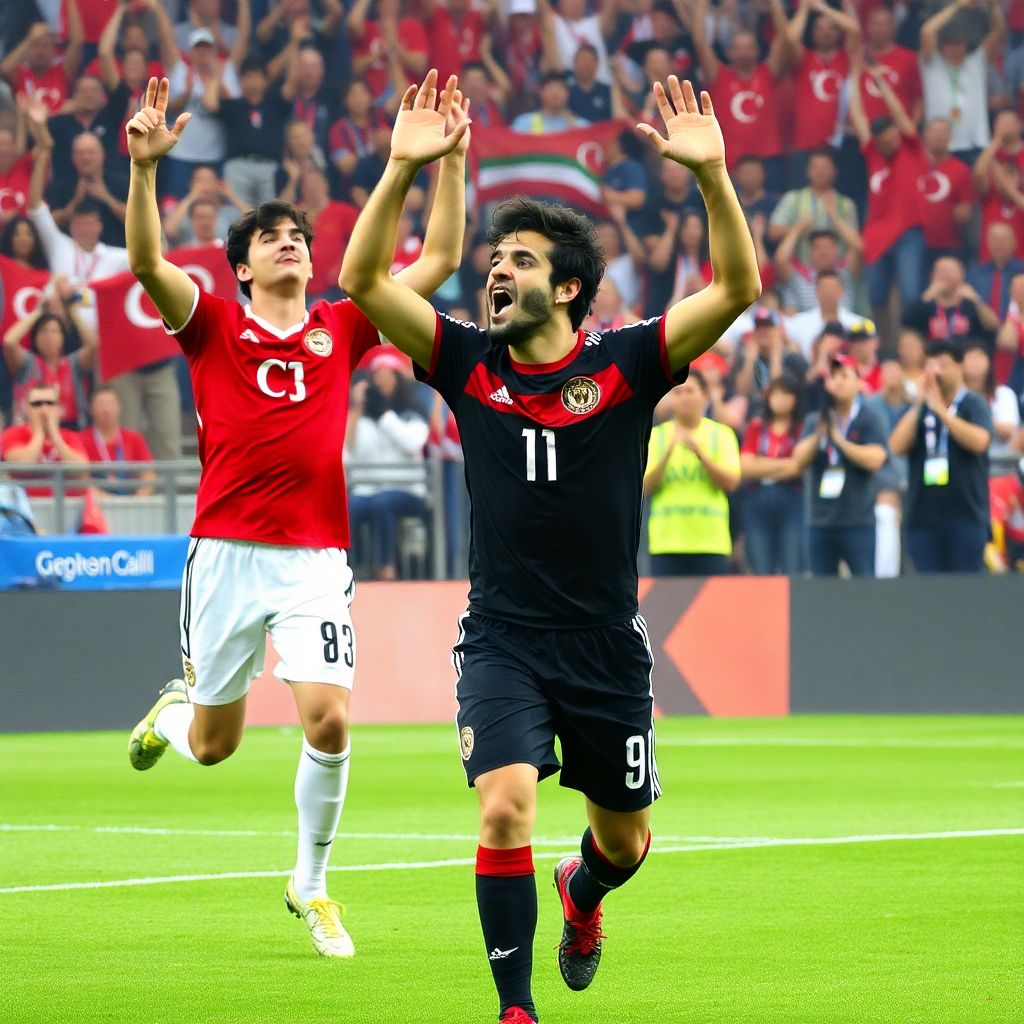
Could Deniz Undav Really Not Be Persuaded? At Most 10 Goals…
The chronic scoring drought in Turkey’s national team striking department has exploded back into the spotlight after Deniz Undav’s goals for Germany. While the Stuttgart forward continues to shine in the Bundesliga and on the international stage, Turkey’s centre‑forward pool is struggling to reach even modest figures. In the current squad list, the only player to hit double digits is not even a natural striker, but a winger: Kenan Yıldız, who has 10 goals.
This contrast inevitably leads to the same uncomfortable question: has Turkish football just let “the missed opportunity of the century” slip through its fingers with Deniz Undav?
A striker crisis laid bare
For years, Turkey’s national team has been searching for a reliable number nine. Veterans have aged, promising youngsters haven’t yet delivered consistently, and tactical experiments with false nines or converted wingers have only partially worked. The brutal reality is this: when you look at the current attacking roster, you struggle to find a classic penalty‑box striker whose numbers inspire confidence.
In that context, Undav’s explosion at Stuttgart feels like salt in the wound. Week after week he scores, assists and dictates the game’s tempo, while Turkey’s forwards remain stuck at “at most 10 goals” over long periods. When the only double‑digit scorer is Kenan Yıldız – a player more naturally suited to operating from wide areas or between the lines – the structural problem becomes impossible to ignore.
Undav, Stuttgart, and the Germany decision
Undav’s performances in Germany have been nothing short of spectacular. Strong in the box, clever in positioning, clinical with both feet and capable of linking play, he has turned into one of the Bundesliga’s most efficient forwards. Unsurprisingly, Germany moved decisively to integrate him into their setup.
Turkey, meanwhile, hesitated too long and lacked a clear, convincing project for him. There were talks, interest, and public debates, but no focused, long‑term sporting vision was presented in a way that truly matched the player’s ambitions. Faced with the option of joining a resurgent German national team or stepping into a Turkish set‑up marked by instability and constant turnover, Undav chose the environment that looked more coherent.
“Could he not be convinced?” – A question with many layers
It is easy to simplify the issue as a matter of “convincing” or “failing to convince”. In reality, it goes much deeper:
– Was there a sporting plan in which Undav would clearly see his role for years to come?
– Did the technical staff show the same determination Germany did, both privately and publicly?
– Did the federation act early enough, before Undav’s profile exploded in Stuttgart and the competition for his allegiance became fierce?
When all these questions are left unanswered or answered too late, players of dual nationality naturally drift toward countries that appear more organized and ambitious. The regret then turns into a loud public debate: was this avoidable, or was it always destined to happen?
Hakan Çalhanoğlu’s admission and symbolic turning points
Even within the team, leading figures have hinted that all is not well. Hakan Çalhanoğlu’s recent admission about key moments and errors in important matches has been interpreted as a tacit acknowledgment that the collective structure is fragile.
In one high‑stakes Turkey match, an early red card – a first in that specific context – changed the dynamics immediately, underlining how mentally and tactically unprepared the side can be when adversity hits. Instead of absorbing the shock and reorganizing, the team crumbled, reinforcing the narrative of a side that lacks both resilience and a clear attacking identity.
Montella under fire: from “spiritual fate” to tactical responsibility
Vincenzo Montella, brought in with hopes of modernizing Turkey’s game, has increasingly become a lightning rod for criticism. Some observers draw ironic parallels, branding him a kind of “fatalistic Sufi sheikh”, repeating that “there is no path beyond destiny” whenever things go wrong.
This perception is strengthened by certain choices:
– Persisting with forms of cautious, reactive football even when more proactive options were available.
– Leaving creative players like Arda Güler on the bench for long stretches or using them in ill‑suited roles.
– Keeping silent or passive during games while key players, like Kerem Aktürkoğlu, visibly struggle and play through pain.
At some point, a coach stops being merely unlucky and becomes accountable for patterns that repeat themselves: sterile possession, few clear‑cut chances and a complete reliance on individual brilliance rather than a designed attacking system.
The “learned helplessness” of Turkish football
Around the national team, a mood of “learned helplessness” has taken root. Fans and pundits alike speak as if Turkish football is condemned to oscillate between chaos and brief flashes of brilliance. The feeling is not just that things are bad – but that they could always get even worse.
This mentality reflects itself on the pitch:
– When the team goes a goal down, heads drop quickly.
– Players revert to hopeful long balls instead of sustained structured attacks.
– Risks are either not taken at all, or taken in moments of desperation with no plan behind them.
In such an environment, a forward like Undav – who thrives on clear patterns of movement, quick combinations and a steady supply of chances – is more likely to flourish elsewhere, where the tactical scaffolding is sturdier.
Federation under pressure: elections and uncertainty
The situation is compounded by the growing crisis at the federation level. The president’s position is increasingly fragile, with mounting calls that elections have become unavoidable. The impression of a leadership “whose time is up” adds to the sense of drift.
Discussions over Montella’s compensation, possible successors, and even whether certain members of the national setup might simply remain abroad rather than return to a toxic atmosphere – all these details feed into an image of systemic instability. When coaches operate under the constant shadow of dismissal and players hear rumors of internal conflicts, long‑term projects become nearly impossible.
Other fault lines: clubs, stars and missed planes
On the domestic front, tensions are no less intense. From goalkeepers like Uğurcan Çakır piecing together important sequences of three consecutive strong performances, to questions about what happened to once‑heralded talents like Berke Özer, Turkish football keeps producing stories of bright beginnings and abrupt disappearances.
Even minor episodes – such as speculation over whether the “double” or look‑alike of a star like Arda Güler missed a flight to the United States or was quietly dropped from plans – take on symbolic meaning. They hint at poor communication, lack of planning and an enduring inability to build coherent, long‑term pathways for players.
“Golden generation sank”: why the world is watching
The phrase “the golden generation sank” echoes loudly beyond Turkey’s borders. A wave of highly talented, often Europe‑based players was supposed to elevate the national team into a permanent contender. Instead, inconsistent coaching, constant tactical overhauls and off‑field turmoil have prevented the creation of an elite, stable side.
International observers, who once spoke of Turkey as a dark horse, now increasingly highlight the contrast between available talent and actual results. When a forward like Undav chooses Germany and prospers, the global reaction is clear: this is not just the loss of a single player, but another sign that the system is leaking value at every seam.
Lessons from elsewhere: what Undav’s case should teach
Looking at national teams that consistently retain and maximize their dual‑nationality players, some patterns emerge:
– Early, personal contact from coaches and federation officials.
– A clear sporting project explained in detail, not vague promises.
– A stable technical staff and long‑term vision.
– An environment of professionalism and trust, where players know where they stand.
In contrast, Turkey’s approach has too often been reactive. Interest intensifies only after a player explodes in a top league, rather than when he is still on the rise and more open to long‑term influence. With Undav, by the time the full scale of his potential was universally recognized, Germany already had a strong sporting and emotional case to present.
Can the damage still be limited?
Undav’s choice is made; that chapter is closed. But the deeper question remains: will Turkish football learn from this or simply move on until the next similar loss triggers another round of outrage?
To limit the damage, several steps are essential:
– Identifying dual‑eligible talents early and integrating them meaningfully into youth setups.
– Building a recognizable, consistent attacking style so that strikers know what kind of service and structure to expect.
– Stabilizing leadership at federation level and ending the endless carousel of short‑term coaching solutions.
– Prioritizing the physical and mental well‑being of players like Kerem Aktürkoğlu instead of pushing them through pain to mask deeper tactical flaws.
A striker shortfall that numbers alone can’t explain
The headline figure – a national team forward pool stuck at “maximum 10 goals” while a wing player tops the scoring chart – is not just a statistic. It is the tip of an iceberg that includes planning failures, mismanagement of human resources, tactical incoherence and a culture too willing to blame fate instead of confronting structural issues.
Deniz Undav’s goals for Germany are a weekly reminder of what might have been. But focusing only on him risks missing the broader picture. Unless Turkey radically rethinks how it scouts, convinces and develops its attacking talents, the next Undav, wherever he grows up, may also choose another flag. And then the same question will return, louder than before: was he really impossible to convince, or did a broken system make his decision for him?