One goal, one point and a night for the history books
The 2026 FIFA World Cup has already delivered gripping comebacks and dramatic finishes, but one of its most touching stories so far came from a team that, until this summer, had never even celebrated a single World Cup goal. The Democratic Republic of Congo, long absent from the global stage and often overlooked in the conversation about African football, finally etched its name into the tournament’s history in a way that went far beyond the final scoreline.
In Houston, under the bright lights and in front of a crowd that expected a routine win for the European giants, Portugal quickly took control. In the 6th minute, rising star Joao Neves opened the scoring, calmly finishing to give Portugal a 1-0 lead. Many assumed the match would follow a predictable script: early goal, growing pressure, a few more strikes, and three easy points for the favorites.
But Congo had come to the World Cup with a different mindset. This was not just another group-stage game; it was a chance to rewrite decades of disappointment. In their previous World Cup adventure, the African side had never found the net, leaving the tournament with no goals, no points, and a lingering sense of unfinished business. The players who took the field in 2026 carried that history on their shoulders.
As the first half dragged on, Congo defended with discipline, absorbing waves of Portuguese attacks while trying to find any chance to counter. Just when it seemed Portugal would head to the dressing room with a comfortable lead, the match took a dramatic turn. Deep into first-half stoppage time, in the 45+5th minute, Yoane Wissa seized his moment.
A quick transition, a precise pass, a well-timed run: Wissa found himself with a sight of goal and struck. The ball hit the back of the net, and in that instant, decades of frustration dissolved. It was Congo’s first-ever World Cup goal, scored in the dying seconds of the half, against one of Europe’s most respected teams.
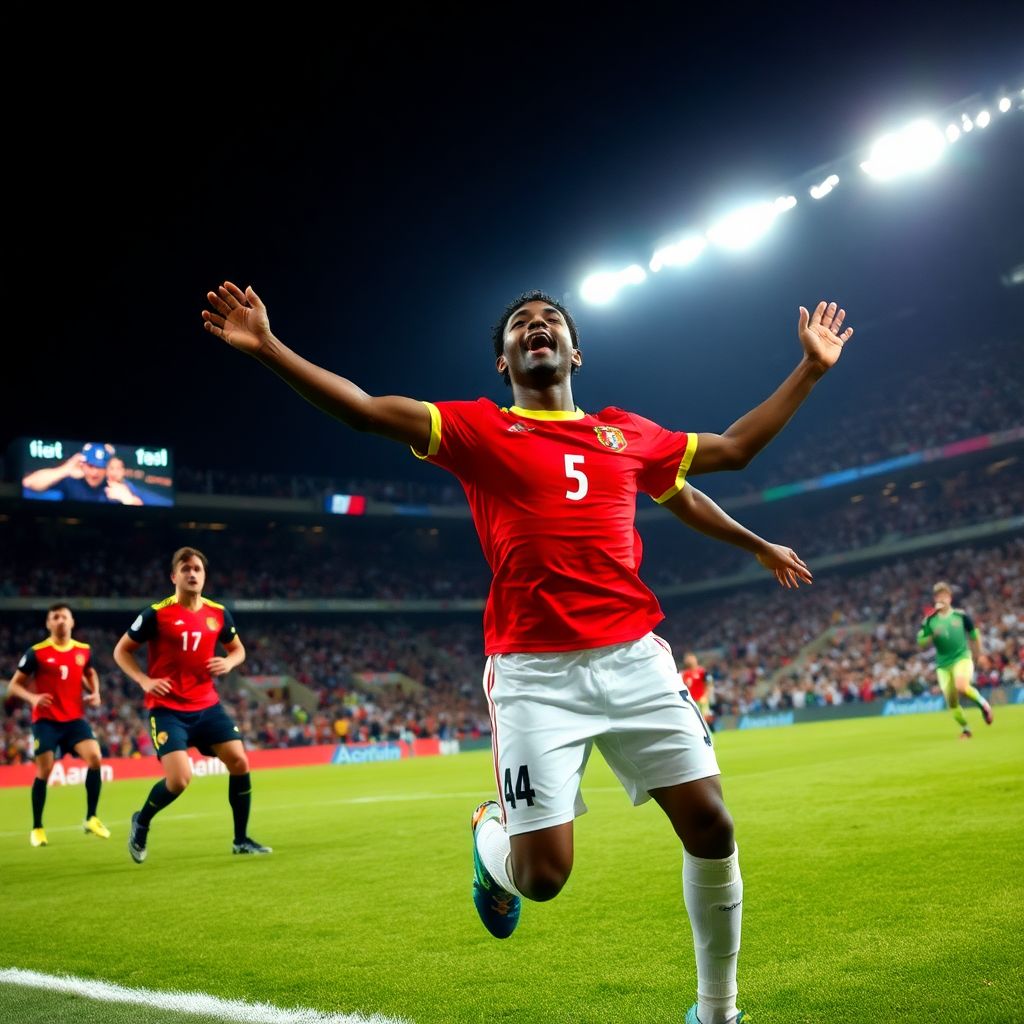
The celebrations on the pitch were electric. Players sprinted toward the corner flag, substitutes rushed from the bench, and the coaching staff erupted on the sidelines. For them, it was not just an equalizer; it was the breaking of a 52-year drought, the end of a long wait that had spanned generations of players and fans.
The second half brought more tension than chances. Portugal pressed for a winner, but Congo held firm, defending as if every tackle and clearance carried the weight of their footballing identity. When the final whistle blew and the scoreboard read 1-1, the significance of the result was clear. The Democratic Republic of Congo had not only scored its first goal in World Cup history but also claimed its first point at the tournament. One goal, one point, and an unforgettable night.
Yet the story of this match was not confined to the stadium in Houston. Thousands of kilometers away, in Lisbon, another scene was unfolding that captured the world’s imagination.
In the Portuguese capital, the famous Praça do Comércio had been transformed into a giant open-air viewing area. Huge screens were set up, and thousands of Portuguese fans packed the historic square to watch their team’s World Cup opener. Surrounded by flags, jerseys and a sea of red and green, the expectation was a festive evening capped by a convincing win.
Among this overwhelming majority of home supporters, a small group of Congo fans had also gathered. They were vastly outnumbered, but they came with flags, scarves and an unshakable belief that their team could produce something special. For most of the match, their voices were drowned out by the Portuguese chants echoing around the square.
Then came Wissa’s goal.
When the ball crossed the line in Houston, that tiny cluster of Congolese supporters exploded with joy in Lisbon. Jumping, shouting, embracing one another, they let out every emotion that had built up over years of waiting. Surrounded by thousands of Portuguese fans who had just seen their team concede, this handful of Congo supporters celebrated without restraint.
The contrast was striking: a “handful” of people in blue, red and yellow, completely immersed in jubilation, in the middle of a crowd that had suddenly fallen silent. Cameras captured the scene, and the images quickly began to circulate worldwide. It was a moment that encapsulated everything that makes the World Cup unique.
Football lovers across the globe reacted instantly. Many described the footage as the purest example of what the sport is supposed to be: passion, emotion and shared humanity, all condensed into a few seconds of unfiltered joy. Some observers summed it up simply: “This is the beauty of football.” Others said the scene proved that “football’s romantic side is still alive,” even in an era dominated by statistics, business and relentless competition.
Another detail that caught the eye was the attitude of the Portuguese fans in the square. There was no hostility, no anger directed at the celebrating Congo supporters. Instead, most watched on with a mix of surprise and respect. A few even smiled, recognizing that they were witnessing a historic moment for another nation. That calm, almost protective atmosphere made the celebration stand out even more. It was rivalry without hatred, disappointment without bitterness.
The joy of the Congolese fans, particularly given the scale of their wait-52 years without a World Cup goal-was quickly labeled one of the tournament’s most emotional scenes so far. In a sport where entire countries measure their progress in trophies and titles, Congo’s achievement was modest on paper: just one goal, just one point. But on an emotional level, it was like winning a cup final.
For the Democratic Republic of Congo, the 1-1 draw against Portugal became much more than a surprise result in the group stage. It turned into a national milestone, a moment that will be replayed and remembered whenever the story of Congolese football is told. The match delivered the two things they had never managed to secure at a World Cup: a goal to celebrate and a point to show for their efforts.
This kind of breakthrough can transform the trajectory of a national team. Young players in Congo watching the game saw that it is possible to stand toe-to-toe with a powerhouse and come away with something tangible. For them, Wissa’s goal will not just be a highlight clip; it will be a reference point, a story they grow up hearing, proof that their country belongs on this stage.
From a sporting perspective, the draw may also shift how opponents approach Congo in the rest of the tournament and in future competitions. No longer just an invited outsider expected to quietly exit the group, the team has signaled that it can resist pressure, score at crucial moments and handle the emotional intensity of the World Cup. That reputation can influence tactics, respect levels and even how fans around the globe perceive African football.
The match in Houston also reminded the world of something often forgotten amid discussions about tactics and star power: for some nations, simply scoring in a World Cup match can be a once-in-a-generation achievement. Not every team arrives with ambitions of lifting the trophy. Some come seeking a first goal, a first point, or a first knockout-round appearance. These milestones may seem small compared to winning the tournament, but for the countries involved, they can be life-changing.
World Cups have always produced such stories-the underdog heroes, the breakthrough performances that stay in collective memory long after the final whistle of the competition. Congo’s night against Portugal is already joining that list. It will stand alongside other moments when football gave a voice to teams that had long existed on the margins of the global game.
There is also a deeper, symbolic layer to this historic draw. The Democratic Republic of Congo is a country that has experienced political instability, economic challenges and social hardship for many years. In such a context, football often becomes more than entertainment; it is an outlet, a platform for pride and unity. When Wissa scored, it was not just eleven players on a pitch celebrating. It was an entire nation seeing itself represented and respected on the world’s biggest sporting stage.
The sight of Congolese fans celebrating in a foreign capital, surrounded but unbowed, carried that symbolism even further. In that small group, people saw not only happiness but resilience-the ability to find joy and dignity despite being outnumbered and, in footballing terms, outgunned. That is part of why the images went viral: they told a universal story of hope.
Looking ahead in the tournament, Congo’s task remains difficult. A draw against a heavyweight does not guarantee progression from the group, and there are still tough matches to come. But whatever happens next, the narrative around this team has already changed. They have moved from being an anonymous participant to a symbol of the World Cup’s emotional core.
For Portugal, the match served as a warning that no opponent can be taken lightly, especially in a World Cup where smaller footballing nations are closing the gap in physical preparation, organization and belief. For neutral fans, the game was a reminder that sometimes the most meaningful stories are not written by the favorites.
In the end, the scoreboard summed it up simply: Portugal 1, Democratic Republic of Congo 1. Yet behind those numbers lies a story of perseverance, delayed dreams and shared human emotion. One goal and one point would hardly be notable for tournament favorites-but for Congo, they marked a historic night that will live on in memory, highlight reels and the hearts of fans for years to come.
On that June evening, football once again proved why it captivates billions: not because of predictable outcomes or dominant champions, but because a single goal can change how an entire nation sees itself. In Houston and in Lisbon, on the pitch and in the crowd, the Democratic Republic of Congo finally had its World Cup moment, and the world paused to watch.