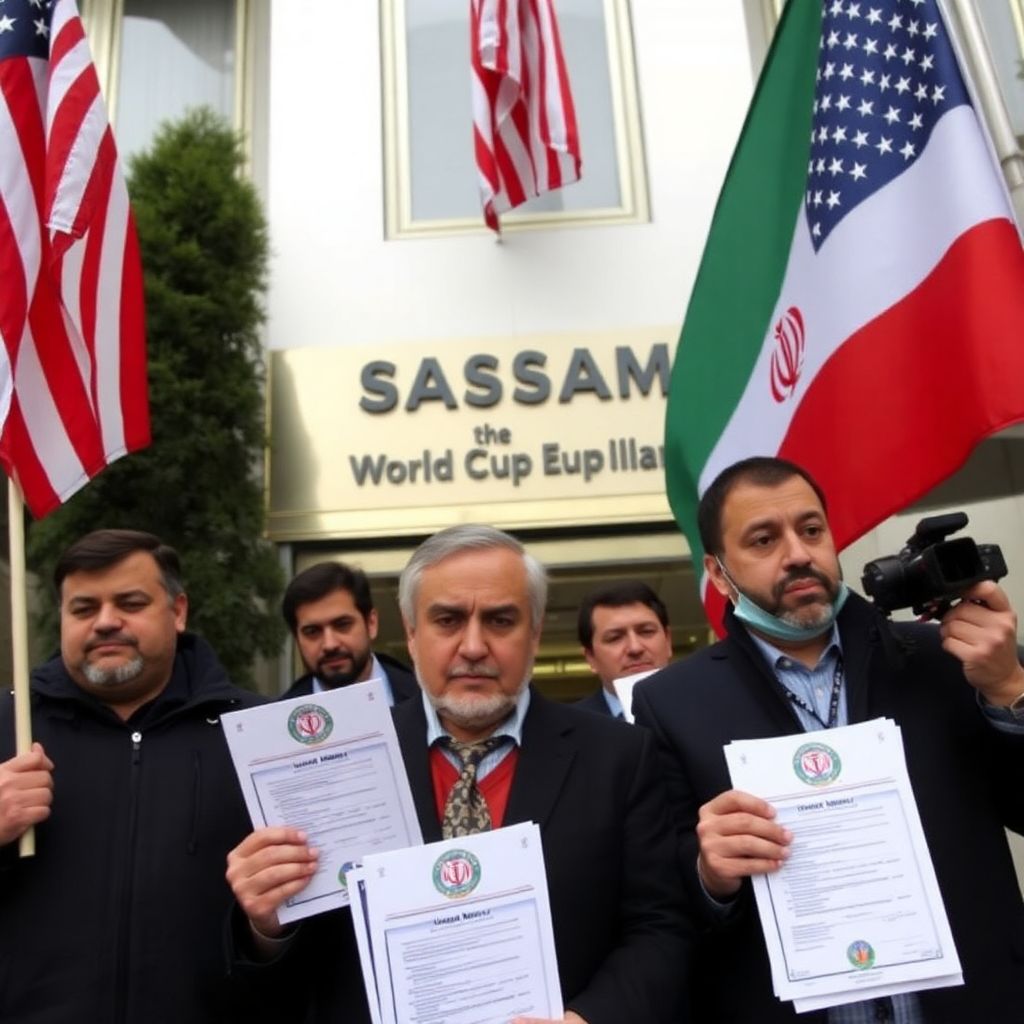
Another crisis from the US: visas denied to Iran’s World Cup media team
As World Cup fever continues to grip football fans around the globe, a fresh diplomatic storm has erupted off the pitch. The United States has reportedly refused to issue visas to the media officers of Iran’s national team, blocking key press staff from entering the country and igniting a new debate about politics intruding into sport.
According to information from team circles, several members of Iran’s communications and press department submitted visa applications in order to accompany the national squad to their World Cup preparations and related activities on US soil. Those applications were rejected, with no detailed public explanation offered beyond standard consular procedures. The decision means Iran will have to manage its international media relations without its full, experienced staff, just as global attention is fixed on every move surrounding the tournament.
The timing of the move makes it particularly sensitive. On the field, the World Cup is about tactics, form and results; off the field, the tournament has long been used as a tool of soft power, diplomacy and national image-building. Denying visas to media officers may not affect the starting XI, but it strikes directly at how a country tells its story, handles press conferences, and navigates the intense scrutiny of the global media. For a team like Iran, whose every political and social signal is dissected, losing that professional shield can have real consequences.
Observers note that Washington’s decision is likely to be interpreted in Tehran as more than a routine bureaucratic outcome. With bilateral relations already strained, any step that can be framed as obstruction or humiliation quickly becomes ammunition in the domestic political arena. Iranian officials are expected to present the visa denials as another example of double standards: a host trying to promote openness and unity through football, while simultaneously restricting participation behind the scenes.
The incident also exposes a broader tension that football has never fully resolved: can major tournaments genuinely be insulated from geopolitics? FIFA has long proclaimed the World Cup as a neutral arena, yet visa decisions, travel bans and diplomatic feuds continually seep into qualification rounds, friendlies and tournament logistics. For media staff especially-who are rarely in the spotlight-being turned into the center of an international dispute underlines how deeply politics has penetrated every layer of the game.
On the sporting side, the action does not appear to jeopardize Iran’s presence at the tournament itself. Players, coaching staff and core technical personnel have been able to continue their preparations. But the imbalance is obvious. Rival teams will arrive with full communications teams, PR strategists and experienced press officers to manage crises, defuse controversies and shape the narrative. Iran may need to improvise, relying on federation officials or hastily reassigned staff, at the very moment when a single misunderstood quote can dominate global headlines.
Meanwhile, the World Cup calendar moves forward. Fans are already turning their attention to the next slate of matches, asking which clashes will dominate tomorrow’s schedule and which dark horses might emerge. On the pitch, the drama is intact; off it, the Iranian visa episode is a reminder that the organizational side of football is now as contested and politicized as any midfield battle.
While this diplomatic flare-up captures global headlines, the rest of the football world continues at full speed. In friendly action, Canada and Turkey produced a thriller, with Turkey edging out a 3-2 victory. The match served as a useful test for experimental line-ups and fringe players who are pushing for a place in future squads. For Turkey, the comeback win also offered a psychological boost amid an intense period packed with both national team duties and club-level transfer stories.
Transfer markets, as always, refuse to sleep. Fenerbahçe are reportedly closing in on an Argentinian winger who delivered an impressive 15 goal contributions in Serie A last season, underlining the Istanbul giant’s ambition to add direct attacking threat and creativity from wide areas. At the same time, there is speculation that if N’Golo Kanté leaves his current club, a Japanese star could step in as his successor-a sign of how Asian players are increasingly seen not as curiosities, but as top-tier solutions for the defensive midfield role in Europe’s elite leagues.
In Germany, Hoffenheim took the opportunity to stir social media by playfully referencing Ozan Kabak in a post aimed at Türkiye’s national team staff, essentially saying “Good morning” in a tone that made it clear they expect the defender to be part of the national conversation. The message underscored how clubs now use national team windows as a stage to boost the profile of their own players, pushing them into the spotlight when selections are being scrutinized.
For some nations, the World Cup has already delivered heartbreak. Early exits mean weeks of soul-searching at home-followed by an avalanche of transfer talk. Once the tournament ends for a team, discussion rapidly shifts from tactics and lineups to which stars may leave for Europe’s biggest clubs and who might replace an outgoing coach. This pattern is repeating yet again: elimination, then immediate obsession with who will move where during the upcoming window.
At the institutional level, the tournament has also stirred turbulence for football’s power brokers. UEFA president Aleksander Ceferin is facing growing criticism and even open calls for a showdown over governance issues, competition formats and the balance of power between clubs, leagues and the confederation. The World Cup, while not a UEFA property, has acted as a magnifying glass: decisions taken in one corner of global football inevitably influence debates elsewhere.
Back in Türkiye, legendary coach Fatih Terim has reinvented himself in front of the cameras. His new TV program and his first statements in that format immediately drew widespread attention, demonstrating that his charisma extends well beyond the touchline. Terim’s analysis of tactics, management and the broader cultural role of football has turned him into a media figure in his own right, one whose opinions can sway fan sentiment and, indirectly, club politics.
On the international stage, stars from the Turkish Süper Lig have left their mark at the World Cup. Ivory Coast’s victory over Ecuador highlighted the influence of top-flight Turkish-based players, who played key roles in tilting the match. In another one-sided affair, Sweden demolished Tunisia with a five-goal performance, showcasing their attacking depth and ability to blow games open when given space. These matches reinforce how the Super Lig has become a springboard for players to display their talents under the brightest lights.
Yet not all off-field stories are flattering. Fenerbahçe have found themselves at the center of a strange “Brown confusion,” with claims of a historic transfer scandal involving players of the same or similar surnames being mixed up in negotiations. While details remain murky, the case is already being described as a potential entry in the annals of bizarre transfer mishaps, a warning to clubs about the need for meticulous verification at every step of the process.
At Galatasaray, internal politics are heating up just as the club attempts to cement its status as a “global power.” Club president Dursun Özbek has reportedly issued a dramatic call to former long-time rival Aziz Yıldırım, inviting him to return and “be our president.” Even if mostly symbolic, such gestures reveal the depth of the institutional struggles within Turkish football, where past leaders remain influential and alliances can shift quickly. Simultaneously, Galatasaray are pushing to extend their brand: after strengthening their presence in Europe, the club is now said to be turning towards the African market, seeking commercial and sporting partnerships across the continent.
Coaching carousels continue to spin. Aykut Kocaman is expected to be officially announced in a new role, with fans and pundits already speculating about what might happen if the announcement is delayed or falls through. At Beşiktaş, a new era is beginning under coach Torelli, with reports that previously favored Italian tactician Italiano has been pushed aside, at least for now. These shifts highlight the volatility of coaching positions, especially at clubs where fan pressure and boardroom impatience leave little room for long-term projects.
On the transfer front, Vedat Muriqi has emerged as a surprise target for Trabzonspor. Signals from his agent have effectively “lit the fire,” encouraging speculation that the powerful forward could return to the Turkish league. For a club chasing both domestic success and European credibility, a striker with Muriqi’s profile could be the centerpiece of an ambitious rebuild.
Even Serie A and the broader European ecosystem intersect with the Turkish game in unexpected ways. After high-pressure stints at clubs like Fenerbahçe, some players and staff have moved on to giants such as Juventus, carrying with them the intensity and expectations of Istanbul. Recently, there were reports of a sideline confrontation involving Selinay during a Juventus match, a reminder that emotional flashpoints are not confined by borders-similar dramas follow high-profile personalities wherever they go.
The media and broadcasting landscape is also rapidly reshaping how fans consume football. Major IPTV platforms have started to forge alliances, effectively “uniting giants” and changing how matches involving clubs like Fenerbahçe and Galatasaray are distributed. This has led to rare scenes of the two arch-rivals being mentioned in the same breath on the commercial front, even as they continue their fierce competition on the pitch. For supporters, the outcome will determine whether viewing becomes easier and more affordable, or further fragmented.
National team benches are likewise under scrutiny. There is growing talk that Montella could be replaced by Okan Buruk at the helm of the Turkish national side. Some insiders suggest this possibility is one reason certain contracts or extensions have yet to be signed. If such a switch were to happen, it would mark a significant shift in Turkey’s footballing philosophy, as Buruk is associated with an intense, pressing style and a close relationship with domestic players.
All these threads-from the US refusal to grant visas to Iran’s media staff, to domestic coaching sagas and global transfer intrigues-paint a picture of a sport that can no longer be separated from power politics, business strategies and media battles. The World Cup remains the ultimate stage for footballing excellence, but every match now plays out against a backdrop of diplomatic maneuvering, broadcasting wars and internal club dramas. The denied visas may seem like an administrative detail, yet they symbolize a broader truth: in modern football, nothing is purely “just about the game” anymore.