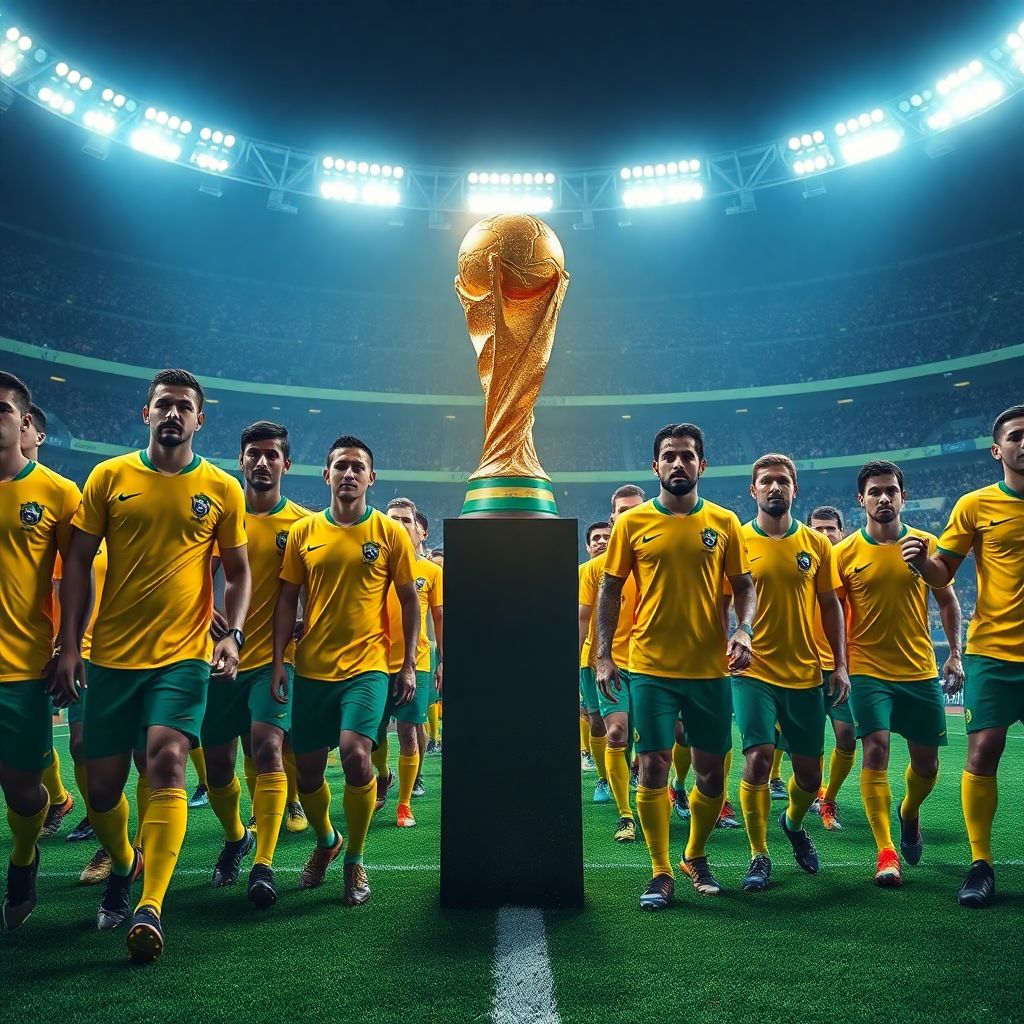
“Samba kings” determined to end 24-year World Cup title drought
Brazil head to the 2026 World Cup obsessed with a single goal: closing the chapter on a 24-year wait for football’s most prestigious trophy. The last time the Seleção lifted the World Cup was in 2002, when a star-studded team led by Ronaldo, Rivaldo and Ronaldinho conquered the world in Asia. Since then, the five-time champions have repeatedly stumbled at crucial moments. Now, with a new generation and a legendary coach at the helm, they want to reclaim their place at the summit of world football.
The 2026 tournament, jointly hosted by the United States, Canada and Mexico, is viewed inside the Brazilian camp as a unique opportunity. The expanded format, wider global spotlight and symbolic setting in North America add extra weight to their mission. Carlo Ancelotti, the Italian mastermind in charge of the national team, has been tasked with blending Brazil’s traditional attacking flair with greater tactical discipline and mental resilience.
Brazil were drawn into Group C, where they will begin their campaign in the United States against Morocco. This opening match is more than just a group-stage fixture: it is a test of character against one of the most organised and physically robust national teams in current world football. Completing the group are Scotland and Haiti, two sides that will arrive as underdogs but cannot be underestimated in a tournament where surprises have become common.
Historically, Brazil remain the most successful team in World Cup history. No other country has lifted the trophy five times. The Seleção have also maintained a unique record: they are the only nation to have participated in every edition of the tournament. Across 114 World Cup matches, Brazil have amassed 73 victories and suffered only 19 defeats, demonstrating both consistency and longevity at the highest level. Yet, for all these numbers, the long gap since 2002 is increasingly seen as a blemish on their rich legacy.
In the latest FIFA world rankings, Brazil occupy sixth place. For many countries, that would be cause for pride; for Brazil, it is a reminder that recent campaigns have fallen short of expectations. Early exits, painful defeats in knockout rounds and the failure to reach a final since 2002 have sharpened the sense of urgency within the squad and among supporters. Ancelotti’s appointment was designed to change that trajectory, bringing his vast experience in club football to a national team hungry for redemption.
Brazil and Morocco have only crossed paths once before on the World Cup stage. Their single previous meeting came at the 1998 tournament in France. Back then, in a group-stage clash in Group A, Brazil cruised to a 3-0 victory, with goals from Ronaldo, Rivaldo and Bebeto. That match is remembered as a comfortable win for Brazil at a time when they were reigning world champions and still a dominant force. Nearly three decades later, the context is dramatically different: Morocco have emerged as one of the strongest teams in Africa and a serious contender on the world stage.
While Brazil’s main focus remains topping Group C, the other fixture in the pool, between Haiti and Scotland, could be crucial in shaping the group’s final standings. Scotland bring experience from European qualifiers, while Haiti will rely on energy, pace and collective spirit. Any points dropped by Brazil against supposedly weaker opponents could complicate their path to the knockout stages, so the Seleção are fully aware that they must approach every match with maximum concentration.
Ancelotti’s 26-man squad blends household names with players eager to make their breakthrough on the global stage. The headline selection was Neymar, who remains the team’s biggest star and their primary creative force. Despite dealing with recurrent injuries in recent years, he still represents Brazil’s most experienced attacking threat. However, a calf problem has ruled him out of the opening game against Morocco, depriving Brazil of their main talisman at the start of the tournament.
In goal, Fenerbahçe goalkeeper Ederson has been called up and is part of the group traveling to North America. His inclusion underlines Brazil’s ongoing strength in the goalkeeping department, where competition for the starting spot remains fierce. Ederson’s distribution, composure under pressure and experience at the top level of European football provide Ancelotti with a reliable option as Brazil seek to build attacks from the back and control the tempo of games.
Up front, Brazil’s attacking arsenal still looks formidable even without Neymar on the pitch. From Barcelona comes Raphinha, a winger known for his direct dribbling, pressing intensity and dangerous left foot. On the opposite flank or drifting inside, Real Madrid’s Vinícius Júnior offers explosive pace, one-on-one brilliance and the ability to decide matches with individual moments of genius. Together, they form a wide duo capable of tormenting any defence, especially in transitions and counterattacks.
Beyond the big names, Brazil’s squad is also rich in versatility. Ancelotti has emphasised players who can operate in multiple roles: forwards who can drop into midfield, full-backs who can move inside, and midfielders capable of contributing both defensively and offensively. This flexibility allows Brazil to adapt their shape depending on the opponent, switching between a possession-dominant approach and a more reactive, counter-attacking style if needed. In a long tournament, such tactical variety can be a decisive advantage.
Psychologically, the weight of history looms large. The memory of previous disappointments, including dramatic exits in the quarter-finals and the infamous home defeat in earlier tournaments, still lingers. However, within the current camp, that pain is being used as motivation rather than a burden. Players and staff are repeatedly speaking about writing a new chapter, one that restores fear in opponents and confidence among supporters. The idea is not to run from the pressure of expectation, but to embrace it as part of wearing the famous yellow shirt.
Morocco, their first opponent, also approach this clash with ambition. In recent years, the North African side has become known for a compact defensive structure, fast transitions and a strong team spirit. Their progress on the international stage has changed how they are perceived: no longer outsiders, but genuine contenders capable of upsetting traditional giants. Brazil’s coaching staff are fully aware that any complacency in this opener could be punished. Detailed analysis of Morocco’s tactical patterns has been part of Brazil’s preparation, with particular focus on defending against quick breaks and set pieces.
For neutral observers, Group C offers contrasting football cultures: South American flair, African intensity, European physicality and Caribbean passion all in one pool. For Brazil, however, there is little room for romanticism. Every training session and tactical briefing is geared towards one objective: building momentum from the very first match. Early wins not only secure points, they create confidence, reduce external pressure and allow for better squad rotation as the tournament progresses.
The absence of Neymar against Morocco also opens a window for others to step into the spotlight. Ancelotti may rely more heavily on Vinícius Júnior as the primary creative outlet, possibly giving him greater freedom to roam centrally. Raphinha’s role could expand as well, with additional responsibilities on set pieces and in orchestrating attacks from the right. Secondary attackers and attacking midfielders will have a chance to prove they can shoulder the creative burden and deliver when it matters most.
Brazil’s defensive organisation will be equally important. Recent tournaments have shown that even the most talented attacking sides can be undone by lapses at the back. Under Ancelotti, there has been an increased focus on compactness between the lines, coordinated pressing triggers and controlled buildup from the defensive third. The aim is to avoid the chaotic transitions that previously left the team exposed, especially against opponents who thrive on counterattacks.
Off the pitch, the atmosphere around the Brazilian national team is a mix of expectation and cautious optimism. Fans know that individual quality is not enough in modern football; structure, mentality and adaptability are just as crucial. Pundits point out that this squad may not have the same level of global superstars as the 2002 champions, but it potentially has more balance. There is less reliance on a single player and more emphasis on collective responsibility, something that could serve Brazil well in high-pressure knockout games.
Ultimately, the 2026 World Cup represents much more than just another tournament for Brazil. It is a chance to prove that the footballing identity that made the Seleção legendary can be updated and strengthened rather than nostalgically preserved. Ending a 24-year title drought would not only add a sixth star to the jersey; it would reaffirm Brazil’s place at the heart of the global game and inspire a new generation to dream in yellow and green.