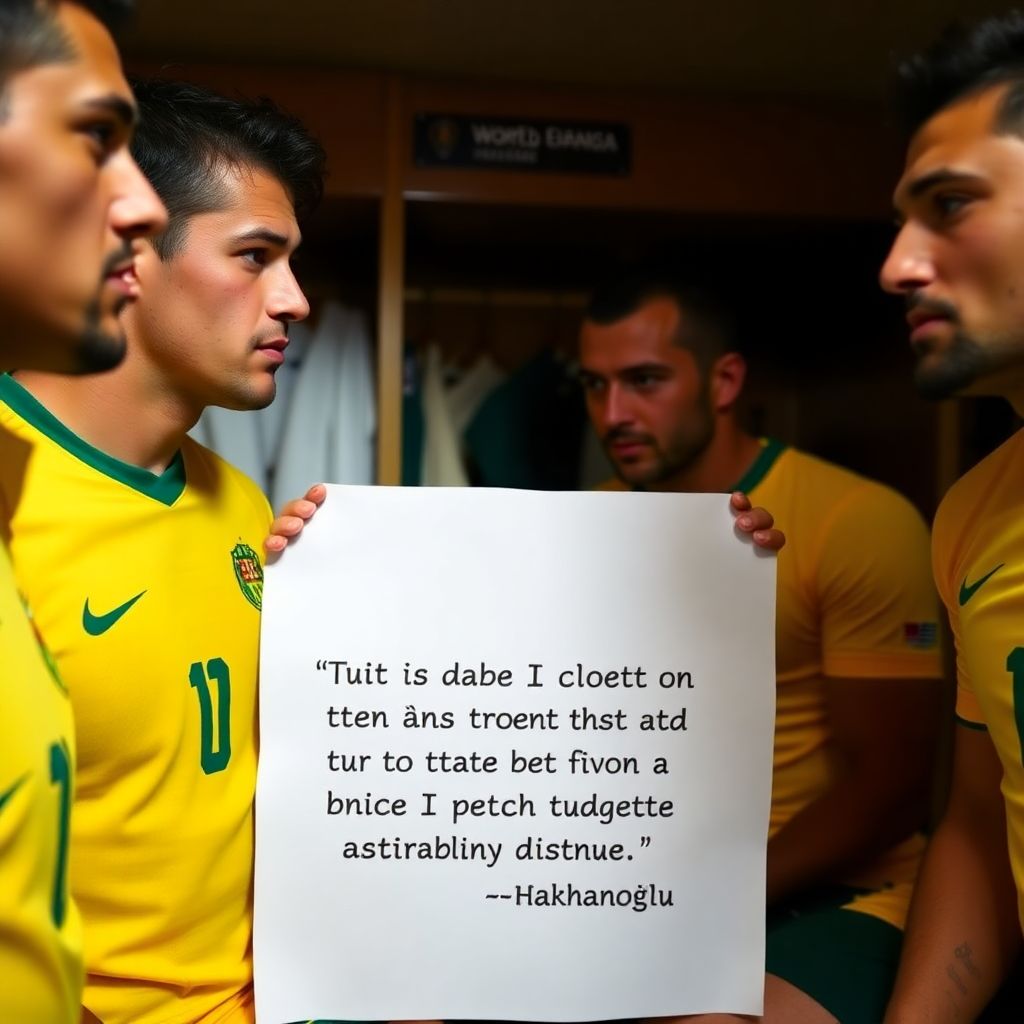
They pinned it on the dressing-room wall – and the Australian press won’t let it go.
On the eve of a huge World Cup clash, Australia is buzzing over a single sentence from Türkiye’s captain Hakan Çalhanoğlu. His bold words, meant as a message of confidence to his own dressing room, have been turned into a psychological weapon: the Kangaroos reportedly printed the quote out and taped it to their locker-room wall, using it as extra fuel against a star-studded Turkish side led by Arda Güler and Kenan Yıldız.
For Australia, this isn’t just another knockout match. Local media are treating it as a test of pride, character and football culture. Every comment from the Turkish camp is dissected, every gesture magnified. Çalhanoğlu’s message, intended to unite his teammates, has been reframed as arrogance – exactly the narrative Australia’s tabloids love, and exactly the kind of “us against the world” storyline a dressing room can feed on.
Mind games before the whistle
Reports from Australia suggest the coaching staff have built a classic “bulletin-board” scenario: turn an opponent’s confidence into insult, use it to sharpen focus, and then talk about “respect” in front of the cameras. Behind closed doors, however, the tone is very different. Players are said to be reminded of every sentence coming from the Turkish squad, every clip of Arda’s brilliance and Kenan’s fearlessness, as if to say: “They think they’re already through. Prove them wrong.”
Türkiye’s camp, meanwhile, is trying not to be dragged into the verbal battle. The staff know that these types of psychological duels can easily distract a young group. With two of Europe’s most talked-about young talents in Arda and Kenan, the focus is on sheltering them from unnecessary pressure, allowing them to express themselves freely once the game starts.
Arda Güler and Kenan Yıldız under the spotlight
For the neutral fan, this duel is about more than Australia’s mind games. All eyes are on the emerging Turkish generation. Arda Güler, already a symbol of technical elegance and big-game temperament, has become the poster boy of this World Cup for Türkiye. Kenan Yıldız, with his direct style and fearlessness in one‑on‑one situations, offers the kind of unpredictability that can decide tight matches.
Australia knows this. The plan, according to local analysis, is to limit Arda’s touches between the lines and to double up on Kenan whenever he isolates a defender. That “sneaky plan” isn’t about one dirty trick; it is about collective skepticism: don’t give the youngsters time, don’t let them feel comfortable, and test whether they can handle the physicality and verbal aggression that Australia traditionally brings to the big stage.
A war of words beyond Türkiye vs Australia
The tension isn’t limited to Turkiye’s duel with the Kangaroos. A separate verbal spat has overshadowed the broader tournament: a heated back-and-forth between figures tied to the United States and Australia has drawn attention for its sheer intensity. Instead of tactical analysis, headlines are dominated by pointed phrases and harsh responses – an “argument that made people forget Türkiye,” as some observers put it.
Ironically, while the rhetoric grows, the US team has been quietly building a footballing identity that goes far beyond slogans. With a new emphasis on structured pressing and vertical transitions, the Americans have delivered results that demand tactical respect, not just media noise.
The Pochettino effect on the United States
Anchoring that change is what many are calling the “Pochettino effect.” The arrival of a top‑level coach – one who understands squad psychology as deeply as tactical nuance – has transformed the conversation around the US national team. Suddenly, discussions involve questions like “What does a manager really do?” and “How much of a result belongs to the coach?”
Under this new approach, the United States did not just beat Paraguay; they dismantled them. Paraguay’s famous physical edge and aggressive duels were supposed to unsettle the Americans. Instead, they became a trap. The US drew Paraguay into pressing traps, broke lines with calculated passing, and then burst forward with pace. Analysts speak of “tactical codes” behind the victory: compactness between the lines, carefully orchestrated overloads on the flanks, and a ruthless insistence on exploiting transitional moments.
The scoreline was emphatic enough to be described as a “4×4 storm”, a performance that bulldozed Paraguay and signaled that this is no longer a side content with just qualifying for tournaments. They want to control games, impose their style and send a message to established football nations.
Lewandowski in motion: transfer dominoes
While the national teams wage psychological and tactical battles, the club world is equally restless. Robert Lewandowski has reportedly boarded a plane, ready to sign a new contract that could reshape the attacking hierarchy in European football. Wherever he lands, he changes everything: dressing-room hierarchy, tactical structure, even the way opponents plan their defensive blocks.
For young forwards, Lewandowski’s move is double‑edged. On one hand, training alongside a goalscoring legend is a dream; on the other, it often means less playing time. Clubs see him as a short‑term guarantee of goals, a proven finisher who turns half‑chances into points. Supporters, meanwhile, read his flights and medicals like political signals: ambition or panic, long‑term planning or last‑minute patchwork.
Fenerbahçe: between foreign frenzy and boardroom chess
Back in Türkiye, Fenerbahçe stands at the center of a different kind of storm. There is talk of a “foreign player frenzy,” with the club scouring the market and considering bold moves while juggling squad limits and financial constraints. Yet the real drama is unfolding not just on the pitch, but in the boardroom.
Behind the scenes, it is said that the blueprint for the current Fenerbahçe project was crafted by powerful figures long before it became public. The narrative goes like this: influential names sketched the plan, Ali Koç put the structure in place, and Aziz Yıldırım, never far from the spotlight, stepped in with offers and counter‑proposals – including the dramatic suggestion: “Take it, you run it.” These maneuvers paint a picture of a club where politics and football strategy are impossible to separate.
Talent hunting: Kuyt, Çetinkaya and the race not to miss out
While the top level wrestles with star names, another battle is unfolding in the shadows: the race to identify and sign tomorrow’s stars before anyone else. Dirk Kuyt and Emre Çetinkaya have reportedly taken a hands‑on role in talent scouting, with one shared motto: “We can’t afford to miss them.”
Modern talent hunting is no longer about watching a few DVDs or highlight reels. It is about data analysis, long‑term tracking, character assessments and even understanding the player’s family environment. Kuyt, who built his career on work rate and professionalism, is said to value mentality as much as technical skill. The goal is clear: assemble a generation of players who can sustain success, not just produce one inspirational season.
Amedspor’s bold gambit: the Zaha proposal
Perhaps the most surprising story comes from Amedspor, who are reportedly preparing a stunning offer for Wilfried Zaha. On paper, it looks impossible. In reality, football history is full of transfers that made no sense at first glance – until they happened.
Zaha would bring not only dribbling and creativity, but also international visibility and commercial potential. For a club looking to redefine its identity and ambition, a move like this is a statement: “We are not here just to survive; we want to matter.” Of course, negotiations at this level are complicated, from salary structure to image rights. But the very existence of such a proposal reveals how aggressively even smaller clubs are willing to dream.
Coaching carousel: Aykut Kocaman, İsmail Kartal and Şenol Güneş
On the technical side, former Fenerbahçe boss Aykut Kocaman is reported to have made a decisive judgment on İsmail Kartal. The message from his circle is that Kartal is more than just a coach; he plays the role of elder brother, father figure and teammate all at once. That human connection with players, often overlooked in statistical debates, can be the thin line between a united squad and a fragmented dressing room.
At the same time, veteran coach Şenol Güneş is said to be scanning the horizon for a new project. In a sharp twist of irony, he is rumored to have shrugged off recommendations tied to artificial intelligence tools and data‑driven job matching. Instead, Güneş trusts his own instinct, accumulated over decades in the game. For him, no algorithm can fully capture the chemistry between coach, club and city.
Dressing-room truth: Yüksek, Çalhanoğlu and Kabak speak
As narratives, quotes and accusations swirl, some players have opted for directness. İsmail Yüksek gave a blunt reply to what was widely mocked as a “funny kangaroo” provocation from the Australian side, effectively telling them that Türkiye would answer on the pitch, not with memes. It was a clear attempt to flip the script: if you want to play games, we will turn them into motivation.
Hakan Çalhanoğlu, for his part, has moved beyond the headline‑grabbing statement that ended up on Australia’s dressing‑room wall. He has also dropped hints about who will be steering the team from the touchline and from inside the pitch, emphasizing leadership continuity and tactical clarity. According to him, the squad knows exactly “who is at the helm” – and that stability is their answer to external noise.
Defender Ozan Kabak reinforced this message. When asked about supposed tension or ego clashes, he was categorical: “There is no such atmosphere in the team.” His words cut through speculation that the emergence of Arda and Kenan might have destabilized the hierarchy. Internally, the view is different: young stars are seen as an asset, not a threat, and the veterans are keen to support them rather than compete with them.
Galatasaray and the ruthless cut: Okan Buruk and Dursun Özbek
Across Istanbul, Galatasaray is going through its own internal reckoning. Coach Okan Buruk has reportedly drawn a hard line through the names of several players, signaling a readiness to move on from those who no longer fit his long‑term vision. That decision has not landed lightly in the boardroom.
Club president Dursun Özbek’s frustration is said to have peaked as he balances the financial reality of moving players out against the manager’s sporting demands. Between transfer fees, wages and squad harmony, every name crossed out by Buruk sends shockwaves through the club’s planning. Yet the underlying message is simple: sentimentality does not win titles. A squad needs to be trimmed, reshaped and, at times, brutally renewed.
Italiano’s verdict on Sergen Yalçın: nothing left to keep
In another corner of the coaching landscape, Italiano’s stance regarding Sergen Yalçın has been described in stark terms. After reviewing options, systems and available profiles, his conclusion was unforgiving: “Throw it all away.” It is not just a criticism of one coach or one philosophy; it is a rejection of a whole way of thinking about the game.
Italiano, known for his insistence on structured buildup and collective pressing, represents a new school that has little patience for improvisation without framework. His decision to scrap everything related to the previous approach shows where modern football is heading: towards stricter systems, well‑drilled automatisms and a reduced margin for individual freedom outside the game plan.
Money, power and the “start your own company” mentality
Amid all this, another narrative quietly reflects the mood of the times: the advice that those waiting for a raise should simply “start their own company.” It sounds cynical, but in the football business it has a special edge. Players, agents and even coaches increasingly operate like independent brands rather than employees.
Wage expectations, image management and sponsorship deals all depend on this entrepreneurial mindset. Clubs want commitment and loyalty; individuals want security and leverage. The phrase captures a wider reality: anyone who sits still, hoping someone else will improve their situation, risks being left behind in a rapidly commercializing football environment.
What it all means heading into the World Cup showdown
Taken together, the stories swirling around Türkiye, Australia, the United States and the major Turkish clubs paint a picture of a sport in constant motion – tactically, commercially and emotionally. Mind games in dressing rooms, tactical revolutions on the pitch, high‑risk transfers and ruthless boardroom decisions are all pieces of the same puzzle.
For Türkiye’s national team, the task is clear. Ignore the noise, turn the Australian media’s obsession with Çalhanoğlu’s words into internal motivation, and allow Arda Güler and Kenan Yıldız to express the very qualities that made them targets in the first place. For Australia, the key is to transform resentment into cohesion, using that quote on the wall not as decoration but as fuel.
Once the whistle blows, the headlines, the kangaroo jokes and the wall posters will not matter. The only thing that will count is who can execute their plan better – the team that treated words as weapons, or the one that trusted its football to do the talking.