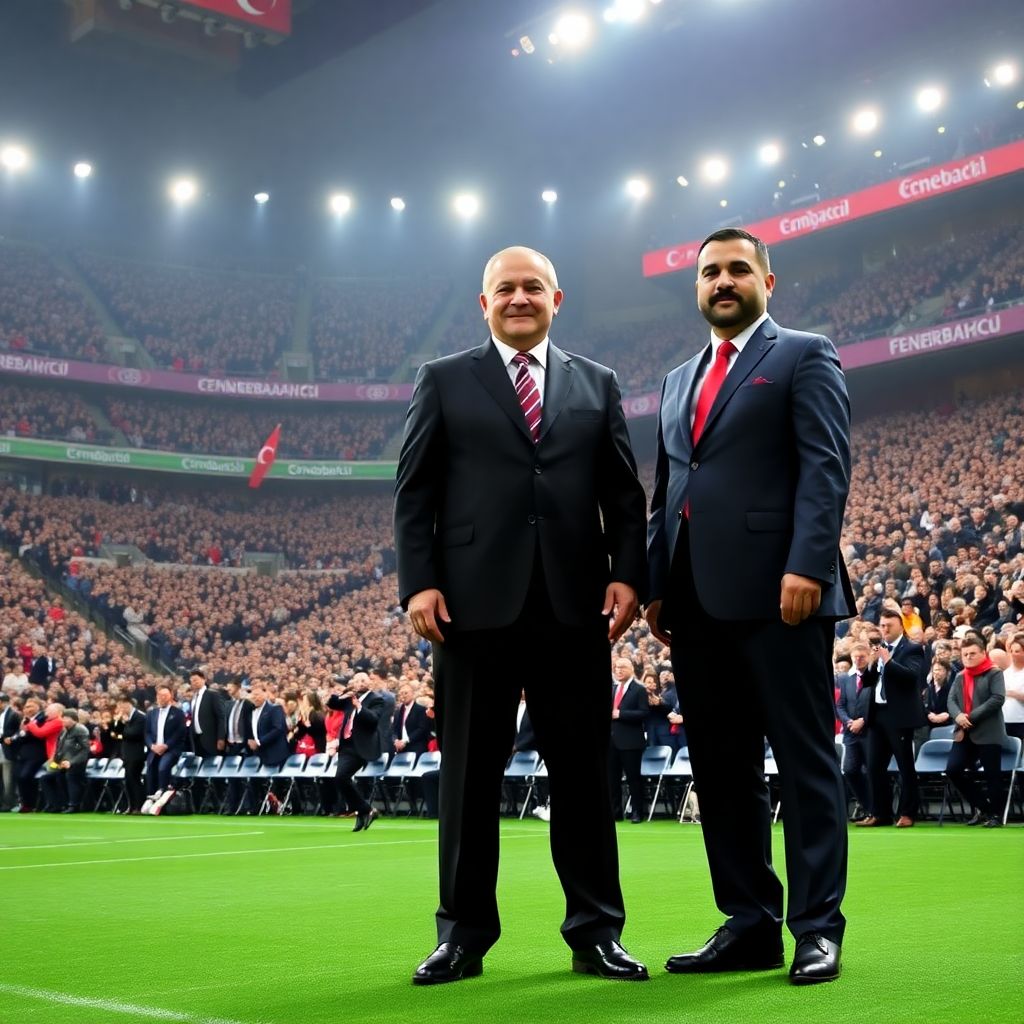
Aziz Yıldırım and Hakan Safi are set to come together under a single banner – and the key figure expected to unite the candidates is already clear. Fenerbahçe High Council (Yüksek Divan Kurulu) president Şekip Mosturoğlu has taken on a pivotal role in the aftermath of the historic general assembly, positioning himself as the bridge between the club’s leading names.
Speaking after the congress, Mosturoğlu underlined that Fenerbahçe cannot afford further fragmentation and that his primary duty is to build dialogue inside the club:
> “We have a general assembly culture. I cannot say it doesn’t exist. When matters are explained, when people sit and talk, they can reach a reasonable point. That tense atmosphere can be diffused. You need to intervene, to step in and put things into a routine.”
According to him, this “intervention” means nothing less than sitting Ali Koç, Aziz Yıldırım and Hakan Safi at the same table and pushing them towards a common stance.
“I will make every effort to bring Ali Koç, Aziz Yıldırım and Hakan Safi together at a reasonable point – this is my job,” he stressed, effectively launching a unity campaign within the club.
A new axis in Fenerbahçe politics
In recent years, Fenerbahçe’s internal politics have been defined by sharp lines: Ali Koç on one side, Aziz Yıldırım and his supporters on another, and now new figures like Hakan Safi entering the scene. Mosturoğlu’s message signals a new axis: instead of competing blocs destroying each other’s legitimacy, a search for a common ground where strong names can collaborate for the club’s benefit.
For many inside the Fenerbahçe community, the possibility that Yıldırım and Safi could consolidate their forces is already being talked about as a potential “game changer” in the race for influence and future elections. A joint front backed or facilitated by Mosturoğlu would significantly reshape the balance of power.
Why Mosturoğlu’s role matters
Mosturoğlu is not just any figure in the club. As president of the High Council, he sits at the institutional heart of Fenerbahçe’s internal order. That position gives him two crucial advantages:
1. Legitimacy in front of all camps – He is expected to act above daily polemics and can claim to represent the traditions and long-term interests of the club.
2. Procedural leverage – High Council processes, congress protocols and internal “culture” all pass, one way or another, through his office.
By openly saying “my duty is to bring them together,” he is not only calling for peace; he is also putting himself at the center of any negotiation process between Koç, Yıldırım and Safi.
Yıldırım’s return and the timing of the unity call
Aziz Yıldırım’s renewed presence has already raised expectations and tensions. Described by many as “returning with his luck” and potentially bringing “big good news in October,” Yıldırım has once again become one of the main focal points of debate.
He has not shied away from a confrontational tone either. Phrases like “If it’s war, then war!” and reports of him “slamming the table” during early disputes underline how easily the situation could turn into yet another destructive showdown.
In that atmosphere, Mosturoğlu’s effort to prevent an escalation before the next crucial decisions are made becomes even more critical. A fragmented front with each candidate fighting on his own would likely deepen polarization; a rapprochement between Yıldırım and Safi, guided by an institutionally recognized mediator, could instead reroute that energy into a shared project.
Hakan Safi’s rising profile
Hakan Safi has emerged as a newer name compared to Ali Koç and Aziz Yıldırım, but he has quickly become one of the important actors in the club’s future political map. His approach is often read as more technocratic and project-based, appealing to those who are tired of endless quarrels and want to hear concrete plans.
The idea that Safi and Yıldırım could “merge” or at least coordinate their visions suggests a potential synthesis: Yıldırım’s experience, networks and charisma combined with a relatively fresh, business-oriented perspective. For some members, this formula sounds like a promising alternative to a purely personalized race between two or three strong egos.
The Ali Koç factor
Any scenario that talks about unity must include Ali Koç. As current president and a powerful figure with substantial financial backing, Koç remains central to Fenerbahçe’s short- and medium‑term future.
Mosturoğlu’s explicit mention of Koç alongside Yıldırım and Safi shows that he does not intend to form an “anti-Koç” bloc. Instead, he seems to be aiming for an arrangement in which Koç is also drawn into a more constructive dialogue, whether as an incumbent seeking a new mandate or as a partner in a broader roadmap.
The key question is whether Koç will view such a call for unity as an opportunity to consolidate stability or as a threat to his existing power base. The answer to that will largely determine how realistic this “triple reconciliation” project is.
A club under pressure on all fronts
While political equations dominate the headlines, Fenerbahçe is also under immense sporting and financial pressure. The competition with Galatasaray and Beşiktaş, as well as European ambitions, force the club to act decisively in the transfer market and in technical decisions.
Names linked with Fenerbahçe tell their own story:
– A massive offer of 45 million euros for young talent Can Uzun has been talked about, underlining just how aggressive the club might be willing to be.
– A potential return for Vedat Muriqi, possibly in a backup striker role, has sparked debate about squad planning and hierarchy among forwards.
– Merih Demiral, reportedly ready to “sacrifice” for Fenerbahçe in a highly emotional gesture, symbolizes the type of player profile fans want to see: committed, ambitious, connected to the club’s identity.
– Even high‑profile foreign names have entered the discussion, with reports of an initial meeting regarding Mason Greenwood showing that the club is scanning every segment of the market.
At the same time, criticism has emerged about past administrations using the club’s name to promote their own companies, “distracting the agenda with empty promises” and focusing on personal growth rather than institutional success. This has made supporters more sensitive to the difference between real projects and marketing slogans.
A broader Turkish football context
The developments at Fenerbahçe do not exist in isolation. Elsewhere in Turkish football:
– Galatasaray are evaluating moves for players like Gedson Fernandes, albeit “not at the maximum level,” as they balance financial constraints with squad improvement.
– Hakan Çalhanoğlu’s path to Galatasaray appears firmly closed, putting an end to a long-discussed transfer scenario.
– Coaches like Okan Buruk and former star Arda Turan standing side by side have become potent symbols of continuity and heritage on the Galatasaray side.
– Kocaman’s underwhelming record against Galatasaray, with only four wins, serves as a reminder of how brutally the big-club environment measures success.
Beşiktaş, meanwhile, continues to create shocks for Italian sides in European competition and domestic transfer battles, leaving some opponents “unable to swallow” recent results or moves. In basketball, tight scorelines like Bahçeşehir Koleji 71-73 Beşiktaş reflect how competitive the city rivalry has become in multiple branches.
Trabzonspor, resurfacing in different competitions and transfer talks, has “become a nightmare for Italians” according to some interpretations, once again asserting itself as a disruptive force.
In this broader landscape, Fenerbahçe knows that internal chaos is a luxury it simply cannot afford.
Why unity is now a competitive necessity
The push to unite Yıldırım and Safi under a common project, and to open channels with Ali Koç, is not only about avoiding verbal clashes in congress halls. It is also about creating a clear direction in an environment where:
– Financial Fair Play and domestic spending limits tighten the margin for error.
– Rival clubs are constantly upgrading their squads and infrastructures.
– International visibility of Turkish clubs depends increasingly on stability and coherent long‑term planning.
A divided Fenerbahçe, with multiple camps pulling in different directions, would struggle to maintain a consistent transfer policy, hire and protect the right coach, or implement modern training and scouting structures.
By contrast, if heavyweights like Yıldırım and Safi align – even informally – and if Koç or his camp is at least in a negotiated understanding with them, Fenerbahçe could approach major decisions with a rare level of internal consensus.
Possible scenarios for a Yıldırım-Safi alliance
Several scenarios are now being whispered inside the club corridors:
1. Joint ticket or shared roadmap
Yıldırım and Safi might not necessarily stand on the same official list, but they could agree on a shared strategic document: financial discipline, stadium and facility projects, youth investment and a clear stance in domestic and European politics.
2. Division of roles
One could assume a more visible political and representative role, while the other takes responsibility for operational management, commercial deals and modernizing the club’s structure.
3. Negotiated support in future elections
Even if they run separately in an initial phase, there could be an understanding that the weaker candidate will withdraw or support the stronger side to avoid splitting the opposition or creating unnecessary tension.
In all these variations, Mosturoğlu’s function would be to keep communication channels open, ensure that personal rivalries do not overshadow institutional needs, and remind everyone of the “general assembly culture” that allows for compromise once issues are properly explained.
Challenges on the road to reconciliation
Despite the optimistic tone of recent statements, the road to genuine unity is not easy:
– Personal histories and old wounds: Past accusations, public statements and election battles have left scars. It is unrealistic to expect them to vanish overnight.
– Different styles of leadership: Koç’s corporate approach, Yıldırım’s more combative style and Safi’s technocratic tone may clash in practical decision‑making.
– Expectations of supporters: Each camp has its own passionate base. For some, “unity” might be perceived as a betrayal of years of opposition and struggle.
– Time pressure: With key transfer windows, European participation and domestic scheduling on the horizon, decisions cannot be postponed indefinitely.
This is why the phrase “time is very limited” around Yıldırım’s table is so meaningful. Political alignment and sporting planning must proceed almost in parallel.
What Fenerbahçe needs from its leaders now
Beyond personal prominence, Fenerbahçe’s stakeholders are increasingly looking for a few concrete things from any leadership configuration that emerges:
1. Clear financial transparency
Honest reporting of debts, obligations, and realistic income projections. No more grandiose promises without visible financial backing.
2. Consistent technical vision
A coach supported by a long‑term project, not hired and fired according to short-term match results or internal political pressures.
3. Structured transfer policy
Well‑scouted, positionally coherent signings instead of opportunistic deals made to score political points or appease momentary public excitement.
4. Respect for the club’s identity
Players like Merih Demiral, who openly speak about sacrificing for Fenerbahçe, embody the emotional connection supporters seek. Leadership needs to understand and protect that identity.
5. Reduction of internal noise
Limiting the public polemics that have too often overshadowed what happens on the pitch.
The meaning of Mosturoğlu’s call for the future
In that sense, Şekip Mosturoğlu’s intervention is not merely a polite appeal for “peace.” It is a recognition that Fenerbahçe’s competitiveness now depends directly on its capacity to reduce internal friction and align its most influential figures behind a shared direction.
If he succeeds in bringing Aziz Yıldırım and Hakan Safi into a joint framework, and if Ali Koç can be persuaded to take part in a constructive dialogue rather than another scorched‑earth battle, the club may finally escape the cycle of constant crisis and begin building a stable, forward‑looking era.
If he fails, Fenerbahçe risks entering yet another period where off‑field conflicts dominate headlines, major transfer and coaching decisions are taken in haste or out of spite, and the club continues to lag behind its ambitions at home and in Europe.
For now, all eyes are on the High Council president who has publicly declared his mission: to unite the candidates, calm the debate and restore a functioning “general assembly culture.” Whether Aziz Yıldırım and Hakan Safi can truly merge their paths – and how Ali Koç will position himself in that equation – will define Fenerbahçe’s next chapter.