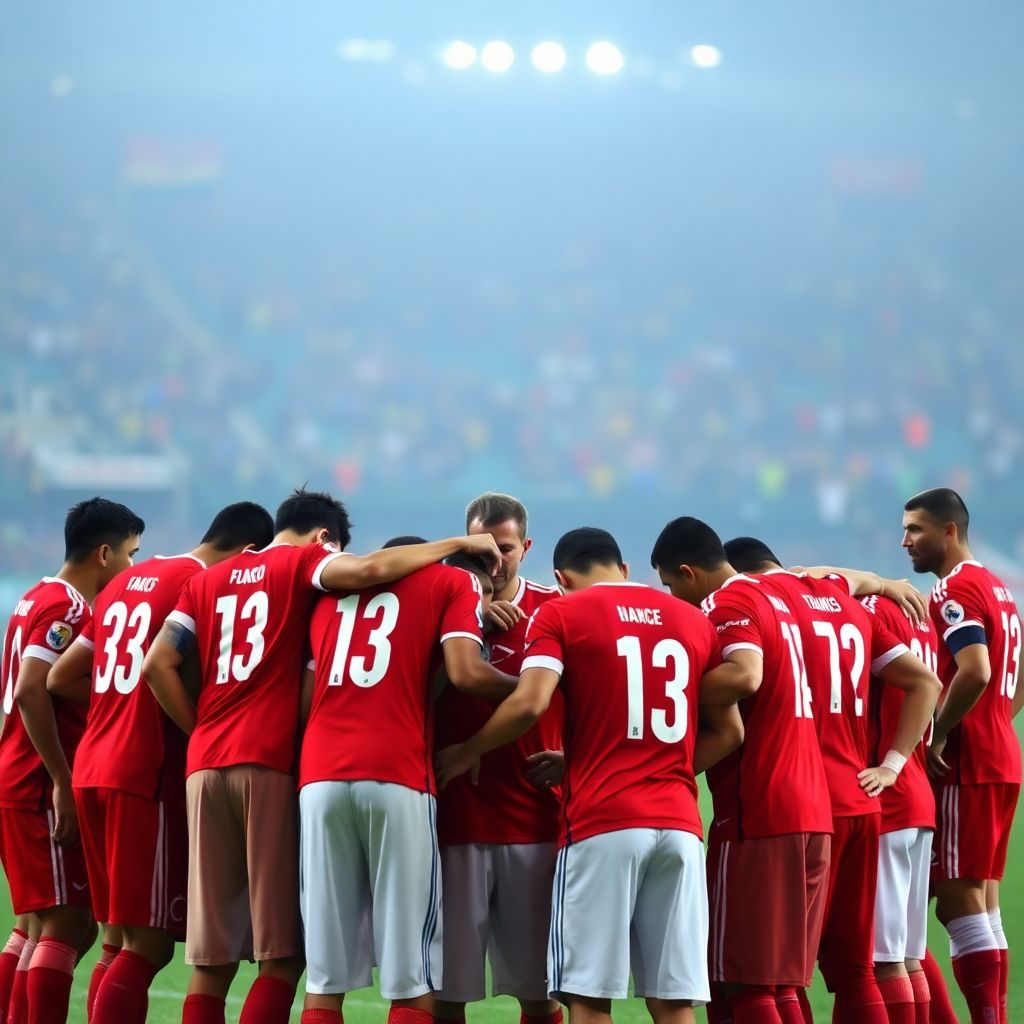
The Only Real Issue: Our Centre-Backs
Former Turkey national team head coach Ersun Yanal believes the current squad has one decisive strength on the road to the World Cup: an exceptional sense of unity. According to him, the team spirit within the Ay-Yıldızlı group is at a very high level and may turn into the key advantage in the tournament. Yet, in his detailed assessment, he points to one clear weakness: the form of the centre-backs.
Yanal, who also previously managed Fenerbahçe and Trabzonspor, followed the Venezuela match from a pitch-side box in the United States and offered a comprehensive “X-ray” of the team. In his words, Turkey is entering the World Cup with a rich attacking arsenal, but the defensive backbone is still not at the desired level.
> “Our team spirit is very strong. This is a crucial criterion for success. Our attacking power is rich; the only problem is the performance of the centre-backs. If we increase our defensive solidity, we can extend our journey at the World Cup. Montella should make more use of Can Uzun and Deniz in this tournament.”
—
Venezuela Match as a Dress Rehearsal
From Yanal’s perspective, the friendly against Venezuela was more than just a preparation game; it was a tactical simulation of the group stage. He underlines that Venezuela’s profile resembles upcoming opponents Australia, Paraguay and the United States, making the match particularly valuable.
Turkey, he says, faced a physically strong, hard-running, compact team that closes down space aggressively and breaks quickly. In such conditions, the national team managed to put out a performance that he considers a solid rehearsal for what awaits them in the group. Not every player is at peak form yet, but the overall structure and readiness look promising.
—
A Deep Squad Rather Than Just Five Ready Names
When asked to name five players he considers “ready,” Yanal refuses to narrow it down to a handful of names. In his evaluation, the current group has a wide pool of players who can step in and contribute at any moment.
He highlights that players like Ferdi Kadıoğlu and Kenan are still to be fully integrated after injuries, and that an in-form Hakan Çalhanoğlu is absolutely “special” for this team. The arrival of new faces such as Deniz Gül further enriches the squad.
From his point of view, the main concern is not in midfield or attack, but specifically at centre-back:
> “There are many players ready to play. Ferdi will come in, Kenan will come in. A good Hakan Çalhanoğlu is unique for this team. With names like Deniz Gül being added, a strong squad is emerging. The only problem, in my opinion, will be the performance of the centre-backs. If they raise their level, our chance in this World Cup will be very high.”
—
Montella’s Midfield Puzzle: Where Does Can Uzun Fit?
One of the hottest topics around the team is young talent Can Uzun. Many observers praise his technical ability and say “the ball suits his feet.” Yanal also sees great potential in him but emphasizes an important nuance: competition in that area of the pitch is fierce.
According to Yanal, Vincenzo Montella will face one of his toughest decisions when choosing the third or even fourth midfielder behind stars like Arda Güler and Hakan Çalhanoğlu. The tactical system and match plan will determine who gets the nod, and there are multiple strong options.
> “In this tournament, after Arda and Hakan, Montella will struggle to choose the third or fourth midfielder, depending on the system. He has many alternatives. Can Uzun is an important player, but I don’t think he will have automatic priority. However, whenever he plays, he will certainly be very useful.”
This highlights a strategic luxury: Turkey now has enough creative, technically gifted midfielders to rotate without a major drop in quality. Used correctly, this depth can become one of the team’s biggest weapons over a long tournament.
—
Deniz Up Front and the “False 9” Debate
Montella is known for his tendency to use Kerem as a centre-forward and to operate effectively without a classic number nine. In the most recent games, however, he has experimented with placing Deniz as the advanced striker, signalling a possible tactical variation.
Yanal believes Deniz is a player whose curve is pointing sharply upward, especially in the striker role:
> “For me, Deniz is a striker who will rise a lot. His performance will increase. But after we get out of the group and into the play-off rounds, Kerem’s form will be crucial. Players like Kenan and Barış are also very close to goal. If we play well collectively, I don’t think we need another ‘big-name’ striker. After the group stage, however, high-quality opponents will push us to the limit.”
In other words, Yanal sees the forward line not as a problem, but as an area of dynamic competition. The key is less about individual star power and more about pressing, movement, and finishing as a unit.
—
Hakan Çalhanoğlu: The Structural Leader of the Team
Hakan Çalhanoğlu returned from injury and got minutes in the Venezuela match, alongside Kerem. Yet to come back fully are Kenan and Ferdi. For Yanal, Hakan is more than just a technical leader; he is the player who gives the team its character.
> “Hakan is, in my opinion, the most important profile in this team. In terms of social influence and team cohesion, he is extremely successful. He has shaped the fabric of this squad. He went through every step from youth to U21 and then the senior national team. His career is progressing at a very high level. I think he is a major part of the impact Montella has built over this team.”
With his personality, professionalism, and consistency, Hakan functions as the axis around which the team’s mentality and game intelligence revolve. For a young group aiming for a big breakthrough, this kind of figure is vital.
—
Physical Rhythm, Travel Fatigue and the Venezuela Performance
Although Turkey defeated Venezuela, there were spells in the game where the tempo visibly dropped. Yanal views this as a normal consequence of context rather than a worrying sign.
He reminds that the team has to cope with long travel distances and time-zone changes in the United States. Adapting to the local clock and recovering physically from repeated flights inevitably affects the intensity displayed on the pitch.
> “We played against a running team: tough, compact, quick in transitions. Considering we arrived after a long journey and will continue to travel across the US, the performance was normal. Until the first match, the team will settle and feel much better.”
Montella’s staff, therefore, has a dual responsibility: maintaining tactical sharpness while carefully managing physical load and recovery. If this balance is struck, the real level of the team will become more visible in the opening group matches.
—
Realistic World Cup Target: The Draw Will Decide a Lot
So what should be a realistic objective for this Turkey side at the World Cup? Yanal’s answer is directly linked to the tournament bracket. In his view, Turkey can go far as long as it avoids the giants too early.
He lists France, Germany, England, Portugal, Brazil and Spain as the most challenging potential opponents. Against such teams, Turkey can always spring a surprise, but the margin for error is very small.
> “Every team is strong and can surprise another, but if we don’t meet teams like France, Germany, England, Portugal, Brazil, Spain too early, I think we will keep going. If we do meet them, we can still cause an upset, but it will be tough.”
This underscores a key point: Turkey has the quality to compete with top nations, yet structural depth, experience in late-stage tournaments, and defensive stability will decide whether those matchups end in miracles or heartbreak.
—
Transitions: A Major Weapon for Turkey
In modern football, Yanal considers transition phases as the core of the game: moving from defence to attack and from attack to defence. He believes the current Turkey squad is especially well-equipped in this area.
The team, he says, has players with the tactical intelligence, positional understanding, and stamina to execute quick and effective transitions. He particularly praises the midfield and, interestingly, the defensive line as a whole (even while criticising the centre-backs’ individual form).
> “Transitions are the most important part of the game. In switches from defence to attack and attack to defence, we have players with strong qualities. We are a team with high endurance, good positioning and the intelligence to execute these transitions. Especially our midfield, and generally our defence, is strong in this regard. They play transition football well, particularly the shift from attack to defence. Another huge advantage is that many of these players are not locked into just one position; they can perform in multiple roles.”
This versatility – full-backs who can play in midfield, wingers who can operate centrally, midfielders who can drop into defence – gives Montella a rare tactical flexibility. It also allows Turkey to adapt quickly within matches to different opponents and game states.
—
Turkey as a Legitimate “Dark Horse”
Many observers list Turkey among the teams that could surprise at the World Cup. Yanal fully agrees with this label and even goes a step further.
> “It’s obvious that this is a team capable of causing surprises. There are players within the group who can become stars of the tournament. As the bonds between these players grow stronger, I think they will have the potential to achieve any ranking.”
The combination of young talents like Arda Güler and Can Uzun with experienced anchors such as Hakan Çalhanoğlu and versatile players like Ferdi Kadıoğlu makes this squad particularly intriguing. If the psychological resilience matches the technical potential, Turkey could indeed become one of the tournament’s stories.
—
Arda Güler: Investing in His Own Future
Although the original remarks only briefly touch on it, Yanal’s view of Arda Güler can be summarized as seeing him as a player who is “investing in himself.” Every minute Arda plays at club and international level, every experience in big stadiums and pressure situations, enriches his footballing intelligence.
For Turkey, Arda is more than a talented playmaker. He is a symbol of a new generation that is not afraid to leave early for Europe’s biggest clubs, to compete for playing time, and to carry creative responsibility. If he stays healthy and continues to grow tactically, Arda can become the face of the national team for the next decade.
—
Why Centre-Backs Are the Only Major Question Mark
When Yanal repeatedly emphasizes the centre-backs as the “only problem,” he is not saying Turkey is weak in defence overall. Rather, he points to a gap between the high level of the attacking and midfield units and the current form and consistency of the central defenders.
At World Cup level, single mistakes in the heart of defence are often punished ruthlessly. Positioning errors on set pieces, late reactions in covering depth, or misjudged duels against physically dominant strikers can instantly erase the benefits of strong team play.
For Turkey to truly maximise its potential, the centre-backs must:
– Improve concentration over 90 minutes against top opposition
– Coordinate better with full-backs and the defensive midfielder
– Take cleaner decisions in buildup to avoid risky turnovers
– Dominate aerial duels, especially in their own box
If this unit reaches a stable, reliable level, the rest of the team is already equipped to compete with anyone.
—
The Continuity Problem: Why Turkey Swings Between Peaks and Absences
History shows a pattern: Turkey sometimes shines at major tournaments, then disappears from the stage for long periods. Yanal ties this inconsistency to deeper structural issues rather than to individual generations of players.
Turkey possesses one of the youngest populations in Europe and enormous raw talent, not just in football but across multiple sports. Yet the country has struggled to build a system that continuously produces, develops, and integrates this talent at the highest level.
To achieve continuity, several long-term steps are essential:
– Strengthening youth academies with modern training methods and data-driven development
– Ensuring that promising players get regular minutes at club level instead of being blocked by short-term foreign signings
– Creating a unified football philosophy from youth to senior national teams
– Investing in coaching education so that every age group works with well-prepared, modern-thinking coaches
– Building mental resilience programs to help players handle pressure in decisive qualifiers and tournaments
Yanal hints that these are not topics that can be solved with quick fixes. They require serious strategic planning, patience and the willingness to think beyond one tournament cycle.
—
Olympic Lessons and the Broader Sporting Context
When he touches on the Olympics, Yanal implicitly points to a wider pattern: Turkey occasionally wins medals or reaches finals in various branches, but rarely sustains that success over decades. The same logic applies to football.
From this angle, the World Cup journey is not just about one generation or one coach. It is also a test of whether Turkish football has learned from past cycles, can stabilise its production line, and can transform individual brilliance into a lasting culture of success.
If the current national team manages to go far at the World Cup while playing modern, courageous football, it could accelerate reforms at youth level and inspire clubs to trust young domestic players more. That would be one of the most valuable legacies of this generation.
—
What Will Ultimately Decide Turkey’s Fate?
Summing up Yanal’s perspective, Turkey’s World Cup fate will be determined by a few intertwined factors:
– Maintaining and protecting the exceptional team spirit already present
– Fixing or at least minimizing the vulnerabilities at centre-back
– Using creative players like Arda, Hakan and Can Uzun in roles that maximise their strengths
– Managing physical load and travel fatigue intelligently in the US
– Avoiding the biggest favourites too early in the knockout stages
– Playing to its major strength: fast, intelligent transition football with versatile players
If these pieces fall into place, Turkey is not just a team that might “surprise” – it can become a serious contender that writes one of the most compelling stories of the tournament. If not, the experience will still be a crucial step in building the continuity and long-term structure that Turkish football has sought for years.