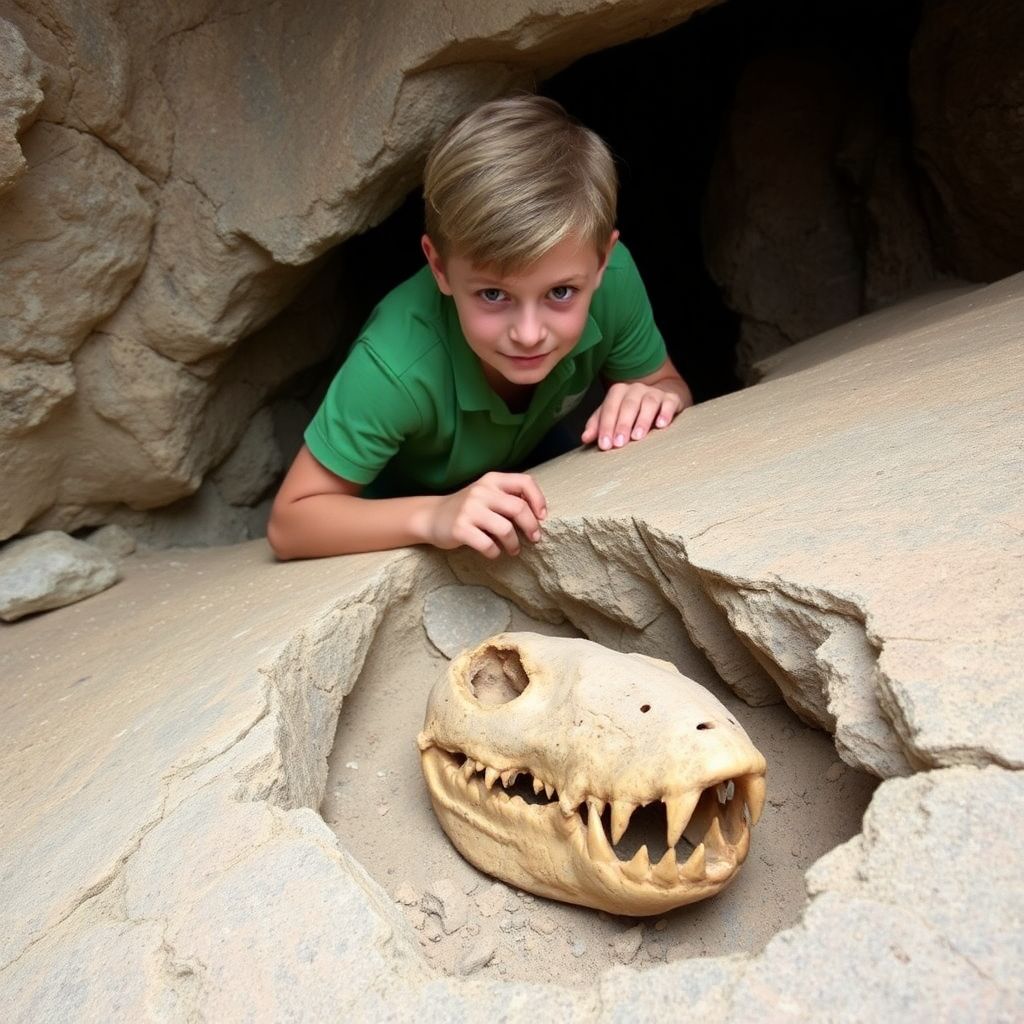
A 52-million-year-old giant fish skull has been unearthed in Wyoming – and the person who spotted it was not a veteran paleontologist, but a high school student splitting rocks with a hammer.
During a summer field program in a dry, stony corner of Wyoming near Kemmerer, California teenager Gabe Robinson was carefully breaking open pieces of rock when one slab split to reveal something extraordinary: the face of an ancient fish staring back at him. The exposed fossil showed a long, crocodile-like snout lined with small, sharp teeth – the unmistakable profile of a gar, a predatory fish that has changed little in over 100 million years.
At first, the discovery did not even look particularly dramatic. What caught attention was not the full shape of the skull, but subtle raised areas on the surface of the rock that resembled bone. Teaching assistant Patrick Riordan was the first to notice the unusual protrusions and call for a closer look. When Field Museum curator Lance Grande arrived to inspect the specimen, he realized this was far from a routine find: embedded in the slab was an almost complete skull of a massive gar fish dating back approximately 52 million years.
Grande, who has overseen the program for 16 years, described the discovery as one of the most significant in the project’s history. In an area scoured by fossil hunters for decades, the odds of finding a largely intact skull of a large fish are vanishingly small. Most of the time, paleontologists must work with scattered fragments. To uncover an entire skull, and of such a large animal, is exceptionally rare.
The fish itself would have been impressive in life. Based on the size of the skull, researchers estimate the gar’s total length at close to two and a half meters. That would have made it a dominant predator in the lake ecosystem that once covered what is now a high, arid plateau. Today the region is cold, windblown and largely barren, snowbound for much of the year. But 52 million years ago, during the Eocene epoch, this landscape was home to a warm, almost tropical lake teeming with life – fish, turtles, and a rich variety of other aquatic organisms.
The fossil was found in the Green River Formation, specifically on Lewis Ranch and Tynsky Quarry near Kemmerer. The Green River Formation is one of North America’s most productive fossil deposits, renowned for exquisitely preserved fish remains. Collectors and scientists have worked this region for many years, documenting layer upon layer of ancient lake sediments. Precisely because the formation has been so thoroughly explored, discovering such a well-preserved, large skull here is particularly surprising. It suggests that even in “well-known” fossil beds, major finds can still be hiding in plain sight, sealed within unassuming pieces of rock.
Preserving any fossil is a matter of extreme geological luck. For an animal to fossilize, it usually must be buried quickly after death, before scavengers, decay, and water currents can scatter or destroy its remains. Even when conditions are ideal, most skeletons end up distorted, crushed, or disarticulated over millions of years under the weight of accumulating sediments.
Grande emphasizes this point: when fossilization does occur, it is typically in a fragmented state. Delicate bones, particularly skull bones, are prone to breaking and collapsing under pressure. Fish skulls are especially fragile because they are made of thin, lightweight bones that are easily crushed as more sediment accumulates on top. Discovering a recognizable fish skeleton is already uncommon; finding a nearly complete skull of a large fish is something that borders on extraordinary.
The gar to which this skull belonged was no ordinary fish species in evolutionary terms either. Gars are often described as “living fossils” because their overall body plan has remained strikingly similar for more than 100 million years. Modern gars still patrol the freshwaters of North America with their elongated bodies, armored scales, and toothy snouts, much like their ancient relatives. Robinson’s find therefore represents a distant ancestor of species that are still swimming in rivers and lakes today – a direct link between the modern fauna and a long-vanished Eocene ecosystem.
The discovery emerged from a program called Stones and Bones, a four‑week educational initiative run jointly by the University of Chicago and the Field Museum. Unlike many academic field schools aimed at university students, this one is designed specifically for high schoolers. Participants spend the first week working in the museum, learning how to handle specimens, understand rock layers, and recognize fossils. The next two weeks are spent in the field, where students put their training into practice at active excavation sites such as the Green River Formation.
Robinson was one of these students, and his discovery underscores how meaningful contributions to science can come from newcomers as well as seasoned professionals. Under guidance, curious and patient teenage participants can make finds that reshape what researchers know about an ecosystem or fossil group. It also highlights the value of exposing young people to real scientific work instead of limiting them to classroom simulations.
Now that the skull has been excavated, the delicate work shifts from field to laboratory. Fossils rarely emerge from rock ready for display. The specimen is being prepared by the Field Museum’s preparator, Tony Bellos, who will painstakingly remove the surrounding rock matrix using specialized tools under a microscope. This process can take weeks or months, depending on the fragility of the bone and the hardness of the rock. Every flake removed must be carefully controlled to avoid damaging the fossil itself.
Once cleaned and stabilized, the skull will be cataloged, labeled, and stored among the roughly 30 million specimens housed in the Field Museum’s collections in Chicago. Whether it eventually goes on public display or remains available primarily for research has not yet been decided. Many of the most scientifically important specimens never reach the exhibition halls, but instead live in climate‑controlled storage, where they can be examined by specialists from around the world. Regardless of its future, the skull will be permanently preserved as part of the museum’s scientific record.
Beyond the drama of a spectacular fossil, this find carries wider implications for how we understand ancient lakes and long‑term environmental change. The Green River Formation represents one of the best-documented ancient lake systems on Earth. It records seasonal layers of sediment, volcanic ash, and organic material, capturing a detailed picture of climate, water chemistry, and biodiversity over millions of years. Large top predators like this gar help scientists reconstruct the structure of that ecosystem: what occupied the top of the food chain, how energy flowed through the environment, and how many large fish a lake of that size could support.
The presence of such a big gar also suggests that the lake system was stable and productive for long stretches of time. Apex predators generally require abundant prey and relatively predictable conditions. Their fossils hint at a balanced and intricate web of life – from algae and plankton to insects, small fish, and turtles – all operating under a climate warmer and more humid than today’s conditions in the same region.
Finds like this also invite comparison with modern gar populations. Today, gars sometimes suffer from habitat loss, river modification, and misunderstandings that lead to their removal from certain waterways. Seeing that their lineage has survived tens of millions of years of natural climate fluctuations and geological upheavals, only to be threatened by recent human activity, gives conservation efforts a deeper evolutionary context. The fossil skull is not just a relic of a bygone world; it is a reminder that many of Earth’s living species carry very ancient histories.
The story further illustrates how much scientific value may still be locked inside seemingly ordinary rocks. To an untrained eye, the slab Robinson split would have looked like any other piece of stone. It took patient observation, basic training, and a willingness to look twice at a subtle bump to transform it into a window onto the Eocene. This is why fieldwork often involves slowly and systematically examining rock after rock, knowing that 99 out of 100 may contain nothing – but the hundredth can preserve a once‑in‑a‑lifetime specimen.
For students and educators alike, this discovery is a powerful argument for hands‑on science education. Allowing teenagers to work side by side with professionals, to make real contributions and handle objects that are tens of millions of years old, can fundamentally change how they see science and their own potential role in it. A fossil like this can launch not only research papers, but careers – and can inspire peers who read about a high school student making a find that even experts rarely encounter.
In the end, what began as a simple swing of a hammer in a remote Wyoming quarry turned into a major paleontological event. A long‑snouted predator from a tropical lake, buried under layers of mud and compressed into stone for 52 million years, has resurfaced thanks to a moment of curiosity and careful attention. Its nearly complete skull now bridges the gap between an ancient, lush world and our present‑day high desert – and between expert science and the fresh eyes of a high school student who happened to be in exactly the right place at exactly the right time.