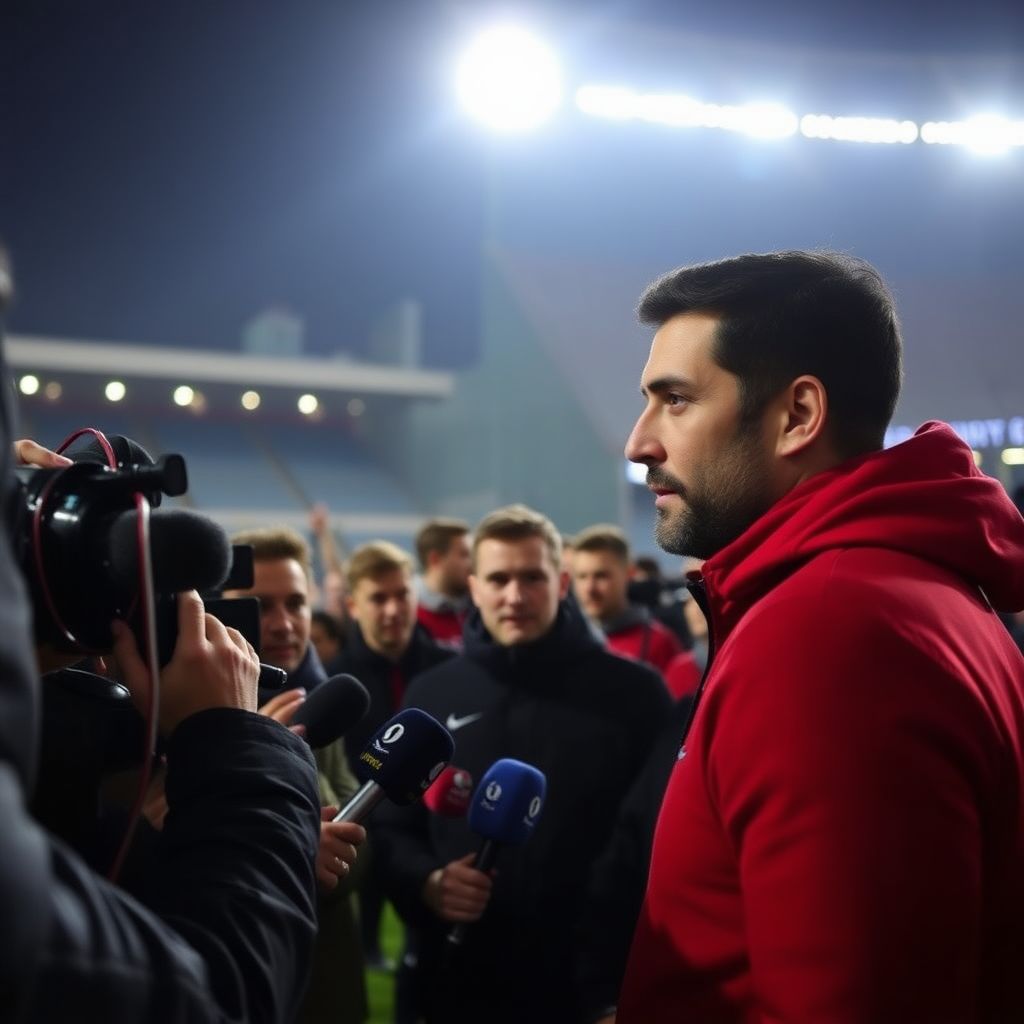
Hakan Çalhanoğlu responds to transfer rumours: clear message after Venezuela match
The friendly victory over Venezuela ended with a 2-1 win for Türkiye, but the final whistle did not stop the questions. As soon as Hakan Çalhanoğlu left the pitch, the focus quickly shifted from the national team’s performance to his future at club level and the growing rumours linking him with Fenerbahçe.
In recent weeks, reports have claimed that Fenerbahçe presidential candidate Hakan Safi reached a 3+1‑year preliminary agreement with the Inter midfielder and captain of the Turkish national team. According to these claims, if Safi wins the election and takes office, one of his first blockbuster moves would be to “bring Çalhanoğlu to Kadıköy” and rebuild the heart of Fenerbahçe’s midfield around him.
After the Venezuela game, Çalhanoğlu was inevitably asked about these transfer stories. His response was measured and carefully worded. He underlined that he is currently an Inter player, that he respects his contract and his club, and that his full concentration is on both Inter and the national team. Without giving a direct yes or no about Fenerbahçe, he effectively cooled down the euphoria around an immediate move by stressing that this is “not the right time” to discuss transfer decisions publicly while he is on international duty.
In other words, he did not slam the door on a future return to Türkiye, but he made it clear that, for now, nothing is settled and his priority is to perform where he is.
Fenerbahçe elections turn into a transfer battleground
The background to this story is a highly charged presidential election at Fenerbahçe. The choice is being framed as Aziz Yıldırım versus Hakan Safi, with both camps trying to impress the fans by promising ambitious sporting projects and high-profile signings.
On one side stands Aziz Yıldırım, the former long‑time president, who has built his campaign around emotion, nostalgia and the promise of returning Fenerbahçe to title-winning days. During the congress he delivered a particularly emotional speech, confessing how much he misses celebrating championships in the club’s own stadium and hearing the “championship songs” echo from the stands again. It was a message tailored to a fan base tired of waiting and hungry for trophies.
Opposite him is Hakan Safi, presenting himself as the leader of a new era, determined to break old habits and structures. His rhetoric has been aggressive and direct. In one of his strongest lines, he declared: “If it’s about the table, I break the table; if it’s about the structure, I tear down the structure.” The slogan is meant to signal that no internal balance of power, no informal network and no entrenched interest will stand in the way of his plans.
Within this heated political climate, the idea of landing Hakan Çalhanoğlu has become more than just a transfer – it has turned into a symbol. For Safi, it would be a statement that Fenerbahçe can bring back top Turkish stars in their prime. For Yıldırım’s supporters, it highlights the pressure to respond with equally strong sporting guarantees.
A national team win, a captain under scrutiny
Türkiye’s 2-1 victory over Venezuela provided a welcome boost ahead of tougher challenges for the national team. As captain, Çalhanoğlu once again operated as the brain of the side, dictating tempo, helping build play from deep and providing defensive balance. The performance reaffirmed why he remains one of the most influential Turkish players in Europe.
But the match also showed the downside of modern football celebrity: even on a night when the national team wins, club speculation overshadows tactics and team development. The first and loudest question after the game was not about Venezuela’s pressing or Türkiye’s attacking transitions, but about whether Çalhanoğlu will be wearing yellow and navy blue in Kadıköy next season.
His answer, while calm, was a subtle attempt to keep the focus where he wants it – on the pitch, not on election campaigns and transfer politics.
What Çalhanoğlu’s answer really tells us
On the surface, Çalhanoğlu’s words may sound like the usual diplomatic response: respect for his current club, concentration on the national team, and no commitment to the rumours. But read between the lines and several points stand out:
– He did not validate the notion of a signed or sealed agreement with any Fenerbahçe candidate.
– He emphasized his satisfaction at Inter, a club where he has become a key figure.
– He left space for future possibilities without locking himself into any scenario.
– He signalled that he does not want his name used as a campaign tool while political battles unfold at club level.
For Inter, this is reassuring. For Fenerbahçe fans, it is a message that hope is allowed, but expectations of an imminent announcement are premature.
Greenwood, Suárez, Demiral and the new transfer chessboard
Fenerbahçe’s transfer agenda is not limited to Çalhanoğlu. Another big storyline is the pursuit of Mason Greenwood. At one stage, Roma seemed to have moved to the front of the queue for the English forward, influencing how Fenerbahçe organize their offensive options for the new season. That apparent advantage for the Italians forced Fenerbahçe to reconsider their priorities and look at alternative attacking targets, while still keeping Greenwood on the radar.
Luis Suárez’s name has also circulated around Istanbul. Even without explicit statements, his body language and short comments in recent months have been dissected in detail, with observers claiming that “he did not say anything, but he said everything.” The idea is that Suárez, through his guarded remarks, has hinted at being open to a final European challenge, adding more fuel to the rumour mill.
Merih Demiral is another player whose future could be affected by Fenerbahçe’s election results. The Turkish centre‑back has long been mentioned as a candidate to strengthen the defence. A Safi victory, with its promised structural overhaul and big-name signings, could push Fenerbahçe to accelerate efforts to bring Demiral home. In contrast, a different sporting strategy under Aziz Yıldırım might prioritise other profiles and positions.
In all these cases, Çalhanoğlu’s situation acts as a sort of barometer for the scale of Fenerbahçe’s ambitions: if they can seriously compete for a star installed at a Champions League club like Inter, then no high-profile target is off limits.
What happens if Hakan Safi loses?
A crucial question hangs over the race: what becomes of Safi’s transfer plans if he fails to win the election? The scenario affects not only Çalhanoğlu, but also names such as Suárez, Greenwood and Demiral, who have all been associated in various ways with his campaign.
If Safi is defeated:
– Any informal or preliminary understandings he might have developed with players or agents will effectively lose their institutional backing.
– New management might not feel bound by promises made during the campaign.
– Financial frameworks and risk levels for transfers could be revised, changing the viability of big signings.
– Players may hesitate to commit to a club in leadership flux without clear sporting direction.
In simple terms, a Safi defeat would put a question mark over every move that has been linked directly to his presidential project. Some deals might survive if they make sense on a purely sporting and financial level, but the political drive behind them would vanish.
What if Aziz Yıldırım is the one who loses?
The reverse scenario is equally significant for Fenerbahçe’s future. If Aziz Yıldırım does not return to the presidency, it would symbolise a definitive end to an era. For years, he embodied power, continuity and a particular style of leadership at the club.
His defeat would mean:
– A full departure from the methods and networks built during his long tenure.
– The emotional promise of “bringing back the championship songs” would remain unfulfilled, at least under his guidance.
– The responsibility for rebuilding Fenerbahçe’s winning identity would fall entirely on a new generation of leaders.
– The club would be pushed to modernise its approach to scouting, analytics, finances and communication under a different vision.
For the players linked with Fenerbahçe, Yıldırım’s loss would not necessarily end transfer interest, but it would reset the context. They would have to evaluate a different project, different people in charge and, in some cases, a different style of football.
Galatasaray: cleaning the house and looking ahead
While Fenerbahçe are consumed by elections and transfer promises, Galatasaray are facing their own crossroads. Inside the club there is talk of a “clean‑up time” in the squad. The focus is shifting from who will arrive to who must leave. Underperforming or ageing players, large salaries and imbalanced positions are all under review.
Some of the players who previously enjoyed the trust of certain coaches are now on the exit list. Names associated closely with Sergen Yalçın’s preferences, for instance, are reportedly heading for the departure gate as the club prepares for a new technical direction. Meanwhile, coach Vincenzo Italiano has already delivered something of a cold shower to Serdal Adalı by signalling that his tactical plans require different profiles than those initially discussed.
In parallel, Galatasaray are working on a strategic move for Can Uzun. The plan involves finding the right formula to prise the talent away from Frankfurt, possibly using a combination of transfer fee, long-term development promises and a leading role in the squad. This shows that despite the internal “cleaning operation”, Galatasaray are far from passive in the market.
Inside Galatasaray’s transfer list
A detailed analysis of Galatasaray’s squad needs has produced an internal “X‑ray” of positions to be reinforced. From that has emerged a transfer list that covers multiple zones of the pitch: a creative midfielder, a modern full‑back, a versatile forward and at least one centre‑back.
Agent Gardi has reportedly put six names on the table as potential solutions, and club executives are already examining which of them fit both the tactical model and the financial reality. Some of these targets are designed to be immediate starters, others to add depth and future resale value. The challenge for Galatasaray is to reshape the squad without losing the competitive edge required for both domestic and European campaigns.
Trabzonspor and the looming 30 June deadline
Away from Istanbul, Trabzonspor are wrestling with their own problems – and there are many of them. The club is facing what some insiders describe as “eight major issues” that could shape their season, from unpaid debts and contract renewals to squad gaps and UEFA financial constraints.
The date 30 June looms large. It is a turning point for accounting, for contract clauses, for loan deals and for compliance with financial regulations. Without clear solutions by then, Trabzonspor risk entering the new season with serious structural weaknesses, both on and off the pitch. The club must balance immediate sporting needs with long‑term sustainability, a task that is becoming increasingly difficult in today’s football economy.
Could İsmail Yüksek really join Galatasaray?
Amid all of this, another provocative question has surfaced: could İsmail Yüksek move from Fenerbahçe to Galatasaray? On paper, such a transfer is explosive. The midfielder has become one of Fenerbahçe’s most valuable assets and a key player for the Turkish national team.
Theoretically, things like expiring contracts, release clauses or irresistible offers can open doors that fans consider unthinkable. But politically and emotionally, a direct move from Fenerbahçe to Galatasaray carries enormous weight. It would require not only a strong financial package, but also a player willing to face the pressure and criticism that come with crossing such a historic divide.
Here, Çalhanoğlu’s stance again offers a clue: top Turkish players abroad are very aware of how intense domestic rivalries are. Any decision to return home is weighed not just in sporting terms, but also through the lens of fan culture, media pressure and long-term legacy.
The bottom line on Çalhanoğlu’s future
After the Venezuela match, Hakan Çalhanoğlu did not deliver the headline some Fenerbahçe fans were hoping for. He did not confirm a pre‑agreement with Hakan Safi, nor did he promise to come to Kadıköy if a particular candidate wins. Instead, he chose the path of professionalism: he reaffirmed his commitment to Inter and to the national team, left his options open for the future and refused to be drawn into the election battle.
For now, the story is this: Fenerbahçe are at a historic turning point, presidential candidates are using big names to strengthen their hand, and Turkish giants across the board – from Fenerbahçe to Galatasaray and Trabzonspor – are trying to navigate a complex transfer market.
Hakan Çalhanoğlu remains at the centre of attention, but the only certainty he has offered is that the present belongs to Inter and Türkiye. Everything else will depend on elections, negotiations, finances and, not least, his own long‑term vision for his career.