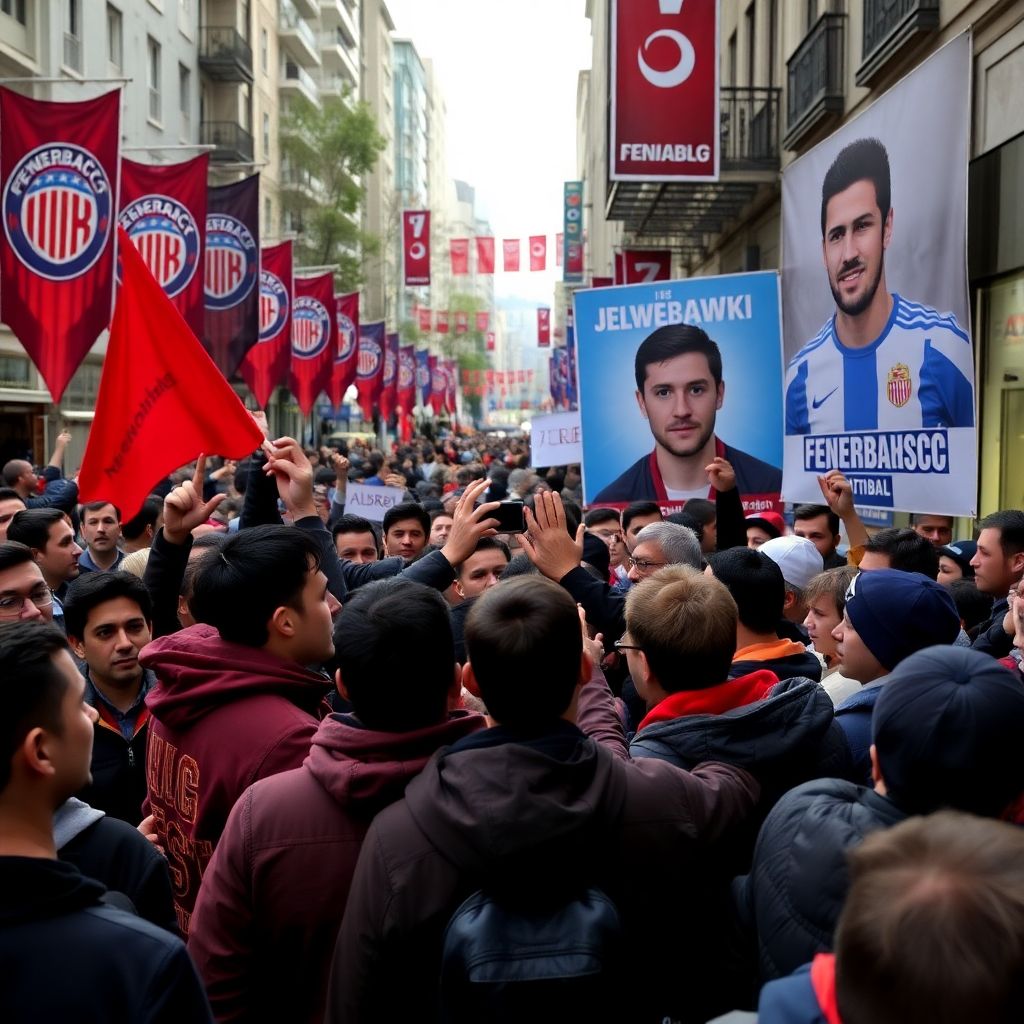
Lewandowski debate shakes Fenerbahçe as elections approach
The idea of bringing Robert Lewandowski to Istanbul has turned Fenerbahçe into a battleground of opinions. Presidential candidate Hakan Safi’s bold promise to sign the Polish superstar has electrified part of the fan base, while another part sees it as a dangerous, expensive gamble that could destabilize the club’s financial balance and sporting project.
The controversy immediately revived the famous warning of former president Aziz Yıldırım: “Don’t waste the club’s money on ageing players.” That sentence, once seen as a general principle, now sounds like a direct response to the Lewandowski plan. Many supporters interpret Safi’s proposal as an all‑in move on a veteran star rather than an investment in a sustainable squad.
Hakan Safi: “We will build the most ambitious squad in the club’s history”
Safi, however, is not backing down. In his campaign, he insists that Fenerbahçe must think big again, arguing that the club has the financial and sporting power to attract top names. According to Safi, a figure like Lewandowski would not only boost the team’s scoring power but also transform the club’s international image, merchandising, and sponsorship opportunities.
He presents the transfer as part of a larger, aggressive squad overhaul: a team built to dominate domestically and finally break the bad luck in European competitions. In that vision, Lewandowski is the headline act, the symbol that Fenerbahçe is ready to sit at the same table as the European elite.
The age factor: risk or opportunity?
The core of the debate revolves around Lewandowski’s age. At 30+ and with a long career at the top level, critics argue that his best years may be behind him. They point to the financial cost of wages and potential transfer fee, warning that signing such a player could limit resources for younger, resale‑valued talents.
Supporters of the move respond that experience is precisely what Fenerbahçe needs. In their view, Lewandowski’s professionalism, training discipline, and winning mentality could raise standards in the dressing room. They see him as a short‑term but high‑impact solution: a forward who still guarantees goals, attracts better teammates, and forces opponents to change their game plans.
Osimhen speaks out: “My words were exaggerated”
While Lewandowski dominates the domestic debate, another big‑name striker, Victor Osimhen, broke his silence regarding transfer rumors. Recent comments attributed to the Nigerian forward were widely circulated and interpreted as a clear farewell message. Osimhen later clarified that his words had been exaggerated and taken out of context.
This correction cooled down some of the speculation, but also underlined how chaotic and noisy the transfer market has become. For Fenerbahçe, it was a reminder that even when a star’s name is loudly linked with a move, the reality behind the scenes can be very different.
Semih Kılıçsoy’s future becomes clearer
Another key topic for Turkish football is the future of young striker Semih Kılıçsoy. Recent developments have brought more clarity: the outline of his next step is becoming visible, and it appears he will continue to grow within a project that treats him as a central piece rather than a tradeable asset.
For Fenerbahçe, this example is often cited by those who oppose the Lewandowski move. They argue that Turkish clubs should emulate a model based on youth development and smart scouting instead of short‑term, high‑cost star signings. In their view, every euro spent on an ageing icon is one less invested in the next Kılıçsoy.
Noa Lang and the Beşiktaş angle
The market race between the Istanbul giants is heating up. One of the names most frequently mentioned around Beşiktaş is Noa Lang. Although various destinations have been floated, it is increasingly clear what the player’s first choice is, shaping Beşiktaş’s plans and budget.
Lang’s case shows the competition Fenerbahçe faces: while one club focuses on a flamboyant, global name like Lewandowski, another may choose a younger, more dynamic winger, hoping to build a team that can be sold on for profit later. Each strategy has its own risks and rewards, and the fans are carefully watching which model will bring faster success.
Hakan Safi’s domestic transfer targets: Çalhanoğlu and Can Uzun
Lewandowski is not Safi’s only “bomb.” Among his most talked‑about promises are moves for Hakan Çalhanoğlu and young talent Can Uzun. Çalhanoğlu, with his set‑piece mastery and playmaking abilities, is seen as a natural leader in midfield, while Uzun represents the new generation of attacking players, versatile and hungry.
With these names, Safi is trying to balance his project in the eyes of critics: a blend of global superstars and Turkish‑origin talents. The idea is to convince supporters that the club will not be built solely around a single ageing star, but around a spine that can compete for several years.
Aziz Yıldırım and the call for prudence
Former president Aziz Yıldırım’s shadow hangs over the entire discussion. His statement about “not feeding the money to old players” has become a slogan for those who want a more cautious approach. They recall past periods when expensive signings failed to deliver silverware, leaving behind only heavy contracts and financial strain.
Yıldırım’s camp emphasizes the need for defensive stability and structural planning. Rumors that he is eyeing a “dream duo” for the back line fit with this philosophy: less glamour, more balance. For these voices, a solid defender who will anchor the team for five years is worth more than a superstar striker who might stay two seasons.
UEFA sanctions question: who would be responsible?
Another layer to the controversy is the fear of potential UEFA sanctions. The debate is not just about sporting performance; it is about whether an aggressive transfer policy might push the club too close to financial fair play limits. Within this climate, the question “Who will be responsible if UEFA punishes Fenerbahçe?” is being asked more often.
Critics of the Lewandowski plan argue that leaders must think beyond election cycles. If an expensive project fails or triggers sanctions, it is the club, not a single administration, that pays the long‑term price. Supporters of the plan counter that without bold steps, Fenerbahçe will remain stuck in a cycle of near‑misses.
Young blood for Galatasaray, interest from Trabzonspor
While Fenerbahçe wrestles with its star‑signing dilemma, Galatasaray is reportedly closing in on a young Ukrainian talent. Trabzonspor had also shown interest, but Galatasaray seem a step ahead. This underlines a trend: other top clubs are focusing on developing promising players, hoping to combine on‑field success with future transfer income.
For neutral observers, this contrast raises a strategic question: will the Turkish league be shaped in the coming years by high‑profile veterans or by emerging prospects from Eastern Europe, Africa, and South America?
New faces in Beşiktaş: “talent‑hunter” coach
Beşiktaş, for its part, is preparing to bring in a coach known for spotting and developing hidden talents. This move signals a clear direction: a more systematic scouting network, long‑term planning, and a style of football built on adaptable, multi‑functional players rather than just individual stars.
For Fenerbahçe fans watching from the outside, this adds pressure. If their rivals successfully implement sustainable, youth‑centric projects, the cost of a failed “superstar era” in Kadıköy could be even higher.
The broader cultural climate and controversial transfers
Around all of this, the political and cultural climate of football remains tense. Hakan Safi has already been associated with a transfer that some say would “drive feminists crazy,” adding another layer of controversy to his image. While details of that potential move are debated, it shows how transfer decisions today are not only sporting or financial but also social and symbolic.
Clubs are increasingly judged not just by trophies, but by the values their signings appear to represent. A big name like Lewandowski arrives with a huge media package, and every gesture, interview, and commercial becomes part of the club’s identity.
Maldini, Beppe Riso and the “prince” of Safi’s project
Another intriguing angle is the mention of Paolo Maldini and agent Beppe Riso. Maldini’s methods and Riso’s network are cited as inspirations in building Safi’s new structure. Within that framework, a young player has been described as Safi’s “prince” – a future cornerstone around whom the long‑term project will be built.
This suggests that, behind the noise of the Lewandowski debate, there is an attempt to construct a more sophisticated recruitment model: mixing star power with carefully selected prospects guided by experienced football minds.
Fans’ perspective: glory now or stability later?
At the heart of it all lies a simple but emotional question for Fenerbahçe supporters: is it time to gamble everything on immediate glory, or to accept a slower, more cautious rebuild? Some fans, tired of narrow title races and early European exits, want a name that will fill the stadium and scare opponents from day one. For them, Lewandowski is a once‑in‑a‑generation chance.
Others fear repeating old mistakes. They want a club that stands on solid financial ground, produces its own stars, and no longer lives and dies by the form of one ageing superstar. Their priority is a club that will still be competitive and healthy in ten years, not just in the next season.
What Lewandowski would really change
If the transfer were to happen, Lewandowski would do far more than just wear the yellow‑navy shirt. His arrival would shake up tactics, marketing, dressing‑room hierarchy, and the league’s global visibility. Sponsors would queue up, TV ratings would spike, and every away trip would feel like a special event.
But with that spotlight comes pressure. A single missed chance, a minor injury, or a dip in form would be scrutinized endlessly. In such an environment, the club’s internal structure, medical staff, and technical planning must be flawless. Otherwise, a move intended to symbolize rebirth could quickly be rebranded as an expensive miscalculation.
Between dream and reality
For now, the Lewandowski debate remains suspended between dream and reality. Whether the Polish striker ever sets foot in Kadıköy or not, he has already forced Fenerbahçe to confront big questions about its identity, ambitions, and strategy.
As the election day approaches, supporters will not only be choosing a president; they will be choosing a path. A vote for Safi may be read as a mandate for radical, star‑driven change. A vote for a more cautious candidate may signal trust in gradual rebuilding. In either case, the outcome will shape not just one transfer window, but the direction of Fenerbahçe for years to come.