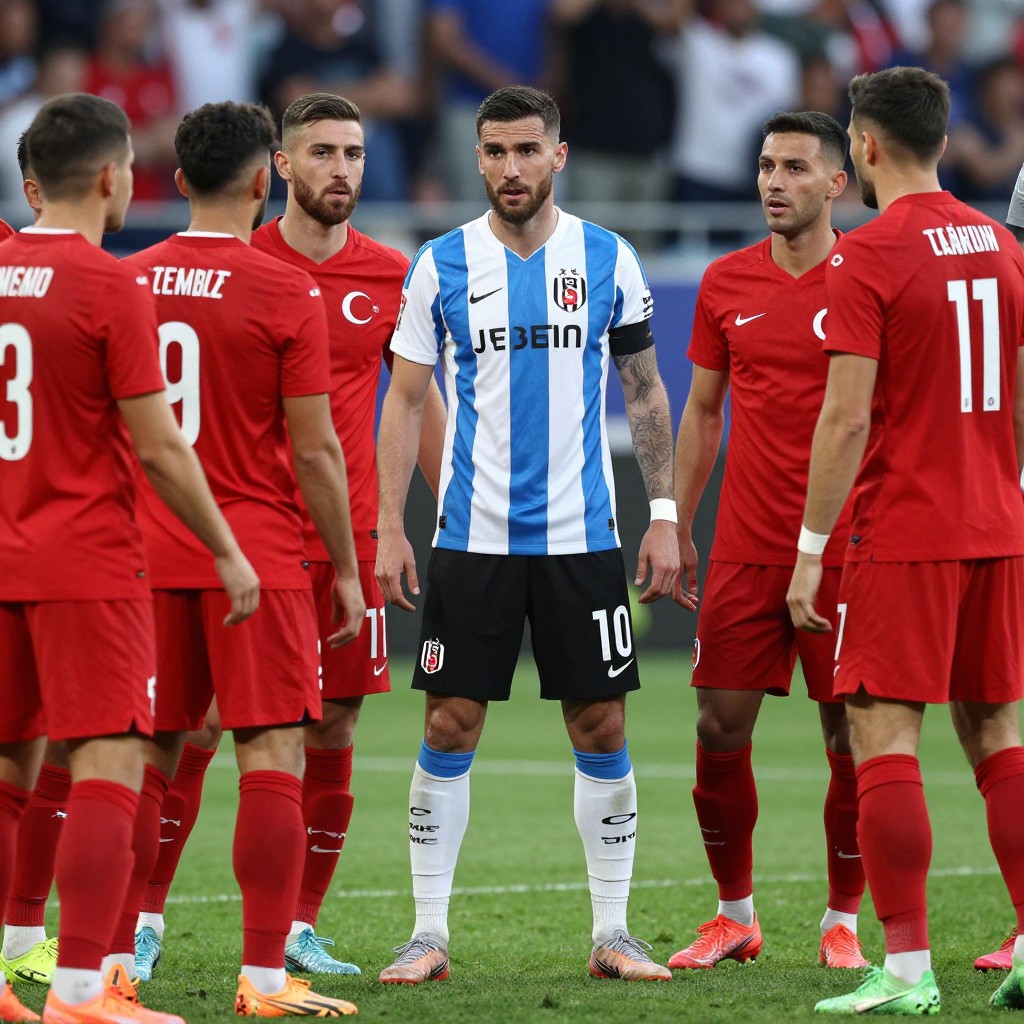
YOUR TURN: ARE BEŞİKTAŞ PLAYERS WELCOME IN THE NATIONAL TEAM?
Serhat Akın’s remarks about Beşiktaş winger İlhan Fakılı and midfielder Salih Özcan have reignited a familiar question: do players from the black-and-white club receive fair consideration when Türkiye’s national teams are selected?
The debate followed a decision to move Fakılı from the senior squad to the Under-21 side after he had initially been called up to the A National Team. The change came ahead of a significant match against Ukraine, prompting Akın to question why one of Beşiktaş’s most in-form Turkish players would not remain with the senior team.
Akın: Fakılı is among the country’s best-performing domestic wingers
Akın argued that Fakılı’s current form warranted a place in the senior squad. He pointed to the player’s strong performances for Beşiktaş and questioned the uncertainty surrounding his call-up, suggesting that the winger was presently one of the most effective Turkish wide players in the domestic game.
The issue is not simply whether Fakılı should have started against Ukraine. Supporters have also focused on the sequence of events: he was selected for the A team, then reassigned to the Under-21s. For a young footballer, that shift can raise questions about how the coaching staff view his readiness and long-term prospects.
Akın also criticised the national team’s handling of Salih Özcan. In his view, Özcan’s place in the side might have depended on the absence of Hakan Çalhanoğlu. He suggested that, if Çalhanoğlu had been available, Salih could have been left on the bench, and questioned how the midfield would have been arranged had other options, including İsmail, been considered.
His broader accusation was pointed: Beşiktaş players, he argued, do not seem to receive the same confidence as footballers from other clubs. He asked whether Beşiktaş was somehow being treated as though it belonged to a different country.
A question of selection-or a deeper pattern?
Akın’s comments have revived a longstanding sense among some Beşiktaş supporters that their club’s players are overlooked by national-team decision-makers. Fans who share that view cite both current selection choices and examples from earlier generations, arguing that prominent Beşiktaş players have not always received opportunities they believe their ability deserved.
Names such as Rıdvan, İlhan Fakılı, Orkun and Salih have been mentioned in discussions about who should be called up or given more playing time. Some supporters have also argued that a midfield featuring Orkun, Arda and Salih could offer a strong combination of technical skill, energy and balance. These are subjective judgments, but they reflect a wider concern: whether selection decisions are being made consistently across clubs.
Others caution against interpreting every change as evidence of bias. The senior and Under-21 teams may have different needs, and a younger player’s move between squads can be based on tactical plans, development priorities or the specific demands of upcoming fixtures. If the A team’s coach expects a player to receive only a few minutes, regular involvement at Under-21 level may sometimes be more beneficial.
That argument is particularly relevant in Fakılı’s case. A place in the senior squad carries prestige, but meaningful playing time can matter more for a developing footballer. The key issue is whether the decision was explained clearly and whether it formed part of a coherent development plan, rather than being experienced as an abrupt and confusing reversal.
Playing time matters as much as a call-up
Being named to a national-team squad does not automatically mean a player has been given a genuine opportunity. For supporters, the more telling measures are whether a footballer trains with the senior group, earns minutes in competitive matches and is considered for subsequent selections.
This distinction may help explain why the Fakılı decision has attracted attention. A call-up can be viewed as recognition of strong club form, while a subsequent move to the Under-21 team may appear to weaken that message. Clear communication from the coaching staff could help players and clubs understand whether such a move is temporary, tactical or part of a longer-term plan.
The selection debate also extends beyond Beşiktaş. Critics of the process have called for more transparent criteria, including clear standards for form, fitness, position and international experience. Without such explanations, even reasonable decisions can fuel suspicions that reputation, club identity or outside influence is shaping the squad.
Historical comparisons are often used to argue that the issue has existed for decades. Some supporters recall past periods when they felt talented Beşiktaş players were not selected as often as expected, while others point out that national-team choices have always depended on the coach, the available squad and the tactical system. Those competing interpretations show why a single call-up rarely settles the wider argument.
Fairness requires consistent standards
The strongest way to address claims of favouritism is not to guarantee places to players from any one club. It is to apply the same standards to everyone and make those standards understandable. If club form is a major factor, it should be weighed consistently. If a player is omitted for tactical reasons, the reasoning should be communicated clearly.
National teams must also balance short-term results with the development of younger footballers. A player’s progress may involve time with both the senior and Under-21 sides, but movement between squads should not leave the impression that a promising performer has been called up without a clear role.
For now, Akın’s remarks have brought renewed attention to the treatment of Beşiktaş players, especially Fakılı and Salih Özcan. Whether the decisions reflect bias, tactical judgment or development planning remains a matter of interpretation. What is clear is that supporters want to see selection decisions explained, opportunities distributed on merit and players assessed by their performances rather than the club badge on their shirts.