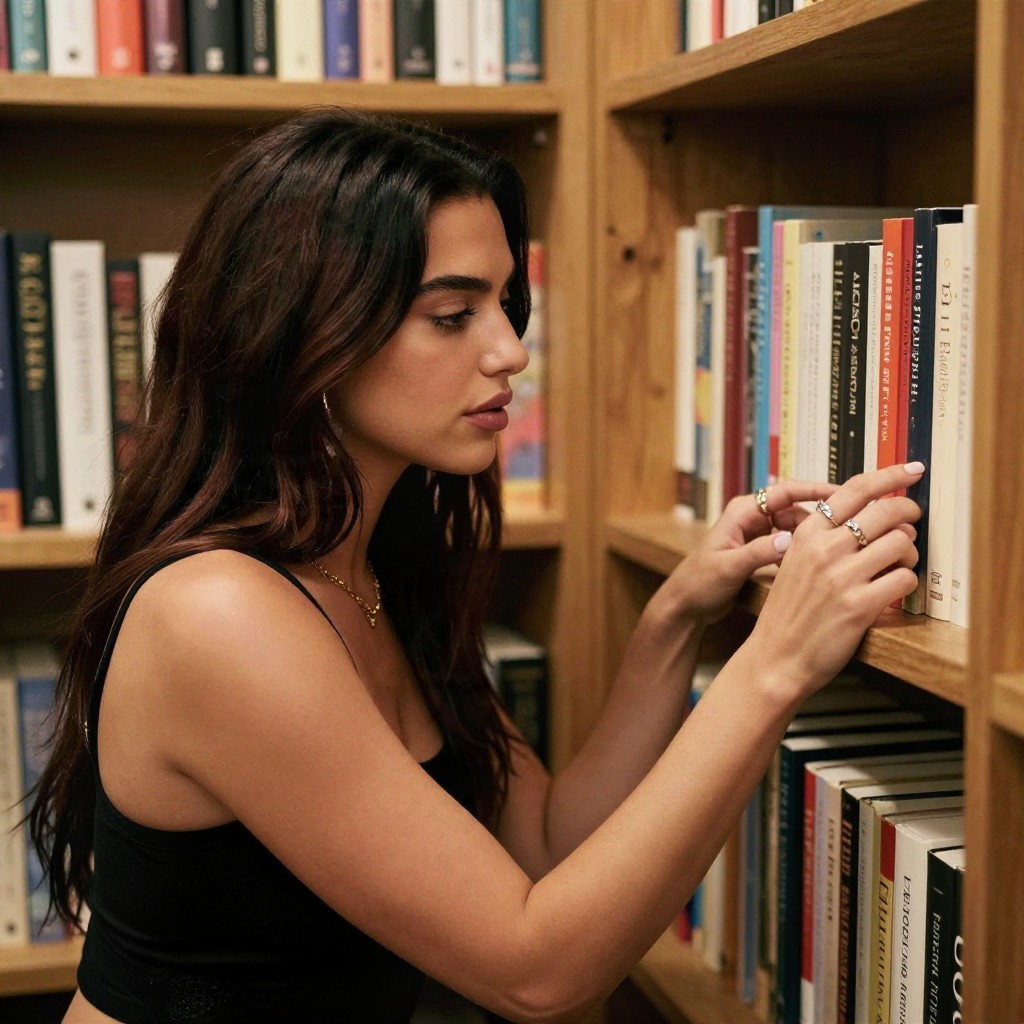
What’s on Dua Lipa’s Bookshelf?
For Dua Lipa, one of the most unconventional things a person can do is read a book-and then talk about it. The pop star, known for hits such as “Levitating,” “Don’t Start Now” and “New Rules,” is rarely without a novel in her bag. Her reading choices, ranging from Kazuo Ishiguro to Orhan Pamuk, reveal a quieter, more personal side of a life usually seen through music, fashion and international tours.
Reading has long been part of Lipa’s everyday routine. She has said that, for as long as she can remember, she has carried a book wherever she goes. That habit has taken on a larger life as her profile has grown: when she recommends a novel, the choice reaches an audience of millions. In October 2024, for example, she picked George Saunders’s *Lincoln in the Bardo* as her book of the month, sharing the selection with her 87.5 million Instagram followers.
The following month, her choice was Zadie Smith’s debut novel, *White Teeth*. Lipa described it as a big, noisy, exuberant and sharply intelligent book, praising the way Smith captures the many voices of London. The selection also reflected the range of fiction that appeals to her: energetic, socially observant writing that moves between different lives, backgrounds and places.
The idea for Lipa’s book club grew out of a simple pattern. Followers often asked what she was reading and which books had made her laugh or cry. In May 2023, she announced the project on Instagram, pairing holiday photographs with a list of favourite titles. Among her early recommendations were Gabriel García Márquez’s *One Hundred Years of Solitude*, Khaled Hosseini’s *A Thousand Splendid Suns*, Ocean Vuong’s *On Earth We’re Briefly Gorgeous* and Rohinton Mistry’s *A Fine Balance*.
The club began in June 2023 with Douglas Stuart’s Booker Prize-winning novel *Shuggie Bain*. Lipa marked the launch with a live podcast conversation with Stuart at the Hay Festival in Wales. The format developed into a monthly selection accompanied by interviews with authors, reading lists, essays and playlists created by writers. From the outset, the aim was not simply to name a book, but to offer readers different ways into it.
In June 2025, the author conversations began appearing as a separate podcast. That was followed by a live recording at the New York Public Library with David Szalay, whose novel had been included on the Booker longlist. Around 300 people attended. The expanding programme has made Lipa’s literary interests visible well beyond a monthly social-media post.
Celebrity book clubs are not new. Oprah Winfrey’s influential club dates back to 1996, while projects associated with Reese Witherspoon and Emma Roberts often connect reading with screen adaptations. Lipa’s emphasis is different: her selections and conversations keep attention on the writing and the experience of reading, rather than treating books primarily as potential film or television properties.
Her choices also suggest recurring tastes. Writer Cat Marnell, after reading the club’s selections for a month, noted Lipa’s apparent attraction to stories set in distant places and in tough neighbourhoods. The list spans countries, generations and social worlds, giving readers a chance to move between intimate family histories, political change and richly imagined settings.
A personal connection to the Balkans is visible in the books Lipa has highlighted. She is the daughter of a Kosovar Albanian family, and Lea Ypi’s memoir *Free*-about the collapse of communism in Albania-was one of the club’s July selections. The book’s subject makes it especially resonant in the context of Lipa’s own family background, while also inviting readers unfamiliar with Albania’s recent history to explore it through an individual life.
There is also a familiar name for Turkish readers on her shelves: Orhan Pamuk’s *Istanbul: Memories and the City*. Its presence sits naturally alongside the club’s broader international outlook. Lipa’s recommendations are not confined to contemporary English-language fiction; they include writers and stories that offer a window into different histories and cultures.
Books have even provided a point of connection in Lipa’s personal life. Callum Turner has recalled that the two realised they were reading the same novel when they sat together at a friend’s birthday in Los Angeles. The book was Hernan Diaz’s *Trust*, which Lipa had also selected for her club. A shared reading experience, in this case, became a small but memorable detail in their relationship.
The project has also moved from screens and podcasts into physical spaces. In Porto, Lipa partnered with the historic Livraria Lello to open the Manifesto Library on June 27. Its permanent collection includes around 100 books that have been banned, censored or publicly challenged. The collection gives a concrete form to an idea Lipa has expressed in simple terms: sometimes reading a book and discussing it is an act of defiance.
In October, her literary work reached another milestone when the Southbank Centre appointed her curator of the London Literature Festival, held from October 21 to November 1. Previous curators have included Ai Weiwei, Malala Yousafzai and Margaret Atwood. The appointment reflects how far Lipa’s reading life has travelled from a private habit into a public cultural role.
Her guiding principle remains straightforward. Lipa has described herself as someone whose bag will contain a well-read book wherever she goes-sometimes even four. The image captures the appeal of her literary work: a superstar’s platform may bring millions of people to a reading list, but the starting point is still personal curiosity, a book carried from place to place and the desire to talk about what is inside it.