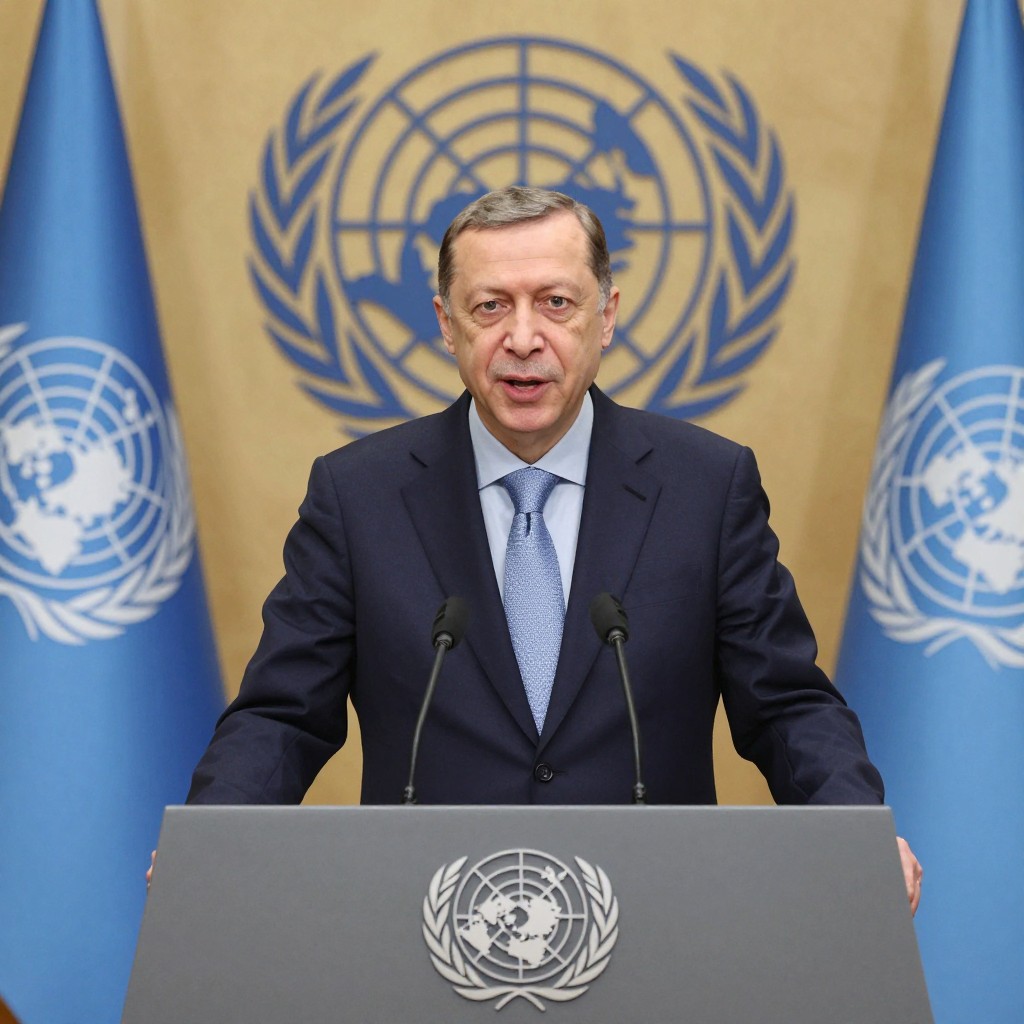
Emine Erdoğan Calls for Globally Safe Digital Systems for Children
Emine Erdoğan has urged the international community to place children’s safety at the heart of digital technology design, warning that protecting minors online cannot remain solely a family responsibility. Speaking at a United Nations event, she emphasized the need for a healthy digital ecosystem in which safety is built into platforms from the very beginning rather than added later as a supplementary feature.
The event, titled “Invisible Architecture: Building Safe Digital Systems for Children – Advancing International Standards and Shared Responsibility,” was held at the UN headquarters on the margins of the organization’s 81st General Assembly. It was organized under Emine Erdoğan’s patronage in cooperation with Türkiye’s Ministry of Family and Social Services, UNICEF and the Office of the UN Special Representative of the Secretary-General on Violence Against Children.
As president of the UN Zero Waste High-Level Advisory Board of Eminent Persons, Emine Erdoğan attended the gathering and welcomed the spouses of participating leaders at the entrance. She walked from Türkevi to the UN headquarters and spoke individually with the guests before the program began.
In her address, Erdoğan described the United Nations as one of the principal platforms for international cooperation and collective responses to global challenges. She said the meeting represented an important first step toward establishing a common path for children’s well-being and expressed gratitude to UNICEF, the UN Special Representative’s office, Türkiye’s Ministry of Family and Social Services and all participants.
Children are treated as targets in the digital economy
Erdoğan characterized children as the most valuable link in the chain connecting humanity’s past and future. However, she argued that modern digital systems increasingly reduce children to user profiles and commercial target groups.
According to her, children’s attention and mental space are being pursued by systems designed to keep them constantly engaged. In this environment, minors may be left vulnerable while behavioral scientists, designers and neuroscientists develop increasingly sophisticated methods to influence their habits.
She pointed to growing research on the possible effects of prolonged screen exposure, including addictive behavior, early mental health difficulties and biological changes associated with excessive digital use. At the same time, she stressed that the aim should not be to label all digital platforms as inherently harmful or to promote hostility toward technology.
The central issue, she said, is the need to recognize technology as a sensitive and potentially dangerous instrument when commercial goals take priority over children’s welfare. Digital platforms are no longer merely communication tools; they have become powerful systems capable of shaping individual behavior, social relations and everyday life.
Screen-time limits are not enough
Erdoğan stated that families have made considerable efforts to reduce the negative effects of digitalization through parental supervision, digital literacy and screen-time restrictions. Yet she argued that individual precautions cannot fully counter the scale and sophistication of global algorithmic systems.
“Screen time cannot be reduced to a simple matter of personal willpower,” she said, emphasizing that children’s online safety must be regarded as a shared responsibility. Parents need support from schools, governments, technology companies, researchers and civil society.
She called for digital products to be developed according to the principle of safety by design. This would require platforms to anticipate potential risks before launch, limit manipulative features, protect children’s personal data and provide age-appropriate environments by default.
A call for common international standards
Erdoğan noted that many countries have already introduced legal and technical measures concerning children’s use of social media. Türkiye, she said, was among the countries that had adopted such precautions at an early stage.
However, national regulations alone may not be sufficient because major technology companies operate across borders. Different rules in different countries can create inconsistencies, make enforcement more difficult and allow companies to shift their practices between jurisdictions.
For that reason, Erdoğan advocated the creation of common global standards under the umbrella of the United Nations. She proposed regular monitoring and reporting mechanisms to assess whether digital platforms meet agreed safety requirements and to ensure that commitments are implemented in practice.
What safer digital platforms should provide
A child-centered digital ecosystem would need to include clear age verification, effective privacy safeguards and transparent explanations of how recommendation algorithms operate. Platforms should also give children and parents meaningful control over data collection, advertising and communication settings.
Safety measures must go beyond warning labels or optional parental controls. Systems should limit exposure to harmful content, prevent adults from exploiting children and respond rapidly to cyberbullying, harassment and coercive behavior.
Another important area is the design of notifications and engagement tools. Endless scrolling, automatic playback and reward-based features can encourage compulsive use. Digital services intended for minors should therefore avoid mechanisms that deliberately maximize time spent online at the expense of sleep, learning and social development.
The role of families and schools
Although Erdoğan emphasized that responsibility cannot rest only with parents, families still have an important role. Open conversations about online experiences can help children report disturbing content, manipulation or contact from strangers without fear of punishment.
Schools can support this process by teaching digital literacy as a basic life skill. Students should learn how algorithms influence what they see, how personal data is collected and how to distinguish reliable information from misleading or harmful material.
Educators also need training and practical tools. Without institutional support, teachers may struggle to respond to cyberbullying, privacy violations or excessive digital dependence among students.
Technology companies must accept responsibility
The proposed approach places significant obligations on technology firms. Companies should conduct independent risk assessments, publish understandable safety policies and provide researchers with access to relevant data while protecting user privacy.
Commercial success should not depend on keeping children online for as long as possible. Erdoğan’s remarks underline the need to reconsider business models based on attention, targeted advertising and constant engagement when those models may harm minors.
Independent audits could help determine whether companies are genuinely protecting children or merely presenting voluntary commitments. Clear penalties should also apply when platforms ignore known risks or fail to respond to serious violations.
Building a healthier digital future
The discussion is not about rejecting technology. Digital tools can improve education, communication, access to information and participation in public life. The challenge is to ensure that these benefits do not come at the cost of children’s mental health, privacy or autonomy.
A safer digital future requires cooperation across borders because online risks do not stop at national boundaries. Governments, international organizations, technology companies, parents, schools and children themselves must contribute to the development of fairer standards.
Emine Erdoğan’s message was that digital systems should serve humanity rather than reshape people solely according to commercial priorities. By making safety, dignity and the best interests of the child fundamental principles of technology design, the international community can turn the digital environment into a healthier and more trustworthy space for future generations.