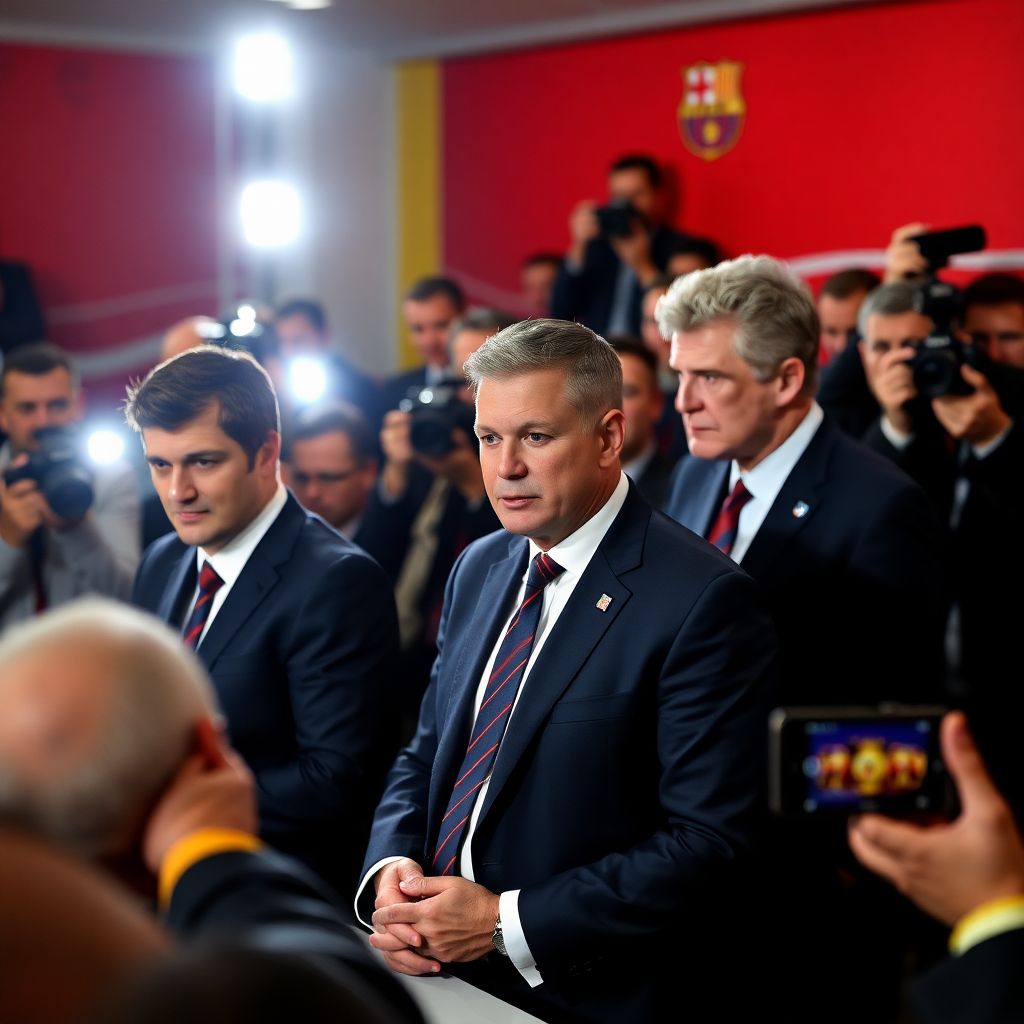
Trabzonspor will not content itself with only Eldor Shomurodov in the transfer market. While the Uzbek striker has been strongly linked with the Black Sea club, the board’s strategy clearly goes beyond a single marquee signing. The club aims to build a deep, competitive squad capable of fighting on multiple fronts in the new season.
The rumors around Shomurodov intensified in recent days, but a decisive clarification came from Rams Başakşehir president Göksel Gümüşdağ. Asked about the situation of the Uzbek forward, Gümüşdağ drew a clear line under the speculation, underlining that any move to Trabzonspor is far from finalized and that several parameters still need to be evaluated. With that statement, he effectively put a temporary stop to the claims that the transfer was “done and dusted.”
Even if Shomurodov eventually arrives, Trabzonspor’s management sees him as just one element of a broader plan. The club’s technical staff has been working on a transfer strategy that includes strengthening not only the attacking line, but also the defense and midfield. The objective is to increase competition for every position and avoid the drop in performance that has been seen in previous seasons when the squad lacked depth.
Within this context, the entire club has gone into what can almost be described as a mobilization phase. From the boardroom to the training ground, the message is the same: the team must be ready both for the domestic league and for European challenges. The aim is not merely to participate, but to be a serious contender in every competition entered.
The spirit of this new era is reflected in the attitude of coaches around the league who are eyeing European qualification. İsmail Kartal, for example, has underlined that the target is always to progress in continental matches and to approach each tie with the mindset of advancing to the next round. This competitive mentality sets the tone for the broader landscape of the Süper Lig, where clubs like Trabzonspor know they must keep up with their rivals’ ambitions.
Another important piece of the puzzle is the center-forward position. Comments from influential figures close to the game, such as Cihan Kamer, point to the need for a striker who will be fully ready by the time the play-off phase comes around. For Trabzonspor, this means not only signing a forward, but integrating him quickly so that he can adapt to the team’s playing style before crucial fixtures begin.
In the meantime, there is plenty of curiosity about potential opponents in European qualifiers and domestic cup draws. Every possible rival brings a different tactical challenge, and Trabzonspor’s scouting department is working proactively, analyzing various scenarios instead of waiting for the draw. This forward-thinking approach is part of the reason why the club is so active in the transfer market now, rather than rushing at the last minute.
Across the league, individual performances are also shaping expectations. Players such as Anderson Talisca continue to draw attention with their self-confidence and remarks about their own displays, while global stars like Mohamed Salah make headlines not only for their salaries but also for their immediate impact on and off the pitch. In that environment, any big-name signing for a Turkish club instantly becomes a benchmark for the others.
One of the major talking points is the striker race among the Istanbul giants. Discussions revolve around which forward will be fit and eligible in time for the play-offs, and whether it might be a name who has already made a splash in the league, such as a player who once scored a hat-trick against Galatasaray. This context adds pressure on Trabzonspor as it searches for its own decisive front-line figure.
Trabzonspor, however, is determined to create a sustainable sense of celebration rather than a brief moment of euphoria. The club wants its fans to feel that the “holiday” of good news and strong performances will not be a one-off. That means not only headline transfers, but also a consistent sporting project, investments in infrastructure, and clear communication with supporters about long-term goals.
On the broader transfer scene, interesting dynamics are unfolding. In Austria, there have been frank admissions concerning Fenerbahçe’s strength and the challenge they pose in European competition. At the same time, opportunities are arising in different markets: for example, proposals from Saudi Arabia for players like Agbadou show that large transfer fees, such as offers reaching 18 million euros, are becoming more and more common. These moves reshape the bargaining power of Turkish clubs and influence how they plan their own squad-building.
Galatasaray, for its part, has been linked with creative midfielders to fill the void left by influential playmakers. The search for a “number 10” who can act as the heir to profiles like Pelkas appears close to an end, with bids on the table and negotiations in advanced stages. Each new development at a rival club pushes Trabzonspor’s management to refine its own targets in order to remain competitive.
Meanwhile, young talents are commanding increasingly high fees. Reports of a 2009-born star being valued at around 7 million euros underline how early potential is monetized in modern football. Trabzonspor, which has a proud tradition of nurturing youth prospects, is carefully balancing the desire to bring in ready-made performers with the need to protect and develop its academy products.
The battle for a place in the Champions League remains one of the clearest measures of success for Turkish clubs. Fenerbahçe is seen by many as being particularly close to breaking an 18-year absence and returning to the group stage. Such a feat would not only bring sporting prestige but also substantial financial rewards, raising the bar for other clubs, including Trabzonspor, in terms of what is required to stay in the race.
Transfer markets are also witnessing interesting price fluctuations. A player once rated at 25 million euros can suddenly become available for less than half that amount, with offers being made at around 10 million euros to clubs like Beşiktaş. These “discounted” opportunities test clubs’ scouting and decision-making: is it a bargain or a trap? Trabzonspor’s recruitment team is watching such situations closely, looking for value without compromising on quality.
Beşiktaş, too, is framing the new season in terms of big symbolic challenges. Talk of “conquering the Queen’s castle” is a colourful way of describing the goal of overcoming strong European opponents, while slogans about not fearing teams nicknamed “Lolipop” illustrate the club’s determination to shake off any perception of fragility. A more competitive Beşiktaş automatically raises the competitiveness of the league, which indirectly affects Trabzonspor.
In several cases, deals appear to be ready in principle but are held back by timing issues. The example of Batrakov is telling: everything is reportedly agreed, yet official signatures are still awaited. Such delays often stem from final administrative checks, financial fair play considerations, or the coordination of multiple transfers that are linked together. Trabzonspor’s board is careful to avoid similar bottlenecks as it plans its own final moves of the window.
Full-back positions are also a subject of intense debate. Names like Oosterwolde and Ismael Jakobs are compared in terms of physical attributes, tactical versatility, and resale potential. The fact that a figure such as Ertuğrul Doğan can put 25 million euros on the table for a key signing shows how seriously top-level Turkish clubs are taking their defensive reinforcements. Strong full-backs have become as important as prolific strikers in modern football.
Away from pure performance, star acquisitions like Mohamed Salah bring lifestyle questions that fascinate supporters: where such players will live, which schools their children will attend, and how they will adapt to a new culture. These aspects may seem secondary, but they influence how smoothly a star settles and how quickly he can perform at his highest level.
For Trabzonspor, the discussion around Salah serves as a useful example. If the club succeeds in adding a player of that stature at some point-whether now or in the future-it must be ready to support him not only with tactics and teammates, but also with a well-planned environment off the pitch. Expectations would be huge: fans would naturally wonder if such a superstar could almost single-handedly carry the team to the championship.
However, the club’s current leadership is aware that no title is won by one man alone. Even a player of Salah’s calibre needs a coherent system, a strong dressing room, and a club structure that protects him during dips in form. That’s exactly why Trabzonspor refuses to pin all its hopes on a single name like Shomurodov, no matter how talented he is.
Looking ahead, Trabzonspor’s roadmap is built on three pillars: targeted transfers, tactical stability, and long-term planning. In attack, they are searching for a profile that combines clinical finishing with intelligent movement off the ball, ideally someone comfortable in both a two-striker system and as a lone forward. In midfield, the focus is on players who can control tempo, carry the ball under pressure, and contribute both defensively and offensively.
Defensively, the need is for mobile centre-backs and full-backs capable of playing in a high line, as modern football demands defenders who are almost as comfortable on the ball as midfielders. In goal, consistency and leadership are valued as highly as shot-stopping ability. The entire spine of the team is under review to ensure Trabzonspor does not fall behind its main domestic rivals.
Another key aspect of the club’s project is the integration of youth. Trabzonspor aims to strike a balance between experienced foreign players and homegrown talents who understand the culture of the club and the expectations of its supporters. The idea is to build a squad where young players can learn from established stars rather than being thrown in without protection or guidance.
Financial discipline also plays a crucial role in all these plans. While big fees and salaries draw attention, the club must respect budget limits and avoid the mistakes of the past, where overspending led to instability. Performance-based contracts, careful wage structures, and realistic resale strategies are just as important as scouting and negotiations.
Finally, communication with fans will shape the perception of this new era. If the board can clearly explain that Shomurodov-should he arrive-is just one piece of a larger puzzle, expectations will be more realistic and patience more likely. Supporters want ambition, but they also appreciate transparency and a sense that every decision is part of a coherent plan.
In summary, the message coming out of Trabzonspor is firm: the club will not stop at Eldor Shomurodov. While the Uzbek forward remains a significant target and a potentially valuable asset, the true objective is to build a complete, competitive squad that can challenge for the Süper Lig title and make its mark in Europe. Only by thinking beyond a single star can Trabzonspor hope to turn the coming season into the start of a sustained period of success.