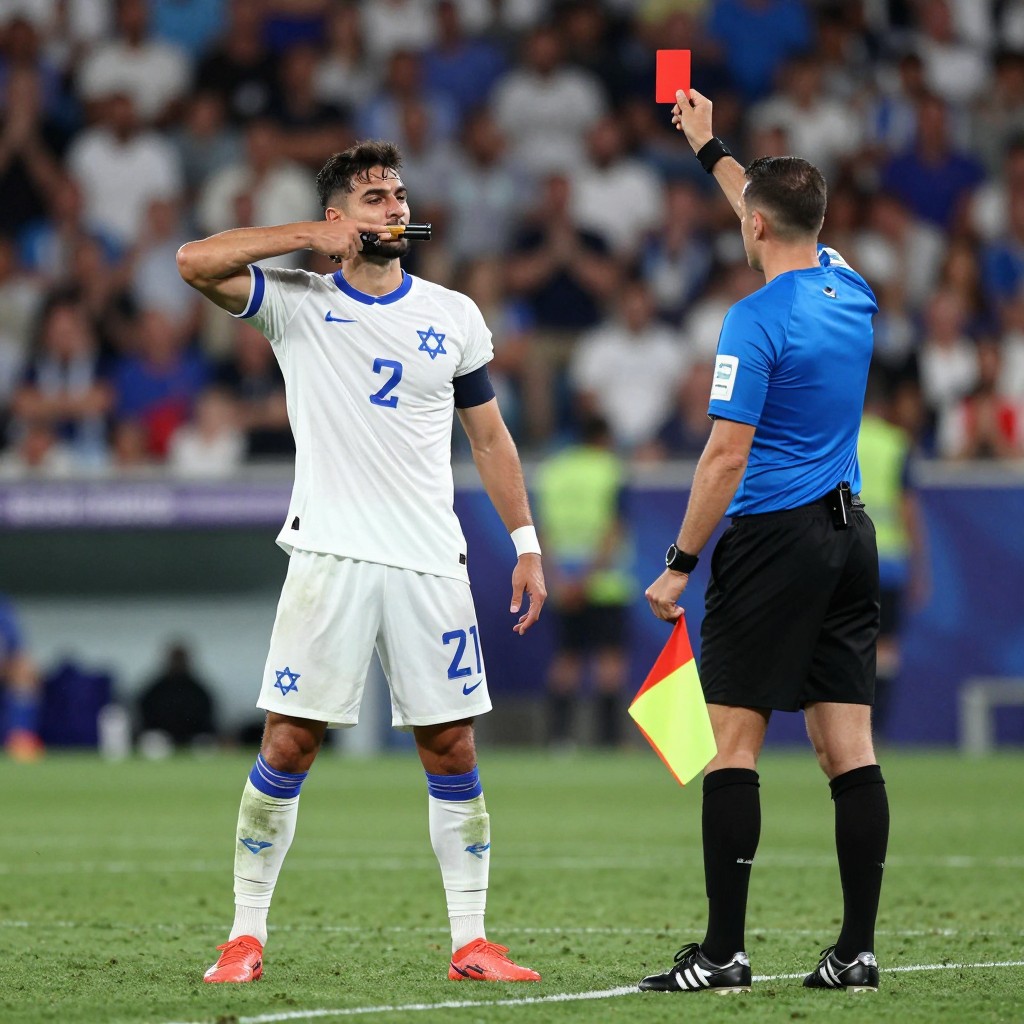
Unbelievable Goal Celebration Ends in Red Card in the Nations League
Austria beat Israel 3-1 in a four-goal UEFA Nations League B match, but one moment after the visitors scored quickly became the game’s defining talking point. Israel’s Abu Farchi was dismissed after celebrating his goal by pulling out the corner flag and pretending to fire it like a gun.
Bulgarian referee Nikolov judged the gesture to be unsporting and showed the forward a second yellow card. The caution was followed by a red, forcing Israel to continue with ten players. What began as a celebration therefore had an immediate and costly consequence for the visiting side.
The incident underlined how a player’s actions after scoring can affect more than the mood in the stadium. Under football’s Laws of the Game, referees can caution players for unsporting behaviour, including celebrations considered provocative or inappropriate. A second booking in the same match means dismissal, regardless of whether the player has committed a separate foul.
Removing or using a corner flag as part of a celebration can also draw the referee’s attention. In Abu Farchi’s case, it was the simulated shooting gesture that prompted the decision. While celebrations are often spontaneous, players remain responsible for ensuring that their actions do not cross the line into conduct officials regard as unacceptable.
The red card changed the conditions under which Israel had to finish the match. Playing a man down can make it harder to press, maintain possession and cover space, particularly against an opponent seeking to protect or extend a lead. Austria ultimately secured a 3-1 victory, although the available match details do not establish precisely how much the dismissal shaped the final score.
For Israel, the episode also offers a reminder that a goal celebration can become a turning point in its own right. A player who has just scored may be caught up in the emotion of the moment, but a booking can quickly turn that high into a setback. When the caution is a second one, the team loses a player as well as the chance to celebrate without further consequences.
For referees, such decisions require a judgement about the meaning and impact of a gesture. Officials must consider what they see on the pitch and apply the competition’s disciplinary rules. A celebration that seems harmless to some spectators may be interpreted differently by the referee, especially when it involves an imitation of violence or an object used in a provocative way.
The match also highlights why players are generally expected to keep celebrations controlled. Gestures directed at opponents, the crowd or the cameras can attract disciplinary action, and delaying the restart or interfering with equipment may create additional problems. The safest approach is to celebrate with teammates while avoiding actions that could be understood as taunting, aggressive or dangerous.
Austria’s 3-1 win will be remembered as a result in the Nations League, but Abu Farchi’s dismissal gave the contest an unusual and controversial subplot. His celebration lasted only moments; the red card, however, left Israel facing the remainder of the match with a numerical disadvantage.