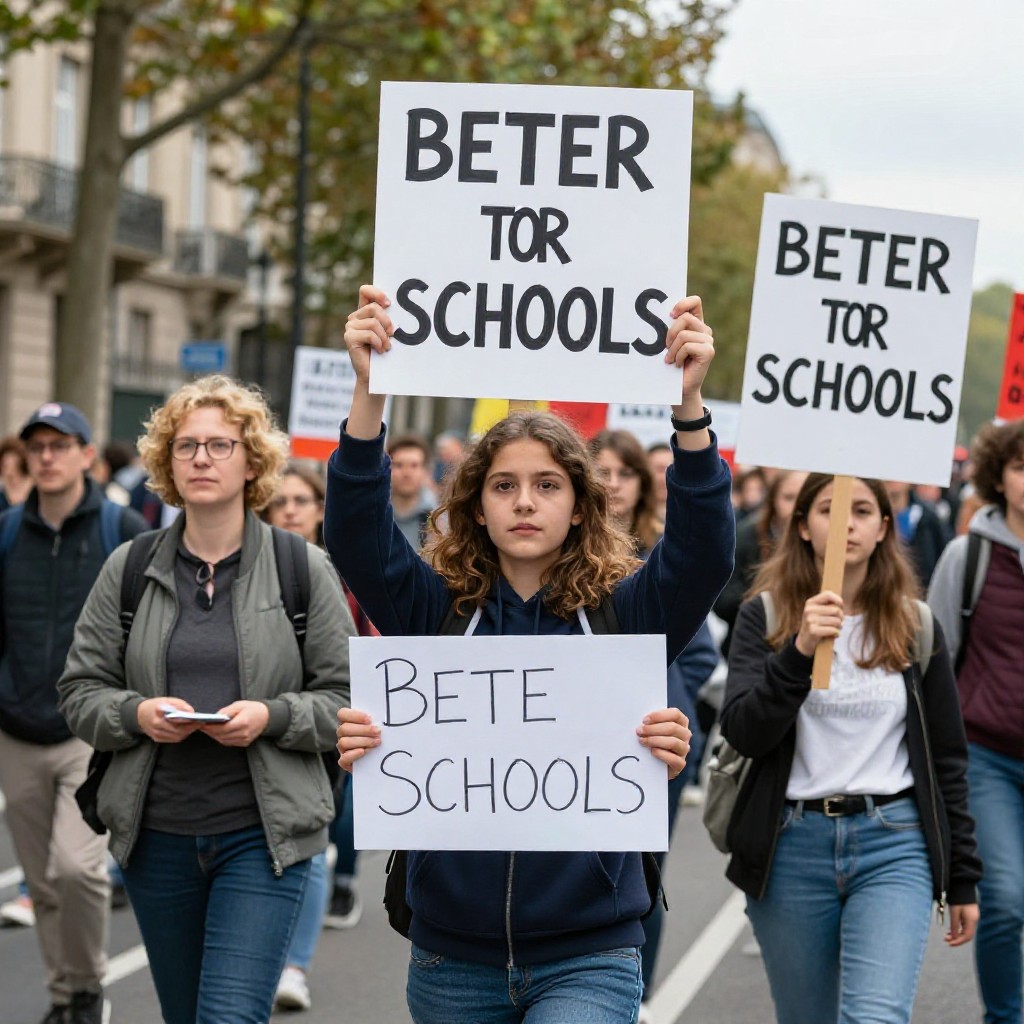
Student Protests Spread Across France as Calls for Better Schools Grow
A protest movement that began among French high-school students has expanded into a nationwide demonstration, drawing in teachers, parents, trade unions, opposition politicians and members of the public. The unrest is putting pressure on President Emmanuel Macron’s government, which is seeking a response while facing a record level of public debt and limited room for new spending.
Students say their schools are in poor physical condition, classrooms are overcrowded and workloads are excessive. They are also protesting a shortage of teachers, including vacancies left unfilled when staff are not replaced, and inequalities associated with Parcoursup, France’s university admissions platform. Their demands centre on better learning conditions, adequate staffing and properly maintained school buildings.
The demonstrations began in Paris before spreading to cities across the country. While students initially gathered mainly inside or near their schools, many have since joined large street marches. Reports from Lille, Marseille, Lyon, Clermont-Ferrand and Rennes describe high-school students taking part in mass protests.
Estimates of the crowds differ. France’s Interior Ministry put nationwide turnout at about 266,000, including 56,000 people in Paris. Student organisers gave a higher figure, saying roughly 450,000 people participated across France, among them 100,000 in the capital.
Police used tear gas against large groups of demonstrators, with officers resorting to batons in some locations. Authorities reported 488 arrests, and classes were suspended at dozens of high schools. Despite clashes at the end of the Paris march, officials said most gatherings had remained peaceful, and many students described the demonstrations as calm overall.
Interior Minister Laurent Nuñez has faced criticism from opposition parties over the police response. He said the use of stun grenades had been suspended and that France’s National Police Inspectorate had opened 18 investigations. Amnesty International has also urged the authorities to end what it described as disproportionate police force.
The protests have now become part of a broader political challenge for the government. Prime Minister Sébastien Lecornu is expected to address not only the student movement but also fuel prices, the agricultural crisis and the country’s debt situation. Macron has held talks with Lecornu, Nuñez, Education Minister Édouard Geffray and other ministers as the government searches for a way to ease tensions.
Student unions are calling for further marches in Paris and other cities under the banner of “Act Four,” alongside continued school blockades. Suzanne Nijdam, head of a student union, said the government would need to remove obstacles to education and higher-education funding if it wanted to calm public anger. She described the students’ requests as straightforward: improved conditions, enough teachers and functional school buildings.
The scale and duration of the movement will depend in part on whether students believe the government is prepared to address those concerns. Announcements alone may not satisfy demonstrators if staffing shortages, crowded classrooms and deteriorating facilities remain unchanged. For many families, the dispute is about everyday access to a safe and effective education, not simply a disagreement over policy.
School blockades and street marches also pose practical difficulties for students who are not participating, as well as for parents and staff trying to keep daily routines going. At the same time, the involvement of teachers and parents signals that the complaints extend beyond the student population and are connected to wider concerns about the state of public education.
The government faces a difficult balancing act: maintaining public order while avoiding further escalation, and responding to demands for investment despite tight finances. France’s record public debt limits the scope for a costly intervention, but a failure to offer credible measures could prolong the protests and intensify pressure on Macron’s administration.
For now, student groups are urging supporters to keep mobilising. Their central message is that schools need sufficient staff, manageable class sizes and buildings fit for learning. Whether the government can respond in a way that is both financially viable and convincing to protesters is likely to shape the next phase of the movement.