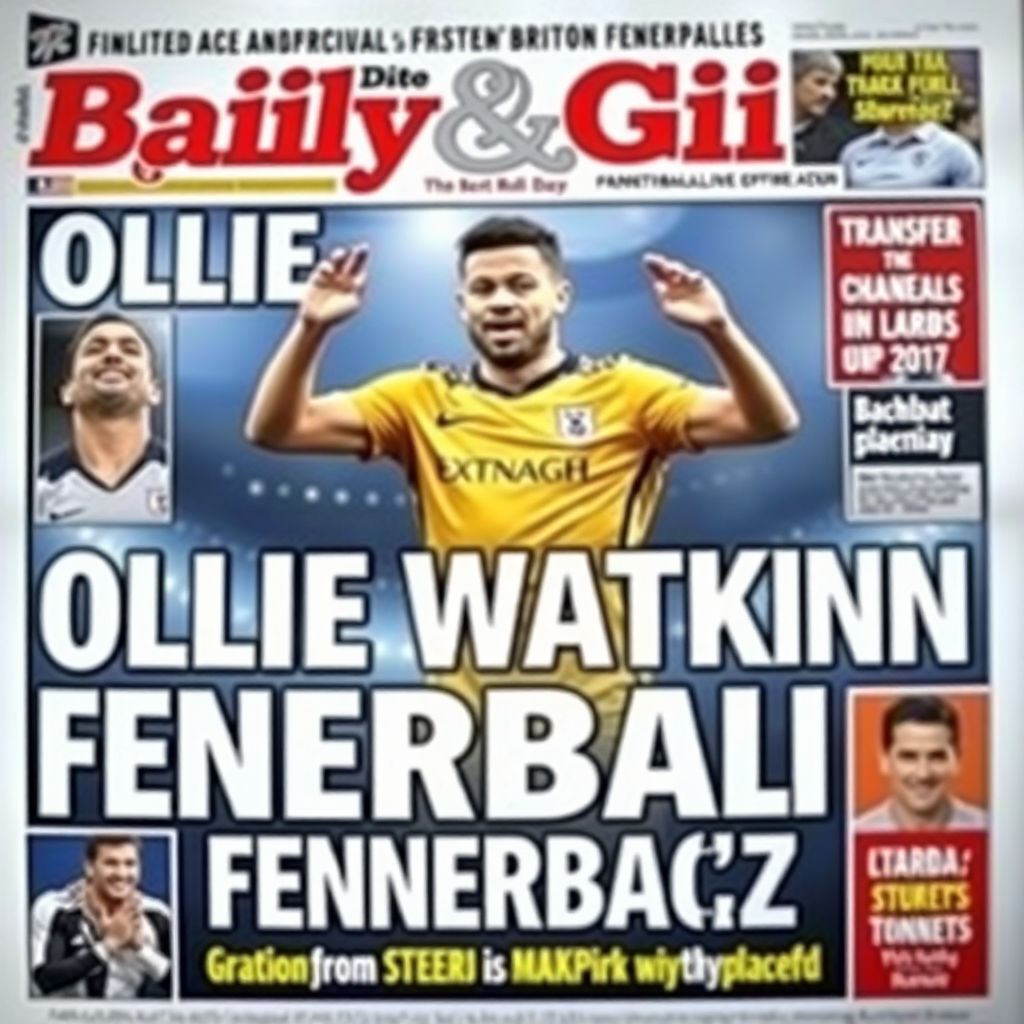
The Sun’s “spectacular scoop”: Ollie Watkins to Fenerbahçe?!
British tabloid culture has long been addicted to sensational headlines, but the latest story linking Aston Villa’s star striker Ollie Watkins with Fenerbahçe pushes that obsession to a new level. According to claims splashed across certain English pages, the Istanbul giants are allegedly preparing a move for the in‑form forward, with talks said to be pencilled in for “after the World Cup” and the deal described as a “dream transfer”.
Strip away the glitter, and the question remains: how much of this is grounded in reality, and how much is pure clickbait built on a flimsy “source”?
Why the Watkins-Fenerbahçe story doesn’t add up
Ollie Watkins is one of Aston Villa’s most valuable assets, a Premier League striker whose price tag would fall into the “burns your hands” category for almost any club. He is under a strong contract, plays for a team targeting European football, and is central to Villa’s tactical system.
For Fenerbahçe, landing a player of this profile would not be impossible in football’s new financial landscape, but it would be an extraordinary move requiring:
– A transfer fee likely well above what Turkish clubs typically spend on one player.
– A salary package competitive with Premier League standards.
– Convincing a settled Premier League star to swap England for the Süper Lig in his prime.
None of these elements has been backed up with credible details. No negotiations confirmed, no concrete figures, no quotes from club officials, agents, or the player himself. Just the magic phrase that newspapers love: “according to sources”.
The “after the World Cup” trick
One of the oldest transfer‑rumour tactics is to push any supposed breaking point into the future: “after the tournament”, “after the season”, “after negotiations with the club”, and so on.
By floating “after the World Cup” as a key time frame, the rumor creates a cushion. If nothing happens, the paper can claim:
– The player changed his mind.
– The club pulled out.
– Another team hijacked the deal.
In other words, the headline generates huge traffic today, while the risk of being proven wrong is pushed months down the road and can easily be buried under the next sensational story.
Clicks at all costs: the new transfer economy
What we see around the Watkins-Fenerbahçe story is part of a bigger pattern. Media outlets, especially tabloids, know that transfer news is one of the most clickable types of content in football. A name like Watkins + a passionate fanbase like Fenerbahçe’s equals guaranteed attention.
The formula is simple:
1. Pick a popular club.
2. Attach a high‑profile name.
3. Add phrases like “shock move”, “dream transfer”, or “from a reliable source”.
4. Avoid specific and verifiable information.
The result? Millions of views, thousands of reactions, and almost no accountability.
Turkish clubs as favorite targets for wild rumors
Turkish giants such as Fenerbahçe, Galatasaray, Beşiktaş and Trabzonspor have some of the loudest and most loyal fanbases in the world. This makes them irresistible for speculative foreign coverage.
Today it’s “Watkins to Fenerbahçe”. Yesterday it was other names thrown around with equal confidence:
– A new left‑back for Trabzonspor, allegedly one who “tortured” Argentina’s defence and is presented as the purest form of a modern full-back.
– A “real last chance” move for Nathan Aké, dragged into the spotlight via English reports claiming clubs from Turkey are monitoring his situation.
– Central defenders with a worrying injury history – the so‑called “glass men” – linked to Fenerbahçe’s back line, even though their record shows 240 days out and 75 missed games in just five years.
The pattern repeats: big names, dramatic adjectives, minimal evidence.
While tabloids dream, Turkish clubs keep working
Behind the noise, Turkish clubs are engaged in real, targeted work on the market – often for far more realistic profiles than the names that dominate headlines abroad.
– Eyüpspor, for example, are pursuing a Polish winger, a move that fits their sporting project and budget. It’s not flashy enough for giant headlines in London, but it’s the kind of signing that builds squads.
– Samsunspor are building quietly with double signings aimed at giving the team depth and competition.
– Galatasaray are fighting on multiple fronts and battling three serious rivals in Europe for certain targets, reflecting a more balanced and strategic approach than the sensationalist narratives suggest.
– Fatih Terim, consistently associated with ambitious aims, has once again publicly set Europe as the target, underlining that Turkish managers are thinking in terms of long-term competitiveness, not just short-term hype.
The Greenwood soap opera and the auction culture
The same culture of exaggeration is visible in the coverage of Mason Greenwood, whose career is being treated almost like a soap opera. Reports describe him as “put up for auction”, with a list of potential suitors lined up, each update more dramatic than the last.
This theatrical style of reporting spills over into how Turkish clubs are mentioned:
– One day they are “leading the bidding war”.
– The next day they have been “overtaken at the last second”.
In both cases, fans are turned into spectators of a never-ending drama, where the transfer itself becomes less important than the storyline around it.
The myth of watching “1,100 players”
Another favourite theme in rumor‑driven coverage is the idea that clubs send scouts to monitor an almost absurd number of players. Claims that “Fenerbahçe watched 1,100 players” before deciding on their targets sound impressive, but in practice serve mostly to inflate the narrative.
Yes, modern scouting departments have huge databases and software that track thousands of footballers. But “monitoring data” and “seriously pursuing” a player are very different things. Turning preliminary data checks into evidence of advanced negotiations is misleading at best.
Galatasaray, UEFA and the financial reality
Away from bombastic rumours, real numbers tell a different story. Galatasaray, for instance, have already invested around 25 million euros in transfers and are being watched closely by UEFA, which still expects about 10 million euros more in terms of financial balancing and obligations.
These figures show why many of the outlandish rumours about Turkish clubs signing multiple Premier League‑level stars in one window are deeply unrealistic. There are financial fair play rules, budgeting constraints and long-term planning decisions that cannot simply be ignored for the sake of a flashy headline.
Trabzonspor’s “shepherd of the mountains” and the 150 million TL story
Local narratives can be just as colourful. Trabzonspor are reportedly about to tie down a key figure, the “shepherd not of the mountains, but of Trabzonspor”, to a deal that could see him earn around 150 million TL. The wording is poetic, designed to forge a myth around a player or coach, turning him into a symbol of the club’s identity.
This kind of storytelling is powerful inside Turkey, where emotional ties to clubs are extremely strong. But when re-exported by foreign tabloids, such stories are often twisted or stripped of nuance, becoming just another ingredient in the endless rumour stew.
Colombia with Davinson, Ghana’s “sorcerer” and World Cup dramatics
National teams are not spared either. Coverage around Colombia’s performances, featuring Davinson Sánchez, has been framed as a “vow” to go far, while Ghana’s supposed “sorcerer” is cast as the last hope against defeat.
These narratives bleed into transfer speculation:
– A strong tournament, and suddenly a player is linked with every major club.
– A poor performance, and rumours emerge of clubs “withdrawing interest” or “reconsidering”.
It’s another side of the same coin: real football used as raw material for exaggerated storytelling.
What’s really happening in the Turkish market?
Beyond the noise, several threads are genuinely worth following:
– Okan Buruk has openly acknowledged that certain names from the World Cup are on his transfer list, which shows a targeted approach to scouting and recruitment rather than the random frenzy portrayed in some headlines.
– The situation around Ugochukwu is framed as “anything can happen at any moment”, a phrase that may sound like more drama but actually reflects how fluid negotiations can be when multiple clubs are involved.
– In Bodrum, eyes have turned to Abdullah Kavukcu, whose movements on the market are being closely watched. He has been chasing a particular transfer, and his strategy could influence how several teams shape their squads.
These are the types of developments that, while less spectacular from a tabloid point of view, actually shape the future of clubs.
Why fans need to read transfer news critically
For supporters, the temptation to believe every exciting headline is huge. A link with a big name like Ollie Watkins triggers hope, imagination and debate. But learning to read between the lines is crucial:
– Does the article mention a fee, length of contract, or concrete talks?
– Is there a direct quote from a club official, coach, or agent?
– Are other reliable outlets independently confirming the story?
– Or is everything based on a vague “source close to the club”?
If details are thin and the language is packed with drama, it is probably engineered for clicks more than for accuracy.
So, is Watkins to Fenerbahçe realistic?
From a purely sporting perspective, Watkins would be a fantastic addition to Fenerbahçe: a mobile, hard‑working striker with Premier League finishing, capable of transforming any attack.
From a financial and practical perspective, however, the move looks extremely unlikely under current conditions:
– Aston Villa have little sporting reason to sell a key man.
– Any fee would likely be massive for a Turkish club budget.
– Competitive offers from inside the Premier League or other big European leagues would almost certainly appear if he were genuinely on the market.
Until solid, verifiable information emerges, the story sits firmly in the realm of speculation.
The bottom line: a “spectacular source” that isn’t
The tagline about The Sun’s “magnificent source” behind the Watkins-Fenerbahçe claim says it all. The real spectacle is not a transfer in progress, but the ability to turn thin air into a viral story.
Meanwhile, Polish wingers are moving to ambitious projects like Eyüpspor, Samsunspor are quietly strengthening with double signings, Galatasaray are calculating every euro under UEFA’s watchful eye, Beşiktaş keep searching for their next creative brain after flirting once more with the idea of a “new Batalla”, and Trabzonspor are defining their identity through key figures and smart deals.
Between the noisy fantasies and the silent realities, the truth of the transfer market lies somewhere in the middle. For now, Ollie Watkins in a Fenerbahçe shirt belongs more to the world of imagination than to the world of contracts and medicals – a perfect example of how modern football coverage often chases clicks first and facts second.